
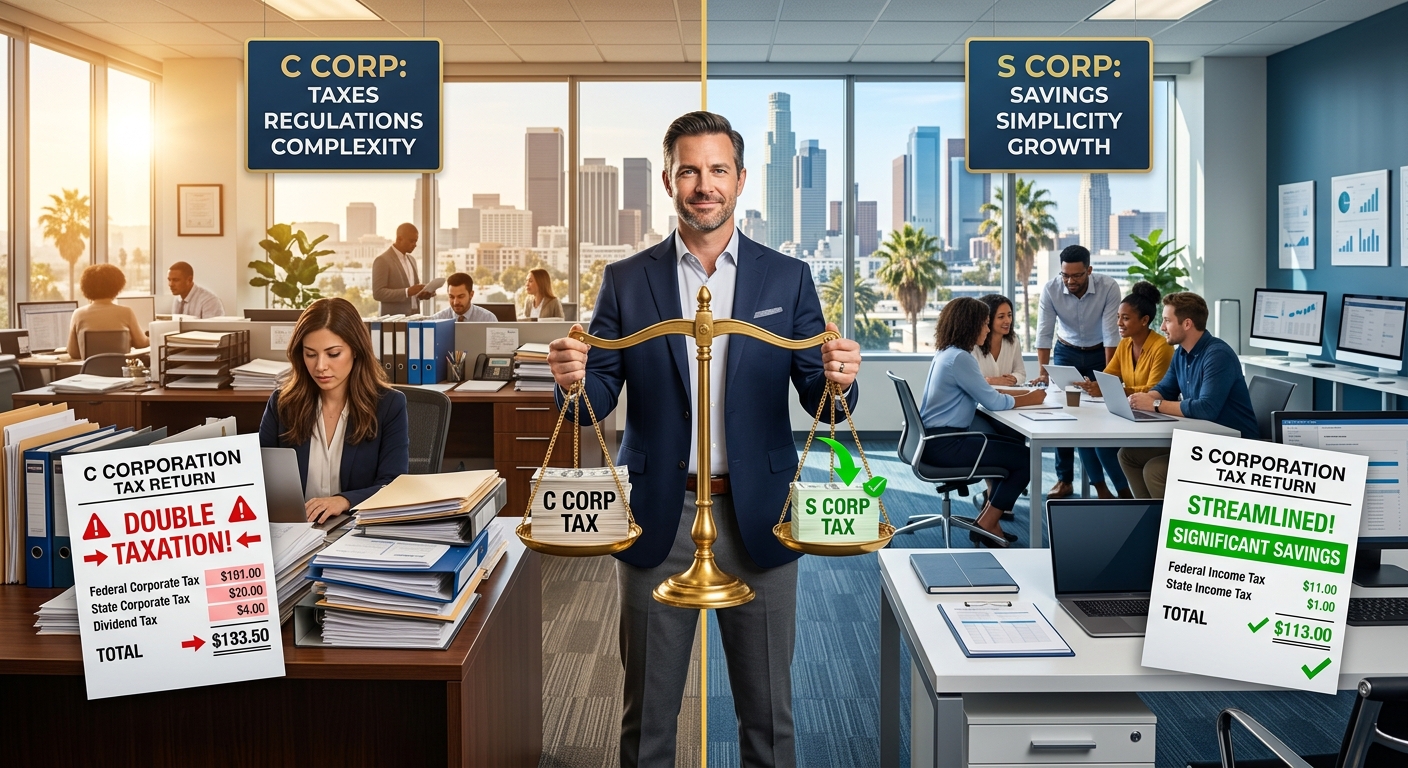
The Tax Gap You Cannot See Until You Run the Numbers
A California business owner earning $250,000 in profit will pay roughly $47,100 more in total taxes operating as a C Corporation compared to an S Corporation. That is not a typo. That is the annual cost of choosing the wrong entity structure, and it compounds every single year you leave it unchanged.
The C Corp vs S Corp taxation debate is not about which entity “sounds better” or which one your attorney defaulted to when you formed your LLC. It is a math problem with a five-figure answer, and the wrong answer drains your bank account every April 15. For the 2025 and 2026 tax years, the gap has widened further thanks to permanent changes under the One Big Beautiful Bill Act (OBBBA), including the made-permanent Section 199A Qualified Business Income (QBI) deduction, the restoration of 100% bonus depreciation, a $40,000 SALT cap, and a $2.5 million Section 179 ceiling.
This information is current as of April 11, 2026. Tax laws change frequently. Verify updates with the IRS or FTB if reading this later.
Quick Answer
A C Corporation pays tax at the entity level (21% federal plus 8.84% California) and then again at the shareholder level when profits are distributed as dividends. An S Corporation passes income through to shareholders and is taxed only once at individual rates, plus a 1.5% California net income tax. For most California business owners earning between $80,000 and $500,000 in profit, the S Corp structure saves $12,000 to $80,000 per year in total federal and state taxes.
C Corp vs S Corp Taxation: The Double Taxation Problem Explained in Plain English
Double taxation is the defining disadvantage of C Corporation status. Here is exactly how it works when you trace a dollar of profit through both structures.
How C Corp Double Taxation Hits Your Wallet
Suppose your C Corporation earns $200,000 in net profit. The entity pays 21% federal corporate tax ($42,000) and 8.84% California corporate franchise tax ($17,680). That leaves $140,320 inside the corporation. When you distribute that $140,320 as a qualified dividend, you pay 23.8% federal tax (20% long-term capital gains rate plus 3.8% Net Investment Income Tax) on $140,320, which equals $33,396. California taxes the full dividend at ordinary income rates because the state offers no preferential dividend rate, adding another $18,662 at the 13.3% top bracket. Your total combined tax bill: $111,738 on $200,000 of profit. That is an effective rate of 55.9%.
How S Corp Pass-Through Taxation Works
The same $200,000 of profit in an S Corporation passes through to your personal return on Schedule K-1. You pay yourself a reasonable salary of $80,000 (subject to payroll taxes of 15.3% up to the Social Security wage base, then 2.9% above it). The remaining $120,000 flows to you as a distribution, free of self-employment tax. Your federal income tax on the total $200,000 is approximately $39,110 (at the 32% marginal bracket). The QBI deduction under IRC Section 199A reduces your taxable business income by up to 20%, saving another $8,000 to $12,000 depending on your total taxable income. California imposes a 1.5% net income tax on the S Corp entity ($3,000), plus your personal California tax of roughly $17,400. Your combined total: approximately $71,730. Effective rate: 35.9%.
Key Takeaway: On $200,000 of profit, the C Corp vs S Corp taxation gap is roughly $40,008 per year. Over five years, that is $200,040 in taxes you did not need to pay.
Five Tax Layers Where C Corps Lose to S Corps in California
The double taxation headline only tells part of the story. California adds layers of cost that make the C Corp disadvantage even steeper for business owners operating in the state. Here are the five layers where C Corp vs S Corp taxation diverges most painfully.
Layer 1: Federal Entity-Level Tax
C Corps pay a flat 21% federal corporate income tax under IRC Section 11. S Corps pay zero entity-level federal tax (with narrow exceptions for built-in gains and excess passive income). On $300,000 in profit, that is $63,000 the C Corp pays before a single dollar reaches the owner.
Layer 2: California Franchise Tax Rate Differential
C Corporations pay 8.84% on net income under California Revenue and Taxation Code (R&TC) Section 23151. S Corporations pay just 1.5% under R&TC Section 23802. On $300,000 of net income, that is a $22,020 annual state tax difference at the entity level alone.
Layer 3: The QBI Deduction S Corps Get and C Corps Do Not
The Section 199A QBI deduction, now made permanent by OBBBA, allows S Corp owners to deduct up to 20% of qualified business income from their federal taxable income. C Corp shareholders do not qualify for QBI because the income is corporate, not pass-through. On $300,000 of S Corp income, QBI can shelter up to $60,000 from taxation, saving $13,200 to $22,200 at the 22% to 37% federal brackets.
Layer 4: Dividend Taxation on C Corp Distributions
When C Corp profits are distributed as dividends, shareholders face a second round of tax at 0%, 15%, or 20% federal rates (plus the 3.8% NIIT for high earners). California taxes dividends as ordinary income at rates up to 13.3%. S Corp distributions (after reasonable salary) are not subject to self-employment tax or a second layer of income tax beyond what was already reported on the K-1.
Layer 5: AB 150 Pass-Through Entity Tax Election
California’s AB 150 allows S Corporations to make a Pass-Through Entity (PTE) tax election, paying a 9.3% entity-level tax that generates a dollar-for-dollar federal tax credit for shareholders. This effectively bypasses the $40,000 SALT deduction cap under OBBBA. C Corporations cannot make this election. For an S Corp owner in the 37% federal bracket, the PTE election can save $10,000 to $25,000 per year that a C Corp owner cannot access.
Want to see how your specific profit level stacks up? Plug your numbers into this small business tax calculator to estimate the difference for your situation.
Side-by-Side Tax Comparison at Three Income Levels
Theory is helpful, but the C Corp vs S Corp taxation decision becomes clear when you run the actual numbers. Here is a comparison table at three common California profit levels for the 2026 tax year, assuming a single owner, no dependents, and standard deduction.
| Factor | $100K Profit | $200K Profit | $350K Profit |
|---|---|---|---|
| C Corp Federal Tax (21%) | $21,000 | $42,000 | $73,500 |
| C Corp CA Tax (8.84%) | $8,840 | $17,680 | $30,940 |
| Dividend Tax (Federal + CA) | $10,474 | $23,729 | $46,195 |
| C Corp Total Tax | $40,314 | $83,409 | $150,635 |
| S Corp Payroll Tax | $7,650 | $10,642 | $12,460 |
| S Corp Federal Income Tax | $11,400 | $31,110 | $66,970 |
| S Corp CA Entity Tax (1.5%) | $1,500 | $3,000 | $5,250 |
| S Corp CA Personal Tax | $5,900 | $15,400 | $30,100 |
| QBI Deduction Savings | ($2,640) | ($8,800) | ($15,400) |
| S Corp Total Tax | $23,810 | $51,352 | $99,380 |
| Annual S Corp Advantage | $16,504 | $32,057 | $51,255 |
At $350,000 in profit, the five-year cumulative savings of choosing S Corp over C Corp is $256,275. That is a down payment on a commercial property, a fully funded retirement account, or five years of payroll for a new hire.
The Five Costliest C Corp vs S Corp Taxation Mistakes
Getting the entity right is only step one. California business owners routinely leave five and six figures on the table by making these avoidable errors during and after the election process.
Mistake 1: Setting an Unreasonable S Corp Salary
The IRS requires S Corp owner-employees to pay themselves a “reasonable salary” before taking distributions. Set it too low, and you trigger an IRS reclassification that converts distributions into wages, plus back payroll taxes, interest, and penalties. Set it too high, and you wipe out the self-employment tax savings that make S Corp status worthwhile. The sweet spot for most California owners earning $150,000 to $300,000 in profit is a salary between 35% and 50% of net income. On $200,000, a $75,000 salary saves roughly $8,262 in self-employment taxes compared to paying yourself the full amount.
Mistake 2: Missing the March 15 Form 2553 Deadline
To elect S Corp status for the current tax year, you must file IRS Form 2553 by March 15. File on March 16, and your election does not take effect until the following year. That one-day delay costs the average $200,000-profit business owner $32,057 in unnecessary taxes for the entire year. Late election relief exists under Revenue Procedure 2013-30, but it requires meeting specific reasonable cause criteria and is not guaranteed.
Mistake 3: Ignoring California Bonus Depreciation Nonconformity
OBBBA restored 100% bonus depreciation at the federal level. California does not conform. Under R&TC Sections 17250 and 24356, California caps Section 179 at $25,000 and offers zero bonus depreciation. Business owners who claim $500,000 in federal depreciation but forget to maintain separate California depreciation schedules face amended returns, penalties, and interest. Both C Corps and S Corps face this trap, but S Corp owners who also elected AB 150 PTE may compound the error across three tax layers.
Mistake 4: Leaving the C Corp Without Planning the AE&P Exit
Converting from C Corp to S Corp does not erase accumulated earnings and profits (AE&P). Under IRC Section 1368, distributions from an S Corp with legacy AE&P follow a three-layer ordering rule: first from the Accumulated Adjustments Account (AAA), then from AE&P (taxed as dividends), then from remaining basis. Failing to purge AE&P through a Section 1368(e)(3) bypass election or a strategic deemed dividend can create surprise dividend taxation for years after the conversion.
Mistake 5: Not Electing AB 150 PTE in the First S Corp Year
Many new S Corp owners do not realize they can immediately elect into California’s Pass-Through Entity tax. The election must be made by the original due date (without extensions) of the S Corp return. Missing this election in your first year of S Corp status means losing $10,000 to $25,000 in SALT cap bypass savings for an entire year.
For a deeper breakdown of every S Corp strategy available to California business owners, see our complete guide to S Corp tax strategy.
Three Narrow Scenarios Where a C Corp Wins
The S Corp advantage is overwhelming for the vast majority of California business owners. But three specific situations make C Corp status the better play. If none of these apply to you, the decision is already made.
Scenario 1: You Are Raising Venture Capital
VCs require preferred stock classes, convertible notes, and investor rights that an S Corp cannot accommodate. S Corps are limited to one class of stock under IRC Section 1361(b)(1)(D). If you are pursuing institutional funding, C Corp status is a structural necessity, not a tax choice.
Scenario 2: You Qualify for Section 1202 QSBS Exclusion
Qualified Small Business Stock under IRC Section 1202 allows C Corp shareholders to exclude up to $10 million (or 10x their basis) in capital gains upon sale, provided they hold the stock for at least five years. For a founder planning a $5 million to $50 million exit, the QSBS exclusion can save $1 million to $10 million in federal capital gains taxes. S Corps do not qualify for QSBS.
Scenario 3: Retained Earnings for Aggressive Reinvestment
If your business retains 100% of profits for growth (zero distributions), the 21% flat federal rate can be lower than the 37% top individual rate. However, the accumulated earnings tax under IRC Section 531 penalizes C Corps that retain earnings beyond reasonable business needs, imposing an additional 20% tax. This scenario works only when you have documented, bona fide reinvestment plans and can substantiate them under audit.
Key Takeaway: Unless you are raising VC, planning a $10M+ QSBS exit, or retaining 100% of profits with documented reinvestment needs, the C Corp structure is costing you money every year.
OBBBA Permanent Changes That Tilt the Scale Further Toward S Corps
The One Big Beautiful Bill Act made several temporary provisions permanent, and nearly all of them benefit S Corp owners more than C Corp shareholders.
Permanent QBI Deduction (Section 199A)
The 20% deduction on qualified business income was set to expire after 2025. OBBBA made it permanent. For an S Corp owner earning $300,000, this means a permanent $60,000 deduction, saving $13,200 to $22,200 annually. C Corp owners receive zero QBI benefit.
Restored 100% Bonus Depreciation
Bonus depreciation, which had phased down to 60% for 2024, was restored to 100% under OBBBA for both entity types at the federal level. However, the pass-through nature of S Corps means the deduction flows directly to the owner’s personal return, offsetting other income. C Corp bonus depreciation reduces entity-level income but does not reduce the shareholder’s personal tax unless distributed as a dividend (which triggers the second layer of tax).
$40,000 SALT Cap (Replaces $10,000 Cap)
OBBBA raised the SALT deduction cap from $10,000 to $40,000 for individual filers. S Corp owners who also elect AB 150 PTE can effectively bypass this cap entirely, deducting the full state tax payment at the entity level and claiming a federal credit. C Corp shareholders cannot use the PTE election and are capped at $40,000 in SALT deductions on their personal returns.
$2.5 Million Section 179 Expensing
The Section 179 limit increased to $2.5 million under OBBBA, with a phase-out beginning at $4 million. S Corp owners claim this deduction on their personal return via K-1. C Corp owners reduce entity-level income, but again, the savings only reach the shareholder after the second layer of dividend taxation. Our entity formation services help business owners navigate these elections from day one.
KDA Case Study: Sacramento Consulting Firm Owner Saves $41,600 in Year One
Marcus, a 42-year-old Sacramento-based IT consulting firm owner, had been operating as a single-member C Corporation since 2019. His net profit in 2025 was $240,000. He was paying himself a $150,000 salary and distributing the remaining $90,000 as dividends.
His total C Corp tax burden: $106,200 (including $50,400 federal corporate tax, $21,216 California corporate tax, and $34,584 in combined federal and California dividend taxes on distributions).
KDA performed a full entity analysis and converted Marcus to S Corp status. We set his reasonable salary at $95,000, structured $145,000 as distributions, elected AB 150 PTE, maximized his QBI deduction, and filed Form 3115 to correct depreciation schedules for California nonconformity. His first-year S Corp tax burden dropped to $64,600.
Total first-year savings: $41,600. KDA’s fee for the full restructuring, tax preparation, and AB 150 election: $5,200. That is a 7.0x return on investment in year one, with projected savings of $187,000 over five years.
Ready to see how we can help you? Explore more success stories on our case studies page to discover proven strategies that have saved our clients thousands in taxes.
The 8-Step C Corp to S Corp Conversion Process
If you have determined that S Corp status is the right move, here is the exact implementation roadmap California business owners should follow.
Step 1: Verify S Corp Eligibility
Confirm your business meets all requirements under IRC Section 1361: 100 or fewer shareholders, all U.S. citizens or residents, one class of stock, and no disqualified shareholders (partnerships, corporations, or certain trusts).
Step 2: File Form 2553 With the IRS
Submit Form 2553 by March 15 for current-year effect. All shareholders must sign. Keep a copy of the accepted election letter from the IRS.
Step 3: Notify the California FTB
California does not require a separate S Corp election form. Once the IRS approves your S election, California automatically recognizes it. However, you must begin filing Form 100S (California S Corporation Franchise or Income Tax Return) instead of Form 100.
Step 4: Conduct a Net Unrealized Built-In Gain (NUBIG) Analysis
If your C Corp holds appreciated assets, the built-in gains (BIG) tax under IRC Section 1374 applies for five years after conversion. Identify all assets with built-in gain and plan sales to occur after the recognition period expires.
Step 5: Purge or Plan for Accumulated E&P
Distribute or strategically manage legacy C Corp earnings using the AAA ordering rules under IRC Section 1368. Consider a Section 1368(e)(3) bypass election to distribute AE&P as taxable dividends and clear the ledger.
Step 6: Establish Reasonable Compensation
Set your S Corp salary using comparable data from BLS Occupational Employment Statistics, industry surveys, and local market rates. Document the methodology in your corporate minutes.
Step 7: Set Up Payroll
Register with the EDD for California payroll taxes. Run payroll at least monthly with proper federal and state withholdings, and issue W-2s at year-end.
Step 8: Elect AB 150 PTE by the Filing Deadline
Make the California PTE election on the entity’s original return due date. This election must be renewed annually and cannot be made on an extended return.
What If I Converted Years Ago but Never Cleaned Up?
Many business owners converted to S Corp status in 2018 or later but never addressed the AE&P, BIG tax exposure, or California depreciation nonconformity issues. The good news: it is not too late.
Filing Form 3115 (Application for Change in Accounting Method) allows you to correct depreciation errors retroactively. A NUBIG analysis can still be performed to quantify remaining BIG tax exposure. And a strategic AE&P purge can be executed in any year, not just the year of conversion. The longer you wait, the more you pay in unnecessary taxes on distributions that could have been tax-free.
Ready to Reduce Your Tax Bill?
KDA Inc. specializes in strategic tax planning for business owners, S Corps, LLCs, and high-net-worth individuals. Book a personalized consultation and walk away with a clear plan.
Frequently Asked Questions About C Corp vs S Corp Taxation
Can I Switch From C Corp to S Corp at Any Time?
No. The S election can only take effect on January 1 of a tax year. You must file Form 2553 by March 15 to have the election apply to the current year. Filing after March 15 pushes the effective date to January 1 of the next year. Late election relief is available under Rev. Proc. 2013-30 but requires reasonable cause and timely filing of the first intended S Corp return.
Does California Tax S Corps and C Corps Differently?
Yes. C Corps pay 8.84% on net income. S Corps pay 1.5% on net income. Both face a minimum $800 franchise tax. S Corps can also elect AB 150 PTE to bypass the federal SALT cap, which C Corps cannot. California does not conform to federal bonus depreciation under R&TC Sections 17250 and 24356, affecting both entity types but creating more complex reconciliation for S Corps that also use PTE elections.
What Happens to My C Corp Losses if I Convert?
C Corporation net operating losses (NOLs) do not carry over to the S Corporation. However, the C Corp NOLs can offset built-in gains recognized during the five-year BIG tax recognition period under IRC Section 1374(b)(2). This is one of the most overlooked planning opportunities during conversion.
Will Switching Trigger an IRS Audit?
The conversion itself does not trigger an audit. However, the IRS’s Palantir-powered SNAP AI system flags returns with sudden changes in entity classification, large shifts in reported income, and mismatched W-2/K-1 ratios. Proper documentation of reasonable salary methodology, clean AE&P accounting, and accurate BIG tax calculations significantly reduce audit risk.
How Does the QBI Deduction Phase Out?
For specified service trades or businesses (SSTBs), which include law, accounting, health, consulting, and financial services, the QBI deduction begins to phase out at $191,950 for single filers and $383,900 for married filing jointly in 2026. Above the full phase-out threshold ($241,950 single / $483,900 MFJ), SSTB owners receive zero QBI deduction. Non-SSTB businesses face different limitations based on W-2 wages paid and the unadjusted basis of qualified property.
Book Your Entity Tax Strategy Session
If your business is still operating as a C Corporation and you are not raising venture capital or planning a QSBS-qualifying exit, every month you delay the switch is costing you thousands in unnecessary double taxation. The math does not lie, and the IRS does not give refunds for choosing the wrong entity structure. Book a personalized consultation with our strategy team and get a clear, line-by-line comparison of your C Corp vs S Corp tax position with specific savings projections for your income level. Click here to book your consultation now.
“The IRS does not penalize you for paying less tax legally. It penalizes you for not knowing you could.”



