
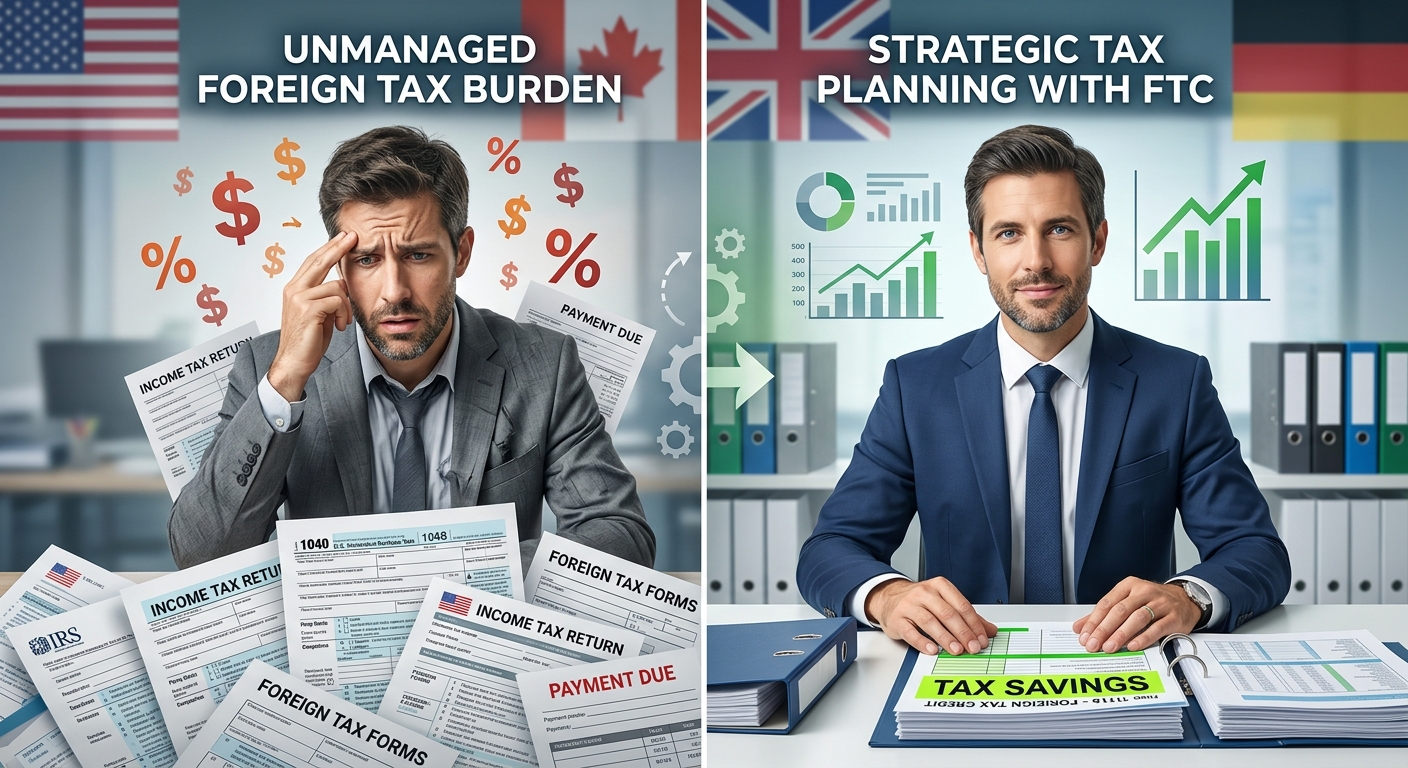
What Is International Double Taxation and Why Does It Matter?
You just closed a contract with an overseas client. Your LLC earned $85,000 in consulting fees from a company in Germany. That money hit your U.S. bank account in March. Germany withheld 25% in foreign taxes at the source. You thought that was the end of it. Then April rolled around, and your CPA told you the IRS wants to tax that same $85,000 again.
Welcome to the world of international double taxation. It is one of the most misunderstood traps for U.S. taxpayers working globally, and most people do not realize they are walking into it until tax season arrives. But here is the good news: the most effective method to avoid international double taxation is not complicated. It just requires you to know which IRS tools to use and when to use them.
International double taxation occurs when two countries tax the same income. For U.S. taxpayers, this typically happens because the United States taxes worldwide income regardless of where you earned it, while the foreign country taxes income earned within its borders. Without strategic planning, you could pay tax twice on the same dollar. The solution lies in foreign tax credits, tax treaties, and proper election timing.
This information is current as of 4/11/2026. Tax laws change frequently. Verify updates with the IRS or FTB if reading this later.
How Double Taxation Happens to Real Taxpayers
Double taxation does not happen because you made a mistake. It happens because two tax systems are working exactly as designed. The U.S. taxes citizens and residents on all income, no matter where they earn it. Meanwhile, most foreign countries tax income sourced within their borders. When those two rules collide, you get taxed twice.
Common Scenarios That Trigger Double Taxation
You sell services to a European company as a U.S.-based consultant. The client withholds tax in their country before paying you. You still owe U.S. tax on that gross income. You own rental property in Mexico. Mexico taxes the rental income. The IRS also taxes it on your U.S. return. You work remotely for a Canadian employer while living in California. Canada withholds payroll tax. California and the IRS both want their share.
Each scenario creates the same problem. Two governments, one income stream, and no automatic coordination between them. Without a plan, you pay both.
What You Lose If You Ignore This
Let’s say you earned $120,000 in foreign consulting income. The foreign country withheld $30,000 in tax. If you do nothing and just report the income on your U.S. return, the IRS taxes the full $120,000. You are now paying tax on income you never fully received. Your effective tax rate just jumped 25 percentage points, and you are funding two treasuries with money you should have kept.
This is not a rare issue. The IRS estimates that millions of U.S. taxpayers with foreign income leave money on the table every year because they do not claim the credits and deductions they qualify for. According to the IRS, unclaimed foreign tax credits totaled over $8 billion in recent years. That is $8 billion taxpayers paid twice when they did not have to.
The Most Effective Method to Avoid International Double Taxation
The single most powerful tool the IRS gives you is the foreign tax credit under IRC Section 901. This credit allows you to offset U.S. tax liability dollar-for-dollar with foreign taxes you already paid on the same income. It is not a deduction. It is a credit, which means it reduces your tax bill directly.
How the Foreign Tax Credit Works
You report your foreign income on your U.S. tax return just like domestic income. Then you file Form 1116 to claim the foreign tax credit. The IRS calculates how much foreign tax you paid on income that is also subject to U.S. tax. You get a credit for that amount, up to the U.S. tax on that same income.
Here is a real-world example. You earned $90,000 in freelance income from clients in the U.K. The U.K. withheld $18,000 in tax. Your U.S. tax on that $90,000 would be about $22,000 at a 24% marginal rate. You file Form 1116 and claim an $18,000 foreign tax credit. Your U.S. tax drops from $22,000 to $4,000. You just avoided paying $18,000 twice.
When to Use the Foreign Earned Income Exclusion Instead
The foreign tax credit is not your only option. If you live and work abroad, you might qualify for the foreign earned income exclusion under IRC Section 911. For tax year 2026, this exclusion allows you to exclude up to $126,500 of foreign earned income from U.S. taxation entirely. You file Form 2555 to claim it.
The exclusion works best if you meet the physical presence test, meaning you were physically present in a foreign country for at least 330 full days during a 12-month period, or the bona fide residence test, which requires you to be a bona fide resident of a foreign country for an uninterrupted period that includes an entire tax year. If you qualify, you exclude the income from your U.S. return. No U.S. tax. No foreign tax credit needed.
But here is the catch. You cannot use both the exclusion and the credit on the same income. You have to choose. If your foreign tax rate is higher than the U.S. rate, the credit usually saves you more money. If the foreign tax rate is lower, the exclusion might be better. The decision depends on your specific numbers.
If you are unsure which strategy fits your situation, our tax planning services can help you model both scenarios and choose the one that saves you the most.
Tax Treaties and How They Reduce Your Burden
The U.S. has income tax treaties with over 60 countries. These treaties exist to prevent double taxation and clarify which country has the primary right to tax specific types of income. They also provide reduced withholding rates on dividends, interest, royalties, and other passive income.
What Tax Treaties Actually Do
A tax treaty does not eliminate your U.S. filing requirement. You still have to report worldwide income. But the treaty can reduce or eliminate the foreign tax you owe, which means less foreign tax to credit and less complexity on your U.S. return. Some treaties also include provisions that exempt certain income types entirely, such as pension income or government salaries.
For example, the U.S.-Germany tax treaty limits withholding on dividends to 15% instead of the standard 25%. If you receive $50,000 in dividend income from a German corporation, the treaty saves you $5,000 in foreign withholding tax. That means less foreign tax to track and claim on your U.S. return.
How to Claim Treaty Benefits
Most treaty benefits require you to file specific forms with the foreign country, not just the IRS. For dividend and interest income, you typically file a certificate of residence with the foreign payer to claim the reduced withholding rate. For employment income, you may need to prove tax residency and provide documentation to your foreign employer.
On your U.S. return, you report the treaty benefit on Form 1116 if you are claiming a foreign tax credit, or on Form 8833 if you are claiming a treaty position that overrides U.S. tax law. The IRS wants to know when you rely on a treaty, so disclosure is mandatory.
Red Flag Alert: Common Mistakes That Cost You Thousands
Most taxpayers who lose money on international taxation do not lose it because they lack access to the foreign tax credit. They lose it because they make small errors that disqualify them or leave money on the table. Here are the mistakes that cost the most.
Mistake 1: Not Filing Form 1116
If your foreign taxes paid are $300 or less ($600 if married filing jointly), you can claim the credit directly on Schedule 3 without filing Form 1116. But most taxpayers with meaningful foreign income exceed that threshold. If you skip Form 1116 when you should file it, the IRS disallows your credit. You pay full U.S. tax and forfeit the foreign taxes you already paid.
Mistake 2: Mixing the Exclusion and the Credit on the Same Income
You cannot double-dip. If you exclude foreign income under Section 911, you cannot also claim a foreign tax credit on that same income. The IRS treats this as a prohibited duplication. If you try it, the IRS adjusts your return and you lose both benefits on the overlapping amount.
Mistake 3: Not Tracking Foreign Taxes Paid
Foreign tax credits require documentation. You need proof of the foreign tax you paid, including withholding statements, foreign tax returns, or payment receipts. If you cannot prove it, you cannot claim it. Keep every foreign tax document the same way you keep your W-2s and 1099s.
Mistake 4: Ignoring State Tax Implications
California does not allow a foreign tax credit on the state return. If you live in California and pay foreign taxes, you get no relief at the state level. You still owe California tax on your worldwide income, even if you already paid tax to another country. This is one of the reasons high earners with international income consider relocating to states with no income tax, like Texas or Florida.
KDA Case Study: High-Net-Worth Individual
Marcus is a private equity consultant based in Los Angeles. He earned $340,000 in advisory fees from clients in the U.K., Switzerland, and Japan in 2025. Each country withheld taxes at the source. Total foreign taxes paid: $68,000. Marcus did not know about the foreign tax credit. He filed his U.S. return and paid an additional $102,000 in federal tax on that same income. His total tax bill was $170,000 on $340,000 of income, a 50% effective rate.
Marcus came to KDA in early 2026 before filing his 2025 return. We reviewed his foreign income, identified every foreign tax payment, and prepared Form 1116 for each country. We claimed $68,000 in foreign tax credits. His U.S. tax liability dropped from $102,000 to $34,000. Marcus saved $68,000 in the first year. Our fee was $4,500. His ROI was 15x.
Ready to see how we can help you? Explore more success stories on our case studies page to discover proven strategies that have saved our clients thousands in taxes.
Step-by-Step: How to Claim the Foreign Tax Credit
Claiming the foreign tax credit is not automatic. You have to take specific steps on your tax return. Here is exactly how to do it.
Step 1: Gather All Foreign Tax Documents
Collect every document that shows foreign taxes withheld or paid. This includes foreign W-2 equivalents, withholding statements from foreign payers, foreign tax return copies, and receipts for estimated tax payments made to foreign governments. You need proof of every dollar you paid.
Step 2: Convert Foreign Taxes to U.S. Dollars
Foreign taxes paid in foreign currency must be converted to U.S. dollars. Use the exchange rate on the date you paid the tax. The IRS provides yearly average currency exchange rates you can use for this conversion. Keep a record of the rate you used in case the IRS asks.
Step 3: Complete Form 1116
Form 1116 calculates your foreign tax credit. You file a separate Form 1116 for each category of income, such as passive income, general category income, or specific treaty-based income. Most taxpayers have general category income. Enter your foreign income, the foreign taxes paid, and the IRS calculates the allowable credit. The credit cannot exceed the U.S. tax on that foreign income.
Step 4: Carry Forward Excess Credits
If your foreign taxes exceed the U.S. tax on that income, you cannot claim the full credit in the current year. But you do not lose it. You can carry the excess back one year or forward up to 10 years. This is especially useful if you have a high-tax year abroad followed by lower-tax years.
Step 5: Report the Credit on Your Tax Return
Transfer the credit from Form 1116 to Schedule 3, line 1. The credit reduces your total U.S. tax liability dollar-for-dollar. If you owe $50,000 in U.S. tax and have a $30,000 foreign tax credit, your bill drops to $20,000.
Special Situations and Edge Cases
Not all foreign income situations are straightforward. Here are the edge cases that trip up even experienced taxpayers.
What If You Are a Dual Citizen?
Dual citizens are subject to U.S. tax on worldwide income just like any other U.S. citizen. Your citizenship in another country does not exempt you from U.S. filing requirements. You still report all income to the IRS, and you still claim foreign tax credits or exclusions to avoid double taxation. Some dual citizens assume their foreign citizenship protects them from U.S. tax. It does not.
What If You Live in a Country With No Income Tax?
If you live in a country with no income tax, such as the UAE or Qatar, you have no foreign taxes to credit. You cannot use the foreign tax credit because you did not pay foreign tax. But you might still qualify for the foreign earned income exclusion under Section 911 if you meet the physical presence or bona fide residence test. This exclusion can save you up to $126,500 in U.S. tax even if you paid zero foreign tax.
What If You Operate a Business in Multiple Countries?
If you run a business with operations in multiple countries, you need to track foreign taxes paid in each jurisdiction separately. You may owe tax to multiple foreign governments and the U.S. Each country’s tax must be credited separately on Form 1116. This gets complex fast, which is why most multi-national business owners work with CPAs who specialize in international tax planning.
California-Specific Considerations
California taxpayers face unique challenges when dealing with international income. The state does not conform to many federal international tax provisions, which creates mismatches between your federal and state returns.
No Foreign Tax Credit on California Returns
California does not allow a credit for foreign taxes paid. If you paid $40,000 in foreign taxes and claimed a $40,000 credit on your federal return, you get zero relief on your California return. You still owe California tax on your worldwide income. For high earners, this can mean an extra $15,000 to $20,000 in state tax with no offset.
Foreign Earned Income Exclusion and California
California does not recognize the federal foreign earned income exclusion. If you excluded $126,500 on your federal return under Section 911, California adds that income back and taxes it. This is one of the biggest surprises for California residents working abroad. They think they excluded the income, but California still wants its share.
If you live in California and earn significant foreign income, consider whether relocating to a no-tax state makes financial sense. The combination of federal tax, California tax, and no foreign tax credit at the state level can push your effective rate above 50% on foreign income.
What Happens If You Miss This?
If you file your tax return and forget to claim the foreign tax credit, you are not stuck. You can amend your return and claim the credit retroactively. The IRS allows you to amend returns for up to three years from the original filing date or two years from the date you paid the tax, whichever is later.
File Form 1040-X to amend your return. Attach Form 1116 with the foreign tax credit calculation. Include copies of your foreign tax documents and an explanation of why you are amending. The IRS will process the amendment and issue a refund if you overpaid. This can take six months or longer, but you will get the money back.
What If You Never Filed and Have Foreign Income?
If you have unfiled returns with foreign income, you need to get compliant as soon as possible. The IRS has programs like the Streamlined Filing Compliance Procedures that allow taxpayers to catch up without facing criminal penalties. You file the last three years of returns and six years of FBARs, certify that your failure to file was non-willful, and the IRS typically waives penalties.
Do not wait. The longer you delay, the more risk you take. If the IRS finds you before you come forward, you lose access to these voluntary disclosure programs and face full penalties and potential criminal prosecution.
Ready to Reduce Your Tax Bill?
KDA Inc. specializes in strategic tax planning for business owners, S Corps, LLCs, and high-net-worth individuals. Book a personalized consultation and walk away with a clear plan.
Frequently Asked Questions
Can I claim a foreign tax credit for taxes paid to any country?
No. The foreign tax must be an income tax or a tax in lieu of an income tax, and it must be imposed by a foreign country or U.S. possession. You cannot claim a credit for value-added taxes, sales taxes, or property taxes. The tax must also be a legal and actual foreign tax liability, not a voluntary payment. If the foreign country later refunds the tax, you must reduce your credit or amend your U.S. return.
What if my foreign taxes are higher than my U.S. tax?
You cannot get a refund for foreign taxes that exceed your U.S. tax liability. The foreign tax credit can reduce your U.S. tax to zero, but it cannot create a refund. However, you can carry forward excess credits for up to 10 years or carry them back one year. This allows you to use the credit in future years when your U.S. tax exceeds your foreign tax credit.
Do I need to report foreign income even if I already paid tax on it?
Yes. U.S. citizens and residents must report all worldwide income to the IRS, even if they paid tax to another country. The foreign tax credit prevents double taxation, but it does not eliminate the reporting requirement. If you fail to report foreign income, the IRS can assess penalties and interest, even if you owe no additional tax after applying the credit.
How does the foreign tax credit work with self-employment income?
Foreign taxes paid on self-employment income are creditable, but they do not reduce your U.S. self-employment tax. The foreign tax credit only offsets U.S. income tax, not Social Security or Medicare taxes. If you earned $100,000 in self-employment income abroad and paid foreign income tax, you can credit the foreign tax against your U.S. income tax, but you still owe the full 15.3% self-employment tax to the IRS unless you qualify for a totalization agreement.
What is a totalization agreement?
A totalization agreement is a treaty between the U.S. and another country that prevents dual Social Security taxation. If you work in a country with a totalization agreement, you typically pay Social Security taxes to only one country, not both. The U.S. has agreements with over 30 countries. If you work abroad, check whether a totalization agreement applies. It can save you thousands in duplicate Social Security taxes.
Pro Tips for Maximizing Your Foreign Tax Strategy
Here are the tactics that separate taxpayers who pay twice from taxpayers who keep their money.
Pro Tip 1: If you have both foreign earned income and foreign passive income, structure your earnings to maximize the Section 911 exclusion on the earned income and use the foreign tax credit on the passive income. This combination can eliminate U.S. tax on the first $126,500 of earned income while still crediting taxes paid on investment income.
Pro Tip 2: If you are moving abroad, plan your departure date strategically. Your eligibility for the foreign earned income exclusion depends on the number of days you spend outside the U.S. Moving mid-year can complicate the calculation. If possible, move at the start of a calendar year to simplify your tax filing.
Pro Tip 3: If you run a business with international income, consider whether a foreign subsidiary or branch structure saves you more tax. The choice affects how you report income, when you pay U.S. tax, and which credits and deductions you qualify for. This is advanced planning that requires a CPA with international tax expertise, but it can save you six figures annually.
Pro Tip 4: If your foreign taxes fluctuate year-to-year, consider carrying forward excess credits strategically. Do not waste a large credit in a low-income year. Amend prior returns to carry the credit back if it creates a bigger refund, or hold it forward if you expect higher income in future years.
Book Your International Tax Strategy Session
International double taxation is not something you fix after the fact. You need a plan before you earn the income, before the foreign country withholds tax, and before you file your U.S. return. If you are working abroad, earning foreign income, or operating a business with international clients, you need a CPA who understands the foreign tax credit, tax treaties, and the exclusions that save you money.
Do not leave money on the table. Do not pay tax twice when the IRS gives you tools to pay once. Book a personalized tax strategy session with our team and get a clear plan for your international income. Click here to book your consultation now.



