
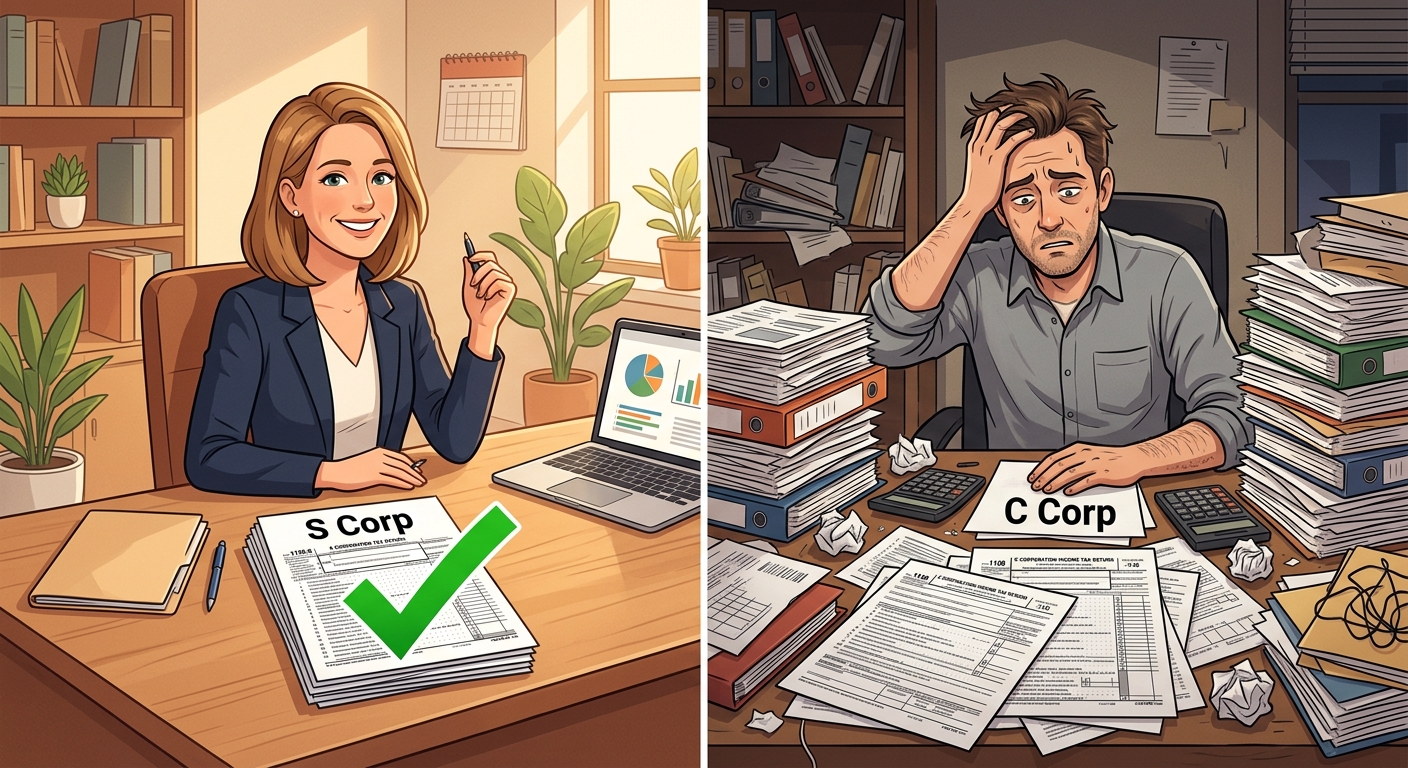
Every year, thousands of California business owners pick an entity structure the way they pick a restaurant: whatever their friend recommended. That one decision quietly locks them into a filing burden, compliance cost, and tax bill they never agreed to. The question which is easier S Corp or C Corp sounds simple, but the answer carries a $38,000 annual swing for owners earning $200,000 or more in profit. The “easier” entity is not always the one with fewer forms. It is the one that matches your income level, your growth plan, and your tolerance for ongoing compliance.
This guide breaks down every layer of that comparison: formation steps, annual filing requirements, tax complexity, California-specific compliance traps, and the real dollar cost of choosing wrong. By the end, you will know exactly which entity structure fits your situation and how to avoid the mistakes that cost business owners tens of thousands of dollars every year.
Quick Answer
For most California business owners earning $60,000 or more in annual profit, the S Corp is easier to manage on a day-to-day and year-to-year basis. It requires fewer tax layers, avoids double taxation entirely, and costs less to maintain than a C Corp. The C Corp only becomes the better choice in narrow scenarios involving venture capital raises, multiple stock classes, or Section 1202 QSBS exclusion planning.
Which Is Easier S Corp or C Corp for Formation and Setup?
The formation process is nearly identical for both entity types, and that similarity is where most of the confusion starts. Both the S Corp and the C Corp begin life as a standard corporation filed with the California Secretary of State using Articles of Incorporation. The difference is what happens next.
C Corp Formation Steps
A C Corp is the default. File your Articles of Incorporation, pay the $100 filing fee, obtain your EIN from the IRS (free, takes five minutes at IRS.gov/EIN), adopt bylaws, hold an organizational meeting, and issue stock certificates. You are done. California charges an $800 minimum franchise tax in the first year (waived for the first year if you formed after January 1, 2024, under AB 85), and you are officially operating as a C Corp.
S Corp Formation Steps
An S Corp requires everything a C Corp requires plus one additional form: IRS Form 2553, Election by a Small Business Corporation. This form must be filed within 75 days of formation or by March 15 of the tax year you want the election to take effect. You also need to confirm you meet the eligibility requirements under IRC Section 1361: no more than 100 shareholders, all shareholders must be U.S. citizens or residents, only one class of stock, and no corporate or partnership shareholders.
That single extra step is the only additional formation requirement. If you miss the deadline, you can file a late election under Revenue Procedure 2013-30, but that adds paperwork and stress. For a deeper walkthrough, see our comprehensive S Corp tax strategy guide, which covers every angle of the election process.
Formation Verdict
Formation difficulty is essentially a tie. The S Corp adds one form. That is it. If someone told you the C Corp is “easier to form,” they are technically correct by one piece of paper, but that one form saves you thousands of dollars every year going forward. Many business owners who skip the S Corp election at formation end up paying for it later.
Annual Tax Filing: Where the Real Complexity Gap Shows Up
Formation is a one-time event. Tax filing is an annual burden that compounds over the life of your business. This is where the “which is easier” question actually matters, and the answer tilts heavily toward the S Corp for most owners.
C Corp Annual Filing Requirements
A C Corp files IRS Form 1120, U.S. Corporation Income Tax Return. In California, you also file FTB Form 100, California Corporation Franchise or Income Tax Return. The corporation pays tax at the entity level: 21% federal corporate rate plus 8.84% California franchise tax. That is a combined 29.84% entity-level rate on every dollar of profit before it ever reaches your personal bank account.
When you take money out as a dividend, you pay tax again on your personal return. Qualified dividends are taxed at 0%, 15%, or 20% federally depending on your income, plus California taxes dividends as ordinary income at rates up to 12.3% (plus the 1% mental health surcharge above $1 million). This is the double taxation problem that makes C Corps more expensive and more complicated to manage.
Here is what that looks like on $200,000 in profit:
- Federal corporate tax: $200,000 x 21% = $42,000
- California franchise tax: $200,000 x 8.84% = $17,680
- Remaining after entity tax: $140,320
- Federal dividend tax (15%): $140,320 x 15% = $21,048
- California personal tax on dividends (~9.3%): $140,320 x 9.3% = $13,050
- Total combined tax: $93,778
- Net take-home: $106,222
S Corp Annual Filing Requirements
An S Corp files IRS Form 1120-S, U.S. Income Tax Return for an S Corporation, and California FTB Form 100S. The corporation itself pays no federal income tax. Instead, all profit passes through to your personal return on Schedule K-1. California charges a 1.5% franchise tax on net income (minimum $800), which is dramatically lower than the C Corp’s 8.84%.
As the owner, you pay yourself a reasonable salary (subject to payroll taxes), and take the remaining profit as distributions (not subject to self-employment tax or the employer share of FICA). That salary-distribution split is the primary tax advantage. Want to see how this affects your specific numbers? Plug your business profit into this small business tax calculator to estimate the difference.
Here is the same $200,000 in profit through an S Corp (assuming $80,000 reasonable salary):
- Payroll taxes on $80,000 salary: $12,240 (employer + employee FICA)
- California franchise tax (1.5%): $200,000 x 1.5% = $3,000
- Federal income tax on pass-through income (~24% effective): $200,000 x 24% = $48,000
- QBI deduction savings (20% of $120,000 distribution): approximately $5,760 saved
- California personal income tax (~9.3%): $200,000 x 9.3% = $18,600
- Total combined tax: approximately $55,880 (after QBI offset)
- Net take-home: approximately $144,120
The difference: roughly $37,900 per year in the S Corp’s favor. Over five years, that gap becomes $189,500. Over ten years, it exceeds $379,000.
Key Takeaway: The S Corp’s tax filing is simpler (no second layer of tax) and cheaper by $38,000 per year on $200,000 in profit. The C Corp’s double taxation creates a permanent cost disadvantage for most owner-operated businesses.
Ongoing Compliance: Payroll, Minutes, and State Requirements
Tax filing is only one piece of the compliance picture. Both entities carry ongoing obligations that cost time and money. Here is where the comparison gets nuanced.
Corporate Formalities (Both Entities)
Both S Corps and C Corps are required to maintain corporate formalities to preserve liability protection. That means:
- Annual board of directors meetings (documented in meeting minutes)
- Annual shareholder meetings
- Maintaining a corporate minute book
- Keeping corporate and personal finances completely separate
- Filing California Statement of Information (Form SI-550) every year ($25 fee)
These requirements are identical for both entities. Neither is easier here.
Payroll Requirements
This is the one area where the S Corp adds a compliance layer. As an S Corp owner-employee, you must run payroll for yourself and pay yourself a “reasonable salary.” That means:
- Setting up a payroll system (typically $40 to $80 per month through a service like Gusto or ADP)
- Filing quarterly payroll tax returns (IRS Form 941)
- Filing annual Form W-2 for yourself
- Paying California Employment Development Department (EDD) taxes
- Filing California Form DE 9 and DE 9C quarterly
A C Corp owner who takes a salary has the exact same payroll requirements. The only scenario where a C Corp avoids payroll is if the owner takes zero salary and only receives dividends. That strategy creates its own problems: the IRS can reclassify dividends as compensation and assess back payroll taxes plus penalties. Our bookkeeping and payroll services handle all of this automatically for both entity types.
California-Specific Compliance Differences
California adds its own compliance wrinkles that affect both entities differently:
| Compliance Item | S Corp | C Corp |
|---|---|---|
| Franchise Tax Rate | 1.5% (min $800) | 8.84% (min $800) |
| State Return | FTB Form 100S | FTB Form 100 |
| Section 179 Cap | $25,000 | $25,000 |
| Bonus Depreciation | Not allowed | Not allowed |
| AB 150 PTE Election | Available (SALT workaround) | Not available |
| Annual Statement of Info | Required ($25) | Required ($25) |
| Estimated Tax Payments | Required quarterly | Required quarterly |
The AB 150 Pass-Through Entity (PTE) elective tax is a major advantage exclusive to S Corps in California. It allows S Corp owners to work around the $40,000 SALT deduction cap (as modified by OBBBA) by paying state tax at the entity level and claiming a federal deduction. C Corp owners cannot use this workaround because C Corps already pay state tax at the entity level, and that tax is not deductible on the owner’s personal return in the same way.
Pro Tip: The AB 150 PTE election alone can save California S Corp owners $3,000 to $12,000 per year depending on income level. If you are comparing entities and ignoring this election, you are understating the S Corp advantage significantly.
The Five Costliest “Which Is Easier” Mistakes
After reviewing hundreds of entity selection decisions, these are the five errors that cost business owners the most money and time.
Mistake 1: Choosing C Corp Because Someone Said “It Is the Default”
The C Corp is the default classification, but “default” does not mean “best.” Sticking with the default on a $150,000 profit business costs roughly $28,000 more in annual taxes than electing S Corp status. That is not a rounding error. That is a new car payment every year, wasted.
Mistake 2: Assuming S Corp Payroll Is Too Complicated
Running payroll costs $40 to $80 per month. The annual tax savings from the S Corp election on $100,000 in profit is approximately $8,400 to $12,000. You are spending $960 per year to save $10,000. That is a 10x return on a compliance cost. Payroll is not a burden. It is the price of admission to a much better tax outcome.
Mistake 3: Picking C Corp for “Growth” Without VC Plans
Many business owners choose C Corp status because they “plan to grow” or “might raise venture capital someday.” Unless you are actively pursuing institutional investors who require C Corp structure and preferred stock classes, you do not need a C Corp. The overwhelming majority of small businesses, including those that grow to $1 million, $5 million, or $10 million in revenue, operate better as S Corps. You can always convert to a C Corp later if a genuine funding event requires it.
Mistake 4: Ignoring the California Franchise Tax Gap
On $300,000 in profit, the California franchise tax difference alone is staggering: $4,500 (S Corp at 1.5%) versus $26,520 (C Corp at 8.84%). That $22,020 state-level gap exists before you even factor in the federal double taxation problem. California business owners who overlook this are bleeding money every single year.
Mistake 5: Filing Late S Corp Election and Paying C Corp Rates for a Full Year
If you incorporate in June but do not file Form 2553 until the following March, you have been a C Corp for nearly a full tax year. On $200,000 in profit, that one missed deadline costs approximately $38,000 in unnecessary taxes. The fix is filing Form 2553 within 75 days of incorporation or using the late election relief under Revenue Procedure 2013-30, but many owners do not learn about this until tax season, when the damage is already done. Our entity formation services build the S Corp election into the setup process so you never miss this deadline.
KDA Case Study: Sacramento Restaurant Group Owner Saves $38,400 by Switching from C Corp to S Corp
Marcus, a Sacramento-based restaurant group owner operating two locations through a C Corp, came to KDA after three years of filing Form 1120 and paying double taxation on $240,000 in annual profit. His previous accountant had never discussed entity alternatives.
KDA identified three immediate problems: Marcus was paying 8.84% California franchise tax instead of 1.5%, absorbing full double taxation on dividends, and missing the AB 150 PTE election entirely. We filed Form 2553 using the late election relief under Revenue Procedure 2013-30, restructured his compensation to a $95,000 reasonable salary with the remaining $145,000 as distributions, elected into AB 150, and stacked a solo 401(k) contribution to reduce his adjusted gross income further.
First-year results: Marcus saved $38,400 in combined federal and California taxes. His compliance costs increased by $1,800 per year (payroll service plus the additional FTB Form 100S filing), but the net savings after compliance costs were $36,600. His KDA engagement fee was $4,800, producing a 7.6x first-year ROI. Over five years, projected cumulative savings exceed $183,000.
Ready to see how we can help you? Explore more success stories on our case studies page to discover proven strategies that have saved our clients thousands in taxes.
When the C Corp Actually Wins: Three Narrow Exceptions
Fairness requires acknowledging the scenarios where a C Corp is the right call. These are specific, narrow situations that do not apply to most small business owners.
Exception 1: Venture Capital or Institutional Investment
Most VC firms require C Corp status because they need preferred stock classes (prohibited under S Corp rules) and expect the company to eventually go public. If you are raising a Series A or beyond from institutional investors, a C Corp is likely required by the term sheet.
Exception 2: Section 1202 QSBS Exclusion
If you hold qualifying C Corp stock for five years and meet the requirements under IRC Section 1202, you can exclude up to $10 million (or 10x your basis, whichever is greater) in capital gains when you sell. This is powerful for founders building a company to sell. However, California does not conform to the federal QSBS exclusion, so California capital gains tax still applies at full rates up to 13.3%. That state-level gap significantly reduces the benefit for California residents.
Exception 3: Retained Earnings Strategy at Very High Profit Levels
A C Corp paying a flat 21% federal rate can retain earnings inside the corporation at a lower rate than the owner’s personal marginal rate (which could be 37% federal plus 12.3% California). This strategy works only if you plan to reinvest profits inside the business rather than distributing them. Be warned: the IRS imposes an accumulated earnings tax under IRC Section 531 if retained earnings exceed $250,000 without a documented business purpose.
Red Flag Alert: If your accountant suggested a C Corp because “the 21% rate is lower,” ask them about the accumulated earnings tax and the double taxation on eventual distributions. The 21% rate is only the first layer. The total effective rate on distributed C Corp profits is 39% to 50% when you include personal-level taxes, compared to 30% to 40% for S Corp pass-through income.
OBBBA Changes That Affect This Comparison in 2026
The One Big Beautiful Bill Act (OBBBA) made several permanent changes that widen the S Corp advantage for most California business owners:
- Permanent QBI Deduction: The 20% Qualified Business Income deduction under IRC Section 199A is now permanent. This exclusively benefits S Corp owners and pass-through entities. C Corp profits do not qualify for QBI. On $200,000 in S Corp distributions, that is up to $40,000 in income excluded from tax, saving $8,000 to $14,800 depending on your bracket.
- SALT Cap Raised to $40,000: The state and local tax deduction cap increased from $10,000 to $40,000 for individuals. Combined with AB 150, this gives California S Corp owners a powerful two-layer state tax deduction strategy.
- 100% Bonus Depreciation Restored: Federal bonus depreciation is back to 100% for qualifying assets. Both entities benefit federally, but neither benefits at the California level (California rejects bonus depreciation entirely under R&TC Sections 17250 and 24356).
- Section 179 Limit at $2.5 Million: The Section 179 expensing limit sits at $2.5 million federally. California’s cap remains at $25,000. Both entities face this same state limitation.
The QBI deduction alone makes the S Corp more valuable by $8,000 to $14,800 per year compared to the C Corp for owners earning $150,000 to $350,000. That advantage did not exist before TCJA and is now locked in permanently under OBBBA.
Decision Framework: S Corp or C Corp for Your Situation
Use this framework to determine which entity is easier and more tax-efficient for your specific circumstances:
| Factor | Choose S Corp If… | Choose C Corp If… |
|---|---|---|
| Annual Profit | $60,000 to $5,000,000+ | Reinvesting 100% and not distributing |
| Number of Owners | 1 to 100 (U.S. residents only) | Need foreign shareholders or 100+ |
| Stock Classes | One class is sufficient | Need preferred, common, warrants |
| Fundraising Plans | Self-funded or SBA loans | VC, Series A, or institutional |
| Exit Strategy | Sell assets, distribute, or wind down | IPO or QSBS exclusion target |
| California Tax Priority | Minimize franchise tax (1.5%) | Willing to pay 8.84% |
| Simplicity Priority | Single layer of tax | Comfortable with double taxation |
| QBI Deduction | Want the 20% deduction | Not eligible regardless |
If three or more factors point to S Corp, the S Corp is almost certainly the right choice. The C Corp only wins when you check at least two of the right-column boxes and your specific financial projections confirm the numbers work.
What If I Already Chose the Wrong Entity?
If you are currently operating as a C Corp and realize the S Corp would have been the better choice, conversion is possible but requires careful planning. Key considerations include:
- Built-in Gains Tax: Under IRC Section 1374, appreciated assets held at the time of conversion may trigger a built-in gains tax if sold within five years of the S Corp election. The federal BIG tax rate is 21%.
- Accumulated E&P: Any retained earnings from the C Corp years carry over as accumulated earnings and profits (E&P). Distributions from E&P are taxed as dividends, not tax-free returns of basis. You must track three separate accounts: stock basis, AAA, and accumulated E&P.
- California BIG Tax: California imposes its own built-in gains tax at 1.5% under R&TC Section 23802, in addition to the federal BIG tax.
- NOL Freeze: Net operating losses generated during C Corp years are frozen under IRC Section 1371(b) and cannot offset S Corp income. They can only be used against built-in gains or if you revert to C Corp status.
Despite these complications, the long-term savings from converting usually outweigh the transition costs. On $200,000 in annual profit, waiting even one additional year costs approximately $38,000 in unnecessary taxes.
Ready to Reduce Your Tax Bill?
KDA Inc. specializes in strategic tax planning for business owners, S Corps, LLCs, and high-net-worth individuals. Book a personalized consultation and walk away with a clear plan.
Frequently Asked Questions
Is an S Corp harder to maintain than a C Corp?
No. Both require the same corporate formalities (minutes, meetings, separate finances). The S Corp adds a payroll requirement, but that costs $40 to $80 per month and saves $8,000 to $20,000 per year in taxes. The C Corp’s double taxation creates more complexity during tax preparation and distribution planning.
Can I switch from S Corp to C Corp later?
Yes. You can revoke your S Corp election at any time by filing a statement of revocation with the IRS signed by shareholders holding more than 50% of the stock. However, once revoked, you cannot re-elect S Corp status for five years without IRS consent under IRC Section 1362(g).
Do I need a lawyer to form an S Corp?
Not necessarily, but having professional guidance ensures you file Form 2553 on time, set a reasonable salary, and comply with California-specific requirements. The cost of professional setup ($1,500 to $4,000) is a fraction of the tax savings in the first year alone.
Which entity is better if I have losses?
S Corp losses pass through to your personal return and can offset other income (subject to basis, at-risk, and passive activity limitations). C Corp losses stay trapped inside the corporation and cannot offset your personal income. For businesses expecting losses in early years, the S Corp provides more immediate tax benefit.
What happens if I miss the Form 2553 deadline?
You can file a late S Corp election under Revenue Procedure 2013-30 if you meet four requirements: the entity intended to be classified as an S Corp, the only reason for the late filing was failure to timely file Form 2553, you have reasonable cause, and you file within 3 years and 75 days of the intended effective date. In most cases, the IRS grants relief if you act promptly.
This information is current as of April 3, 2026. Tax laws change frequently. Verify updates with the IRS or FTB if reading this later.
Book Your Entity Strategy Session
If you are stuck between an S Corp and a C Corp, or if you suspect your current entity structure is costing you $10,000 or more per year, stop guessing. Book a personalized consultation with our strategy team and walk away with a clear, numbers-backed recommendation for your specific situation. Click here to book your consultation now.



