
Most California STR Owners Are Depreciating Their Airbnb Over 27.5 Years While Leaving $40,000 or More on the Table
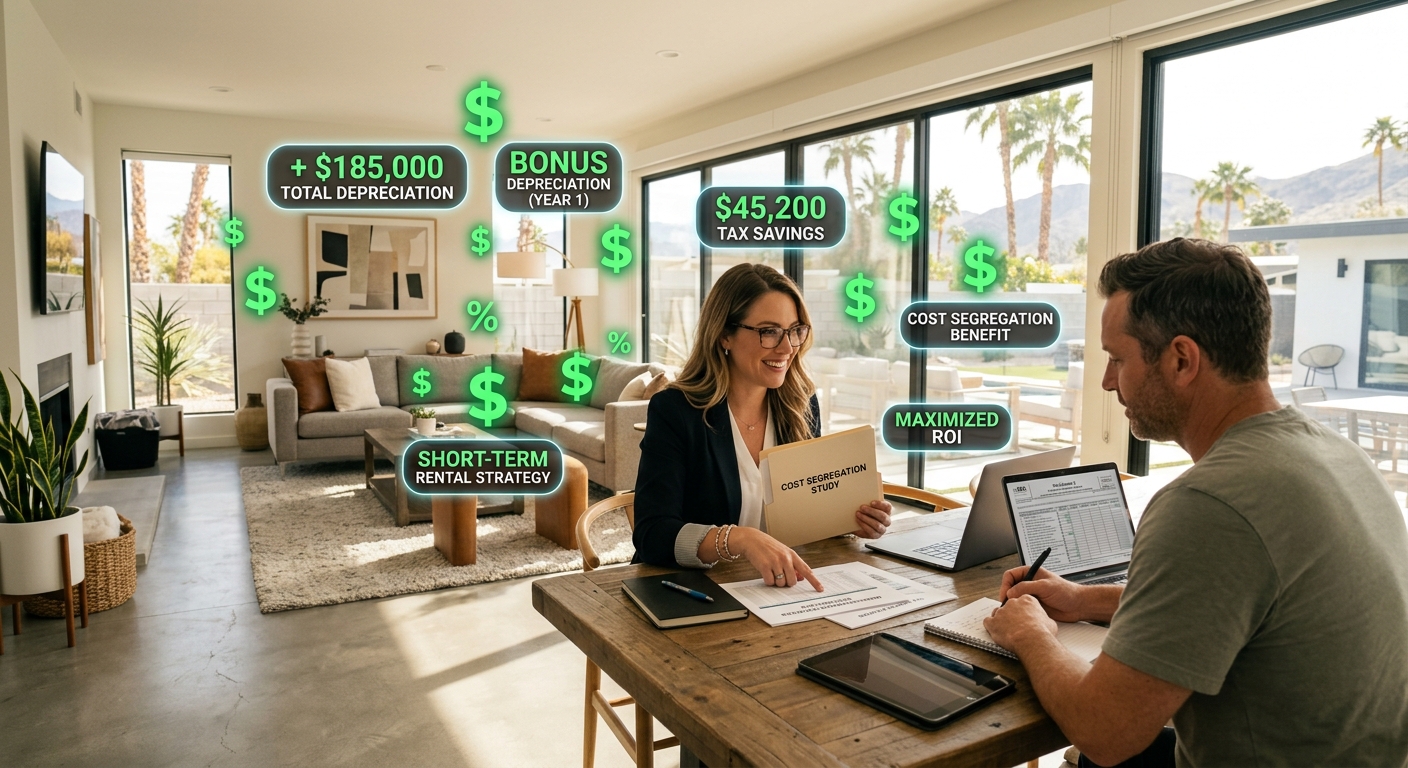
A short-term rental owner in Palm Springs bought a $750,000 property in 2024. Her CPA filed a standard return, spread the building value over 27.5 years, and moved on. She claimed $18,545 in depreciation that year. Had she run a cost seg for short-term rentals California study before filing, she could have reclassified $285,000 of that building into 5-year, 7-year, and 15-year asset categories and claimed over $97,000 in first-year deductions instead. That is a $78,455 difference in one filing year. One study. One return. One decision that separated a modest write-off from a five-figure tax windfall.
Cost segregation is not new. It has existed since the IRS blessed the engineering-based approach in Hospital Corporation of America v. Commissioner back in 1999. But the intersection of cost segregation, short-term rental classification, and California’s aggressive nonconformity rules creates a tax planning environment that most property owners and even some CPAs completely misunderstand. If you own or plan to buy a short-term rental in California, this is the breakdown you need before your next filing.
Quick Answer
Cost segregation for short-term rentals in California allows property owners to reclassify 20% to 40% of a building’s depreciable basis into shorter-lived asset categories (5, 7, and 15 years instead of 27.5 or 39 years), accelerating hundreds of thousands of dollars in deductions into the early years of ownership. When paired with material participation and the STR loophole under IRC Section 469, these deductions can offset W-2 or active business income, not just passive rental income, making it one of the most powerful legal tax reduction tools available to California real estate investors in 2026.
What Cost Seg for Short-Term Rentals California Actually Means and Why the STR Classification Changes Everything
A cost segregation study is an engineering-based analysis that breaks a building into its individual components and assigns each component to the correct IRS depreciation class. Instead of lumping everything into the 27.5-year residential category, the study identifies items like flooring, cabinetry, appliances, landscaping, parking surfaces, plumbing fixtures, and electrical wiring that qualify for 5-year, 7-year, or 15-year recovery periods under the Modified Accelerated Cost Recovery System (MACRS), as outlined in IRS Publication 946.
For a standard long-term rental, cost segregation creates accelerated depreciation deductions, but those deductions are typically classified as passive losses under IRC Section 469. That means they can only offset passive income. If you do not have enough passive income, those losses carry forward until you sell the property or generate more passive income in a future year.
Short-term rentals change that equation entirely. Under IRC Section 469(c)(2) and Treasury Regulation 1.469-1T(e)(3)(ii), a rental activity with an average customer use period of seven days or fewer is not automatically classified as a “rental activity” for passive activity purposes. That means if you materially participate in the operation of your Airbnb, VRBO, or direct-booked short-term rental, the IRS treats those losses as non-passive. Non-passive losses can offset your W-2 wages, your 1099 consulting income, your S Corp distributions, or any other active income stream.
The Seven-Day Rule in Practice
The average period of customer use is calculated by dividing total rental days by total rental periods. If you rent a cabin in Lake Tahoe for 200 nights across 45 separate bookings, your average period of customer use is 4.4 days. That is under seven days. You qualify. If the same property is rented to one tenant for eight months on a single lease, the average period is 240 days. That is a standard rental, and the passive activity rules apply normally.
Many real estate investors operating Airbnb properties in California already meet the seven-day test without realizing it. The typical Airbnb booking in popular California markets like Palm Springs, Joshua Tree, Big Bear, San Diego, and the Napa Valley region averages 3 to 5 nights. That means most California STR owners automatically clear the first hurdle.
Material Participation Requirements
Clearing the seven-day test is only the first gate. You also need to materially participate in the STR activity. The IRS defines material participation through seven tests under Treasury Regulation 1.469-5T. The two most commonly used by STR owners are:
- Test 1: You participate in the activity for more than 500 hours during the tax year.
- Test 4: The activity is a significant participation activity, and your aggregate participation in all significant participation activities exceeds 500 hours.
For a hands-on Airbnb host who manages guest communications, coordinates cleaning crews, handles maintenance, sets pricing, manages listings, and oversees check-in/check-out procedures, hitting 500 hours across one or two properties is realistic. That works out to roughly 10 hours per week. Keep a contemporaneous log. The IRS can and does challenge material participation claims during audits, and your log is your primary defense.
How Much a Cost Segregation Study Actually Saves California STR Owners
The savings depend on three variables: property value, the percentage reclassified, and your marginal tax rate. Let us walk through three real scenarios at different price points.
Scenario 1: $500,000 STR in Joshua Tree
Assume the land value is $75,000 and the depreciable building basis is $425,000. A cost segregation study reclassifies 35% of the building, or $148,750, into shorter-lived asset classes. Under OBBBA (One Big Beautiful Bill Act), which restored 100% bonus depreciation for qualifying assets placed in service after January 19, 2025, you can deduct the entire $148,750 in year one on your federal return.
At a combined federal and California marginal rate of 46.3% (37% federal + 9.3% California), that produces $68,871 in first-year tax savings. Without cost segregation, your standard straight-line depreciation deduction would be $15,454. The cost segregation study itself typically costs $5,000 to $8,000 for a property of this size. Even at the high end, the ROI is 7.6x in year one.
Scenario 2: $850,000 STR in Big Bear
Land at $120,000. Depreciable basis of $730,000. Cost seg reclassifies 32%, or $233,600, into accelerated categories. Federal bonus depreciation yields a $233,600 first-year deduction. At a 49.3% combined rate (37% federal + 12.3% California for income over $677,275), you save $115,165 in year one. Standard depreciation would have been $26,545. The study costs $6,500. ROI: 16.7x.
Scenario 3: $1.4 Million STR in Napa Valley
Land at $280,000. Depreciable basis of $1,120,000. Cost seg reclassifies 30%, or $336,000. First-year bonus depreciation deduction: $336,000. At a 50.3% combined rate (37% federal + 13.3% California top bracket), first-year tax savings: $169,008. Standard depreciation: $40,727. Study cost: $9,500. ROI: 16.8x.
Want to estimate the downstream tax impact when you eventually sell? Run your numbers through this capital gains tax calculator to project the depreciation recapture and net proceeds.
The California Nonconformity Trap That Catches Every STR Owner Who Files on Autopilot
Here is where California makes everything harder. The federal government, under OBBBA, now allows 100% bonus depreciation for qualifying assets placed in service after January 19, 2025. California does not conform. Under Revenue and Taxation Code Sections 17250 and 24356, California has never adopted federal bonus depreciation. Period.
That means every California STR owner running a cost segregation study must maintain two separate depreciation schedules: one for the federal return using 100% bonus depreciation and one for the California return using standard MACRS recovery periods without bonus depreciation.
What This Looks Like in Dollar Terms
Take the $850,000 Big Bear scenario above. Federally, you deduct $233,600 in year one. On your California return, you deduct only the standard first-year MACRS amount for each asset class:
- 5-year property: 20% first-year rate under MACRS half-year convention
- 7-year property: 14.29% first-year rate
- 15-year property: 5% first-year rate
The California first-year deduction on that same $233,600 in reclassified assets might total $38,000 to $45,000 depending on the allocation split. That creates a federal-to-state deduction gap of approximately $190,000. At California’s 12.3% marginal rate, you owe roughly $23,370 more in state tax than you expected if you only looked at the federal picture.
This is the trap. Owners see the massive federal savings, assume California follows along, and are blindsided when their FTB bill comes due. Our cost segregation services at KDA build both schedules into the analysis from day one, so there are no surprises at filing time.
Five Strategies to Minimize the California Gap
- Section 179 Stacking: California does allow Section 179 expensing up to $25,000. Apply this to the highest-value personal property items identified in your cost seg study before using bonus depreciation on the remaining federal side.
- AB 150 PTE Election: If your STR is held in an LLC or S Corp, elect into California’s Pass-Through Entity tax. The 9.3% PTE tax generates a dollar-for-dollar federal income tax credit, effectively converting a nondeductible state tax payment into a federal deduction that bypasses the $40,000 SALT cap under OBBBA.
- Strategic Purchase Timing: Place assets in service in the first quarter of the year to maximize first-year MACRS percentages on the California return (full-year convention vs. mid-quarter convention).
- Retirement Contribution Offsets: Use a Solo 401(k) or SEP-IRA funded by your STR net income to reduce California AGI, partially closing the gap.
- Section 168(k)(7) Election: In rare cases, it may make sense to elect out of bonus depreciation federally to align federal and state depreciation schedules. This only makes sense if your federal marginal rate is low and you want predictable, level deductions over time.
KDA Case Study: Palm Desert STR Owner Saves $87,400 in Year One
David, a W-2 software engineer earning $245,000 in Sacramento, purchased a $920,000 short-term rental property in Palm Desert in early 2025. He self-managed the property through Airbnb and VRBO, handling guest communications, pricing adjustments, cleaning crew coordination, and property maintenance. His contemporaneous activity log showed 614 hours of participation for the year.
His previous CPA had filed his return using standard 27.5-year straight-line depreciation on the entire building value, producing a $23,636 annual deduction classified as passive. Because David had no other passive income, the loss carried forward unused.
KDA ran a cost segregation study on the property and reclassified $297,000 of the $690,000 depreciable basis (43%) into 5-year, 7-year, and 15-year asset categories. We documented his material participation to satisfy the STR loophole requirements, converting the loss from passive to non-passive. The $297,000 in accelerated depreciation, combined with 100% federal bonus depreciation under OBBBA, offset David’s W-2 income directly.
Federal tax savings: $109,890 (at 37% marginal rate). California tax savings after accounting for the nonconformity gap: $22,510 (using Section 179 stacking and AB 150 PTE election). Total first-year net savings after study cost: $87,400. The cost segregation study and KDA’s real estate tax preparation services ran $8,200. That is a 10.7x first-year ROI.
Ready to see how we can help you? Explore more success stories on our case studies page to discover proven strategies that have saved our clients thousands in taxes.
The Five Costliest Mistakes California STR Owners Make With Cost Segregation
Mistake 1: Running a Cost Seg Study Without Confirming Material Participation
The cost seg study itself does not change your tax outcome unless the resulting losses can be used. If you fail the material participation test, those accelerated deductions remain passive losses. You will carry them forward indefinitely, waiting for passive income or a property sale. The study still has value, but you lose the immediate W-2 offset that makes STR cost segregation so powerful. Document your hours before you order the study.
Mistake 2: Ignoring the California Depreciation Gap
We covered this above, but it bears repeating. If your CPA files your California return using the same depreciation figures as your federal return, the FTB will catch it. California runs automated matching programs that flag federal-state depreciation mismatches. The correction comes with interest and potentially a 20% accuracy-related penalty under R&TC Section 19164.
Mistake 3: Using a Desktop Cost Seg Instead of an Engineering-Based Study
The IRS released its Cost Segregation Audit Technique Guide (ATG) in 2004, and it explicitly states that engineering-based studies carry the most weight. Desktop studies that estimate component values from databases without an actual site visit or engineering analysis are cheaper ($1,500 to $3,000), but they are also the first studies the IRS challenges on audit. For a $500,000+ property, the $3,000 you save on a desktop study is not worth the risk of losing $60,000+ in reclassified deductions during an examination.
Mistake 4: Forgetting Depreciation Recapture on Sale
Every dollar you accelerate through cost segregation is subject to depreciation recapture when you sell under IRC Section 1245. Personal property (5-year and 7-year assets) is recaptured at your ordinary income tax rate, not the 25% Section 1250 rate that applies to real property recapture. If you reclassify $300,000 into personal property and later sell, that $300,000 is taxed at up to 37% federally plus 13.3% in California instead of the more favorable capital gains rate. The fix: plan a 1031 exchange at disposition to defer both the gain and the recapture.
Mistake 5: Missing the Lookback Study Opportunity
You do not have to run a cost seg study in the year of purchase. IRS Revenue Procedure 2023-24 allows you to file a Form 3115 (Change in Accounting Method) to catch up on all the accelerated depreciation you missed in prior years, all in one lump sum in the current year. If you bought a California STR in 2021, 2022, or 2023 and never ran a cost seg study, the lookback opportunity lets you claim the cumulative difference between what you deducted and what you could have deducted, without amending prior returns.
Does a Cost Seg Study Trigger an Audit?
This is the question every STR owner asks, so let us address it directly. A properly conducted, engineering-based cost segregation study does not increase your audit risk. The IRS has acknowledged cost segregation as a legitimate tax planning tool. The Cost Segregation ATG was written specifically to help IRS agents evaluate these studies, not to eliminate them.
What does trigger scrutiny is a cost seg study paired with inconsistent or missing documentation. If you claim $200,000 in accelerated depreciation but cannot produce the engineering report, the site visit notes, the asset breakdown schedules, or the material participation log, you are inviting a challenge. Keep every document. The study, the log, the closing statement, the property inspection photos, and the component schedules should all be filed together and retained for at least three years after the return is filed, per the standard IRS statute of limitations under IRC Section 6501.
Can I Use Cost Segregation on a Property I Have Owned for Several Years?
Yes. This is the lookback study we mentioned under Mistake 5. The IRS allows a Section 481(a) adjustment through Form 3115, which captures all the “missed” depreciation from prior years and applies it as a single deduction in the current tax year. No amended returns needed. No penalties.
For California STR owners, the lookback adjustment requires two separate calculations: one for the federal 481(a) adjustment and one for California. Because California never allowed bonus depreciation, the state-level catch-up amount will be smaller than the federal amount, but it still provides meaningful savings. If you purchased a property three or four years ago and used straight-line depreciation, the federal lookback alone could produce a $50,000 to $150,000 one-time deduction depending on property value.
The 2026 OBBBA Changes That Make Cost Seg for Short-Term Rentals Even More Valuable
The One Big Beautiful Bill Act, signed into law in mid-2025, restored several provisions that directly increase the value of cost segregation for STR owners:
- 100% Bonus Depreciation Restored: OBBBA reinstated 100% first-year bonus depreciation for qualifying assets placed in service after January 19, 2025. This reversed the TCJA phase-down that had dropped bonus depreciation to 60% for 2024. Every dollar reclassified through cost seg is now fully deductible in year one on the federal return.
- Section 179 Increased to $2.5 Million: The expensing limit jumped from $1.29 million to $2.5 million, with the phase-out threshold rising to $4 million. While most individual STR owners will not hit these limits, the higher ceiling provides flexibility for investors with multiple properties or large renovation budgets.
- QBI Deduction Made Permanent: The 20% Qualified Business Income deduction under Section 199A is now permanent. For STR owners who qualify (income below $191,950 single / $383,900 married in 2025), this layers on top of cost segregation savings. Your STR net income, after depreciation, gets an additional 20% reduction before tax is calculated.
- SALT Cap Raised to $40,000: The state and local tax deduction cap increased from $10,000 to $40,000. For California STR owners paying significant property taxes, this allows more of those taxes to offset federal income.
California conforms to the permanent QBI deduction and the SALT cap increase but continues to reject bonus depreciation. That makes the dual-schedule planning we discussed earlier even more critical for 2025 and 2026 returns.
Who Should and Should Not Run a Cost Segregation Study
Run a Study If:
- Your STR property’s depreciable basis exceeds $300,000
- You materially participate (or can begin materially participating) in the rental operation
- You have W-2, 1099, or active business income you want to offset
- You plan to hold the property for at least five years (to benefit from the accelerated deduction timeline)
- You recently completed renovations or improvements worth $50,000 or more
Skip the Study If:
- Your property’s total value is under $200,000 (the study cost may not justify the savings)
- You have a property manager handling everything and cannot demonstrate 500+ hours of participation
- You plan to sell within 12 to 18 months (recapture will negate most benefits unless you do a 1031 exchange)
- Your income is low enough that you are already in the 10% or 12% federal bracket (the tax savings from acceleration are minimal)
Ready to Reduce Your Tax Bill?
KDA Inc. specializes in strategic tax planning for business owners, S Corps, LLCs, and high-net-worth individuals. Book a personalized consultation and walk away with a clear plan.
Frequently Asked Questions
How Much Does a Cost Segregation Study Cost for a California STR?
Engineering-based studies for residential STR properties typically range from $5,000 to $12,000, depending on property size, location, and complexity. A $600,000 cabin in Big Bear might run $5,500. A $1.5 million estate in Napa could cost $10,000 to $12,000. The study pays for itself many times over in the first year if your property qualifies and you meet the material participation requirement.
Can I Run a Cost Seg Study on a Property Held in an LLC?
Yes. The entity type does not affect eligibility. Properties held in single-member LLCs, multi-member LLCs, S Corps, or even trusts can all benefit from cost segregation. The key factor is the individual owner’s material participation status and how the depreciation flows through to their personal return.
What If I Convert My Long-Term Rental to a Short-Term Rental?
If you convert an existing long-term rental to an STR, you can run a cost seg study at the time of conversion and file a Form 3115 to catch up on prior years of missed accelerated depreciation. The conversion itself does not trigger a taxable event. However, your material participation clock starts when the STR operation begins, not when you originally purchased the property.
Does the STR Loophole Work If I Use a Co-Host or Property Manager?
Using a co-host or cleaning service does not disqualify you, but you personally must still meet the 500-hour material participation threshold. Hours spent by employees or contractors do not count toward your total unless you are working alongside them. If your property manager handles guest communication, pricing, and maintenance, and you simply collect checks, you will not meet the test.
This information is current as of 3/31/2026. Tax laws change frequently. Verify updates with the IRS or FTB if reading this later.
Book Your Cost Segregation Strategy Session
If you own a short-term rental in California and you are still depreciating the entire building over 27.5 years, you are likely overpaying by tens of thousands of dollars every single year. The combination of cost segregation, the STR material participation loophole, and OBBBA’s restored bonus depreciation creates a rare window where the tax savings are as large as they have ever been. Let our team run the numbers on your specific property, verify your material participation documentation, and build both your federal and California depreciation schedules correctly from day one. Click here to book your consultation now.



