
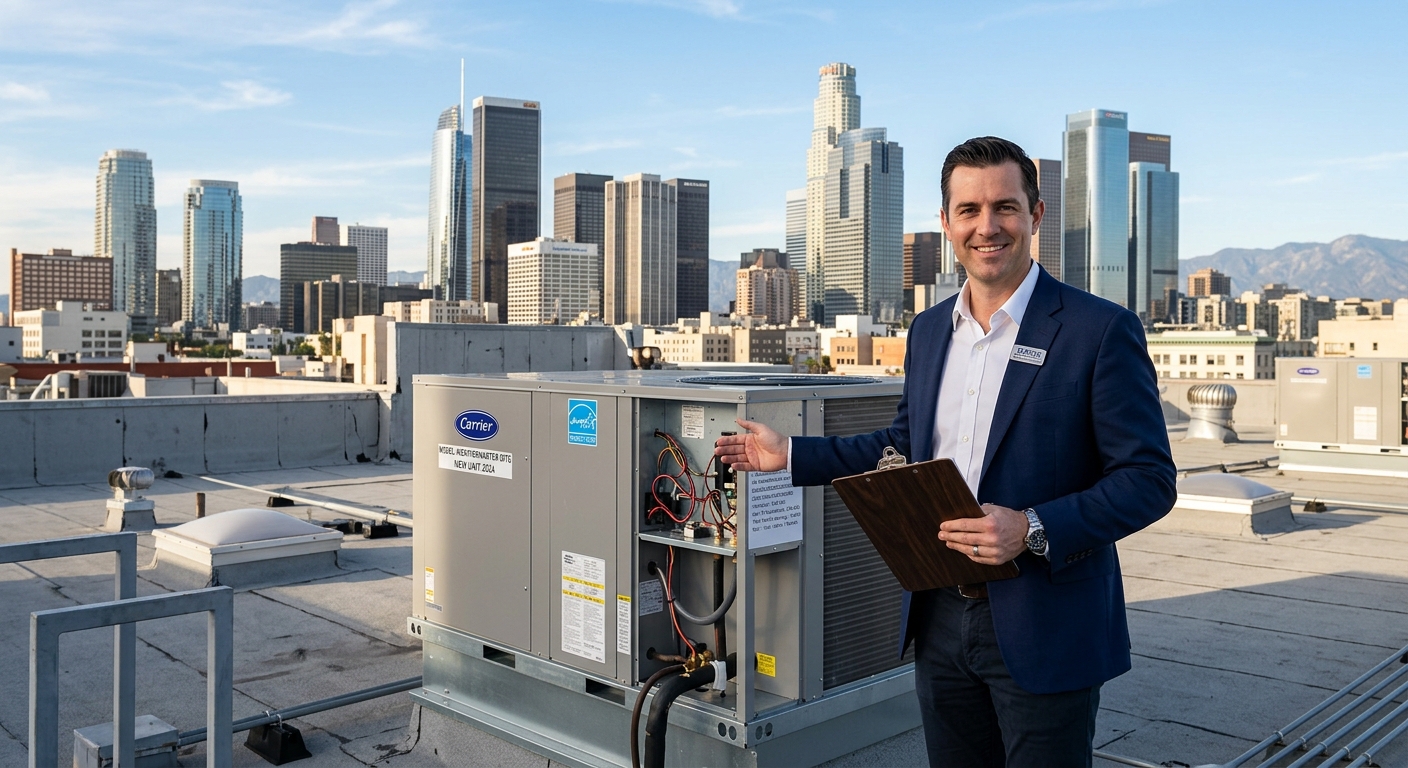
Most California Business Owners Write a Check for a New HVAC System and Miss 60% of the Tax Savings
You spent $85,000 replacing the rooftop HVAC unit at your commercial building last year. Your bookkeeper entered it as a fixed asset. Your tax software spread the deduction over 39 years. And you claimed roughly $2,179 on your 2025 return instead of the full $85,000.
That is not a rounding error. That is a $22,000 tax savings gap sitting on your depreciation schedule because nobody told you that commercial HVAC systems qualify for the Section 179 deduction HVAC 2024 California rules, and the federal write-off landscape shifted dramatically under the One Big Beautiful Bill Act (OBBBA) signed on July 4, 2025.
Here is the short version: the IRS now allows California business owners to expense up to $2,500,000 in qualifying equipment, including HVAC systems, in the year the asset is placed in service rather than depreciating it over decades. But California refuses to follow the federal rules on bonus depreciation, creating a split that costs business owners thousands if they file on autopilot. This guide breaks down exactly how to claim the maximum Section 179 deduction on HVAC equipment, avoid the California nonconformity trap, and keep more cash in your operating account starting with your next return.
Quick Answer
Yes, commercial HVAC equipment qualifies for the Section 179 deduction. Under the OBBBA, the federal Section 179 limit is $2,500,000 for property placed in service in tax years beginning after December 31, 2024, with the phase-out threshold starting at $4,000,000. California caps its own Section 179 deduction at $25,000 and does not allow bonus depreciation at all. A California business owner who installs a $90,000 HVAC system can write off the full amount federally but only $25,000 at the state level, creating a taxable income gap that must be managed with a dual depreciation strategy.
What Qualifies as Section 179 HVAC Equipment Under 2024 and 2025 Rules
Not every heating or cooling unit automatically qualifies for the Section 179 deduction. The IRS draws a clear line between personal property (equipment) and structural components, and getting this classification wrong is one of the most expensive mistakes a business owner can make.
HVAC Systems That Qualify
Under IRC Section 179(d)(1), tangible personal property used in the active conduct of a trade or business qualifies for immediate expensing. For HVAC, the Tax Cuts and Jobs Act of 2017 expanded the definition to include improvements to nonresidential real property, specifically heating, ventilation, and air-conditioning systems. The OBBBA preserved and strengthened this treatment.
Qualifying HVAC equipment includes:
- Rooftop package units (RTUs) for commercial buildings
- Split systems serving office, retail, or warehouse space
- Ductless mini-split systems installed in commercial properties
- Chillers and cooling towers for large commercial facilities
- Boilers and furnaces used exclusively for business heating
- Variable refrigerant flow (VRF) systems
- Dedicated ventilation and air handling units
The system must be installed in a building you own and use for business. Leased equipment under a capital lease may also qualify, but operating leases generally do not. Many business owners overlook this distinction and either miss the deduction entirely or claim it on ineligible property.
The “Placed in Service” Rule That Trips Up Late-Year Purchases
The HVAC system must be placed in service during the tax year you claim the deduction. Placed in service does not mean ordered, paid for, or delivered. It means installed, tested, and ready for use. If you ordered a $120,000 VRF system in November 2025 but the contractor did not finish the installation until January 3, 2026, you cannot claim the Section 179 deduction on your 2025 return. The deduction shifts to 2026.
This timing rule catches California business owners every December. The fix is simple: get a signed completion certificate from your HVAC contractor confirming the date the system became operational. Keep that document with your tax records permanently.
The Federal vs. California Section 179 Gap on HVAC Systems
This is where the real money gets lost. The federal government and California operate on two completely different depreciation schedules, and filing as though they are the same will cost you thousands.
Federal Section 179 Under OBBBA (2025 and Beyond)
| Item | 2024 Rules | 2025+ Rules (OBBBA) |
|---|---|---|
| Section 179 Limit | $1,220,000 | $2,500,000 |
| Phase-Out Threshold | $3,050,000 | $4,000,000 |
| Bonus Depreciation | 60% | 100% (restored permanently) |
| HVAC Eligible | Yes | Yes |
Under the new rules, a business owner who installs a $200,000 HVAC system can deduct the entire amount in year one using Section 179, bonus depreciation, or a combination of both. The OBBBA permanently restored 100% bonus depreciation for qualifying assets, eliminating the phase-down schedule that had reduced it to 60% in 2024.
California Section 179: The $25,000 Cap That Nobody Expects
California Revenue and Taxation Code Sections 17250 and 24356 govern the state’s Section 179 rules. Here is what they allow:
- California Section 179 limit: $25,000
- California phase-out threshold: $200,000
- Bonus depreciation allowed: Zero (California does not conform to IRC Section 168(k))
Read that again. If you spend $200,000 on a new HVAC system, the federal government lets you deduct the full $200,000. California lets you deduct $25,000. The remaining $175,000 must be depreciated on a regular MACRS schedule for California purposes, typically over 39 years for nonresidential real property or 15 years for certain qualified improvement property.
That creates a $175,000 difference in taxable income between your federal and state returns in year one. At California’s top rate of 13.3%, the state tax on that gap could reach $23,275 more than you expected. For a deeper look at how California diverges from federal depreciation rules, explore our California business owner tax strategy hub.
Side-by-Side Example: $90,000 HVAC System
| Deduction Type | Federal (2025) | California (2025) |
|---|---|---|
| Section 179 | $90,000 | $25,000 |
| Bonus Depreciation (remaining) | $0 (fully expensed) | $0 (not allowed) |
| Regular MACRS (remaining) | $0 | $1,667/year (39-year schedule) |
| Year 1 Total Deduction | $90,000 | $25,000 |
| Tax Savings at Top Rate | $33,300 (37%) | $3,325 (13.3%) |
The federal deduction generates $33,300 in immediate tax savings. The California deduction generates $3,325 in year one, with the remaining $65,000 deducted at roughly $1,667 per year over the next 39 years. That is the gap California business owners must plan for.
Five Strategies to Close the Federal-California HVAC Deduction Gap
You cannot change California’s rules, but you can structure your finances to minimize the damage. Our tax planning services are built around exactly this kind of federal-state gap management. Here are five strategies that work.
Strategy 1: Stack Section 179 With the AB 150 PTE Elective Tax
If your business operates as an S Corp or partnership, the AB 150 pass-through entity (PTE) elective tax lets the entity pay California income tax at the entity level. That payment becomes a deductible expense on your federal return, effectively converting a state tax liability into a federal deduction. For HVAC purchases that create large California taxable income, the PTE election can recover $3,000 to $12,000 in additional federal savings depending on your income level and filing status.
Strategy 2: Use the Section 168(k)(7) Election Strategically
Section 168(k)(7) allows you to elect out of bonus depreciation for a specific class of property. Why would you do that? Because if you are already taking the full Section 179 deduction federally, you may not need bonus depreciation at all. Electing out of 168(k) for that asset class simplifies your dual depreciation schedule and reduces the California adjustment you need to track. This is especially useful when your HVAC purchase falls below the Section 179 limit.
Strategy 3: Time Your HVAC Purchase With Income Fluctuations
Section 179 deductions cannot create a business loss. If your net business income for the year is $60,000 and your HVAC system costs $90,000, you can only deduct $60,000 under Section 179 (the remaining $30,000 carries forward). If you expect a high-revenue year, accelerating your HVAC replacement into that year maximizes the deduction. If you want to model your projected tax liability before purchasing, plug your business numbers into this small business tax calculator to see the impact.
Strategy 4: Pair HVAC With Retirement Contribution Offsets
A large Section 179 deduction on your federal return creates a gap with California. You can offset that California-side taxable income by maximizing retirement contributions. A Solo 401(k) allows up to $69,000 in combined contributions for 2025 (or $76,500 if you are 60 to 63 under the OBBBA catch-up provision). That contribution reduces both your federal and California taxable income, shrinking the gap from both directions.
Strategy 5: Consider a Cost Segregation Study for the Entire Building
If you own the commercial building where the HVAC system is installed, a cost segregation study reclassifies building components into shorter depreciation lives. Electrical wiring, ductwork, plumbing, and certain finishes can be moved from 39-year property to 5-year, 7-year, or 15-year property. This accelerates your federal depreciation beyond just the HVAC unit and can generate an additional $15,000 to $50,000 in first-year deductions depending on the building’s value and age.
The Five Costliest Mistakes California Business Owners Make on HVAC Deductions
Mistake 1: Treating the HVAC as a Repair Instead of a Capital Improvement
If you replace an entire HVAC system, the IRS considers that a capital improvement, not a repair. Capital improvements are depreciable assets eligible for Section 179. Repairs (replacing a compressor, fixing a thermostat) are expensed immediately under the ordinary and necessary business expense rules of IRC Section 162. The problem arises when business owners try to deduct a full system replacement as a repair, which triggers audit flags, or when they treat a repair as a capital improvement and miss the immediate deduction.
Red Flag Alert: The IRS uses the “betterment, adaptation, or restoration” test under Treasury Regulation 1.263(a)-3 to determine whether your HVAC work is a repair or improvement. If the work adapts the unit to a new use, restores it to like-new condition, or materially increases its capacity, it is a capital improvement. Document the scope of work with your contractor before filing.
Mistake 2: Filing One Depreciation Schedule for Both Federal and State
Your tax software may default to a single depreciation schedule. That schedule will either match the federal deduction (overstating your California deduction and triggering an FTB adjustment) or match the California deduction (understating your federal deduction and costing you thousands). You must maintain two separate depreciation schedules for every asset where federal and California treatment differs. Period.
Mistake 3: Missing the Business-Use Percentage Requirement
If the HVAC system serves a mixed-use building (part business, part personal residence), only the business-use portion qualifies for Section 179. A building that is 70% business use and 30% personal use on a $100,000 HVAC system means only $70,000 is eligible. Overstating business use is one of the top FTB audit triggers for California commercial property owners.
Mistake 4: Ignoring the Phase-Out Threshold
The federal Section 179 deduction phases out dollar-for-dollar once total qualifying purchases exceed $4,000,000 in a tax year (under OBBBA). California’s phase-out starts at just $200,000. If you spent $210,000 on qualifying equipment in 2025 (HVAC plus other assets), your California Section 179 deduction drops to $15,000 ($25,000 minus the $10,000 excess over $200,000). Miss this calculation and your California return will be wrong.
Mistake 5: Forgetting the Energy Efficiency Tax Credits
The Section 179D energy-efficient commercial building deduction can stack with your Section 179 deduction for HVAC. If your new HVAC system meets ASHRAE 90.1 energy efficiency standards and is installed in a building you own, you may qualify for a deduction of up to $5.00 per square foot under Section 179D. On a 10,000-square-foot building, that is an additional $50,000 deduction that most business owners never claim because their tax preparer does not ask about energy efficiency certifications.
KDA Case Study: Sacramento Restaurant Owner Saves $28,700 on a $95,000 HVAC Replacement
Daniel operated a 4,200-square-foot full-service restaurant in midtown Sacramento. His 18-year-old rooftop HVAC system failed during a July heat wave, and he replaced it with a high-efficiency VRF system for $95,000. His previous CPA planned to depreciate the system over 39 years, which would have generated a first-year federal deduction of $2,436 and a California deduction of $2,436.
KDA restructured the deduction using three strategies. First, we claimed the full $95,000 under Section 179 on Daniel’s federal return, generating $35,150 in immediate federal tax savings at his 37% marginal rate. Second, we filed the California return with the $25,000 Section 179 cap and set up the dual depreciation schedule for the remaining $70,000. Third, we filed the AB 150 PTE elective tax through Daniel’s S Corp, converting $8,400 of California state tax into a federal deduction worth an additional $3,108.
We also identified that Daniel’s HVAC system met ASHRAE 90.1 standards and qualified for a partial Section 179D deduction of $12,600, which his previous preparer had never explored.
Total first-year tax savings: $28,700
KDA fee: $4,200
ROI: 6.8x in year one
Ready to see how we can help you? Explore more success stories on our case studies page to discover proven strategies that have saved our clients thousands in taxes.
What If My HVAC System Costs More Than My Business Income?
This happens more often than you would think. A business owner nets $50,000 in profit and installs an $80,000 HVAC system. Section 179 cannot create a loss, so the deduction is limited to $50,000 for the current year. The remaining $30,000 carries forward indefinitely under IRC Section 179(b)(3)(B) and can be deducted in future years when business income is sufficient.
However, bonus depreciation under Section 168(k) does not have the same income limitation. If you have other income sources (W-2 wages, rental income, investment income), 100% bonus depreciation can create or increase a net operating loss that offsets those other income sources. This is a planning opportunity that requires careful coordination between your federal and California returns because California does not allow bonus depreciation at all.
Can I Claim Section 179 on a Used HVAC System?
Yes. One of the most overlooked features of Section 179 is that qualifying property does not need to be new. If you purchase a used HVAC system for your commercial building, it qualifies as long as it is new to you (you did not previously own it), it is used in your business, and it meets the placed-in-service requirements. This is different from the pre-TCJA rules that restricted bonus depreciation to new property only. Under current law, both new and used HVAC equipment qualify for Section 179 and bonus depreciation at the federal level.
Will Claiming the Full Section 179 Deduction on HVAC Trigger an Audit?
Claiming a legitimate Section 179 deduction does not, by itself, trigger an audit. The IRS expects business owners to use this deduction. According to IRS Publication 946, the Section 179 deduction is specifically designed for business owners who want to expense qualifying assets in the year they are placed in service.
What does trigger audits is misclassification. Claiming a full HVAC replacement as a repair under Section 162, overstating business-use percentage, or failing to maintain documentation of the placed-in-service date are the red flags. The California FTB is particularly aggressive about verifying that business owners are not applying federal bonus depreciation rates on their state returns. Keep your dual depreciation schedules accurate and your contractor invoices organized.
Pro Tip: Maintain a separate file for every HVAC-related document: the purchase contract, contractor invoices, completion certificate with the placed-in-service date, ASHRAE certification (if applicable), and photographs of the installed system. If the FTB or IRS ever questions the deduction, this file resolves the inquiry in one response.
Year-End Checklist for Claiming Section 179 on HVAC in California
- Confirm the system is placed in service before December 31 with a signed contractor completion certificate
- Verify your total qualifying purchases against both the federal $4,000,000 and California $200,000 phase-out thresholds
- Calculate your net business income to ensure the Section 179 deduction does not exceed it (carry forward the excess)
- Set up dual depreciation schedules for federal and California returns on the same asset
- Determine business-use percentage if the building serves mixed personal and business purposes
- Check Section 179D eligibility by requesting ASHRAE 90.1 certification from your HVAC installer
- Evaluate AB 150 PTE election if operating as an S Corp or partnership to offset the California gap
- File Form 4562 (Depreciation and Amortization) with your federal return to claim the Section 179 deduction
- Complete California Form 3885A (Depreciation and Amortization Adjustments) to reflect the state-level differences
- Document everything including invoices, contracts, energy certifications, and completion dates
Ready to Reduce Your Tax Bill?
KDA Inc. specializes in strategic tax planning for business owners, S Corps, LLCs, and high-net-worth individuals. Book a personalized consultation and walk away with a clear plan.
Frequently Asked Questions
Does the Section 179 deduction apply to residential rental property HVAC?
No. Section 179 applies to property used in the active conduct of a trade or business. Residential rental property is considered passive activity under IRC Section 469, and HVAC systems in residential rentals are typically depreciated over 27.5 years using standard MACRS. However, if you operate a short-term rental that qualifies as a business (you materially participate and the average guest stay is seven days or fewer), the HVAC system may qualify. Consult a tax strategist before claiming this.
Can I claim Section 179 on HVAC if I lease the building?
Generally, no. Section 179 requires you to be the owner of the property. However, qualified leasehold improvements made by a tenant may qualify under certain conditions. If you, as a tenant, installed a new HVAC system in a leased commercial space and the lease does not require the landlord to make such improvements, you may have a claim. The classification depends on whether the improvement is considered the tenant’s property under the lease terms.
What is the difference between Section 179 and bonus depreciation for HVAC?
Section 179 lets you choose which assets to expense up to the annual limit ($2,500,000 federally) and cannot create a loss. Bonus depreciation under Section 168(k) applies automatically to all qualifying assets (unless you elect out), has no dollar limit, and can create a loss. For California, Section 179 is capped at $25,000 and bonus depreciation is not allowed at all. Strategically, most California business owners should maximize Section 179 first, then apply bonus depreciation to the remainder on their federal return only.
This information is current as of 3/30/2026. Tax laws change frequently. Verify updates with the IRS or FTB if reading this later.
“The IRS built Section 179 so business owners could reinvest in their operations without waiting 39 years to recover the cost. The ones who actually use it are the ones who keep their cash flow alive.”
Book Your HVAC Tax Savings Consultation
If you recently installed or are planning to install a commercial HVAC system in California, the difference between a $2,400 deduction and a $90,000 deduction comes down to how your return is prepared. Stop leaving five figures on your depreciation schedule. Book a personalized consultation with our strategy team and we will map your federal Section 179 deduction, set up your dual California depreciation schedule, evaluate your AB 150 PTE election, and identify any Section 179D energy credits you are missing. Click here to book your consultation now.



