
What Are Social Security Taxes and Why Do They Matter?
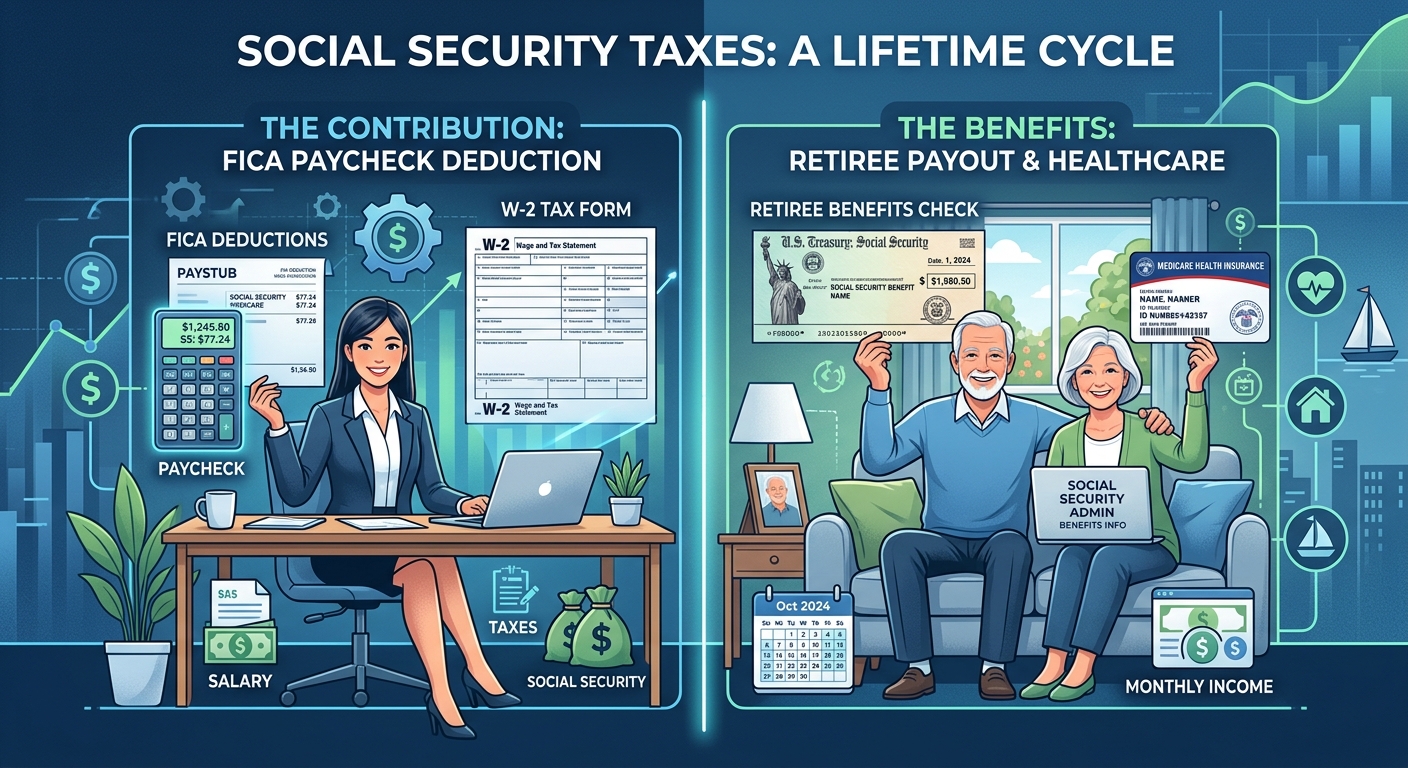
Social security taxes are mandatory payroll taxes that fund retirement, disability, and survivor benefits through the Federal Insurance Contributions Act (FICA). In 2026, employees pay 6.2% on wages up to $176,100, while employers match that amount, totaling 12.4%. Self-employed individuals pay the full 12.4% through self-employment tax. This means a W-2 employee earning $100,000 will pay $6,200 in Social Security tax, while their employer contributes another $6,200.
Most taxpayers accept this deduction as inevitable, but here’s what you’re missing: understanding how Social Security taxes work unlocks strategies to minimize what you pay today while maximizing what you receive tomorrow. If you’re self-employed, you could be overpaying by thousands. If you’re a high earner, you might hit the wage base cap without realizing the planning opportunities that creates. And if you’re approaching retirement, the timing of when you claim benefits could mean a $50,000 difference over your lifetime.
Quick Answer: How Social Security Taxes Work in 2026
For 2026, social security taxes in 2026 operate under these core rules: employees pay 6.2% on earnings up to $176,100 (the wage base limit), employers match that 6.2%, and self-employed individuals pay both portions for a total of 12.4%. Medicare tax adds another 1.45% each for employee and employer (2.9% total for self-employed) with no wage cap. High earners pay an additional 0.9% Medicare surtax on wages above $200,000 (single) or $250,000 (married filing jointly).
Who Pays Social Security Taxes and How Much?
The answer depends entirely on your employment status and income level. Let’s break down the three main taxpayer categories and what you actually owe.
W-2 Employees: The Standard FICA Withholding
If you receive a W-2, your employer withholds 6.2% of your gross wages for Social Security tax and 1.45% for Medicare tax (total: 7.65%). Your employer matches both amounts. This is non-negotiable and happens automatically with every paycheck.
Here’s what that looks like in real numbers. Sarah, a marketing manager in Sacramento, earns $85,000 annually. Her Social Security tax withholding is $5,270 per year ($85,000 × 6.2%). Her employer pays another $5,270. Add Medicare tax ($1,232.50 each), and the total FICA burden is $13,005, split evenly between Sarah and her employer.
Once your wages exceed $176,100 in 2026, Social Security tax withholding stops for the rest of the year. Medicare tax continues on all wages with no cap. If you earn $200,000, you’ll pay the maximum Social Security tax of $10,918.20 ($176,100 × 6.2%), plus Medicare tax on your full $200,000 ($2,900), and you’ll face the additional Medicare tax of 0.9% on the $200,000 minus $200,000 threshold (which in this case equals zero because you’re right at the threshold).
Self-Employed Individuals: Paying Both Sides
If you’re a 1099 contractor, freelancer, or sole proprietor, you pay both the employee and employer portions of FICA through self-employment tax. That’s 12.4% for Social Security and 2.9% for Medicare, totaling 15.3% on your net business income.
Marcus runs a digital marketing consultancy as a sole proprietor and nets $120,000 after business expenses. His self-employment tax calculation works like this: $120,000 × 92.35% = $110,820 (the IRS allows you to reduce your net earnings by 7.65% to account for the employer-equivalent portion). Then multiply $110,820 × 15.3% = $16,955 in total self-employment tax.
The good news? You can deduct half of your self-employment tax ($8,478 in Marcus’s case) as an adjustment to income on your Form 1040. This doesn’t eliminate the tax, but it reduces your adjusted gross income, which can lower your overall tax bill and potentially preserve eligibility for other deductions and credits.
If Marcus converted to an S Corp and paid himself a reasonable salary of $70,000, he’d only pay FICA taxes on that amount. His remaining $50,000 in distributions would avoid self-employment tax entirely, saving him approximately $7,650 annually. This is precisely the type of strategy we help clients implement through our tax planning services.
High-Income Earners: The Wage Base Cap and Additional Medicare Tax
Once your wages hit $176,100 in 2026, you stop paying Social Security tax for the rest of the year. But Medicare tax never stops, and high earners face an extra 0.9% Additional Medicare Tax on wages exceeding $200,000 (single) or $250,000 (married filing jointly).
Jennifer, a software engineer in San Francisco, earns $280,000 annually. Her Social Security tax caps at $10,918.20 ($176,100 × 6.2%). Her Medicare tax is $4,060 ($280,000 × 1.45%). Because she earns over $200,000, she also pays Additional Medicare Tax on the excess: ($280,000 – $200,000) × 0.9% = $720. Her total FICA burden is $15,698.20.
Her employer does not match the Additional Medicare Tax. That 0.9% is entirely on the employee. Employers are responsible for withholding it once wages exceed $200,000, regardless of the employee’s filing status or spouse’s income.
How Social Security Taxes Fund Your Retirement Benefits
Every dollar you pay in Social Security taxes doesn’t disappear into a black hole. The Social Security Administration tracks your earnings history and uses it to calculate your future retirement benefit. The more you earn (up to the wage base limit), the higher your eventual monthly benefit.
Your benefit calculation is based on your 35 highest-earning years, adjusted for wage inflation. If you don’t work 35 years, the SSA averages in zeros for the missing years, which dramatically reduces your benefit. This is critical for anyone with gaps in their work history, stay-at-home parents, or those who took time off for caregiving.
How Much Will You Actually Receive?
The average Social Security retirement benefit in 2026 is approximately $1,920 per month, or $23,040 per year. But that’s an average. High earners who consistently maxed out the wage base can receive up to $4,018 per month at full retirement age (67 for those born in 1960 or later).
If you claim benefits early at age 62, your monthly benefit is permanently reduced by up to 30%. If you delay until age 70, you earn delayed retirement credits that increase your benefit by 8% per year beyond full retirement age. For someone entitled to $3,000 per month at age 67, waiting until 70 increases that to $3,720 per month. Over a 20-year retirement, that’s an extra $172,800.
Here’s the planning opportunity most people miss: if you’re still working and can afford to delay benefits, you can continue building your earnings record while letting your future benefit grow. This is especially valuable for self-employed individuals who may have had inconsistent income in their earlier years.
Common Mistakes That Cost Taxpayers Thousands
Social Security taxes seem automatic and unavoidable, but poor planning leads to overpayment, missed deductions, and smaller retirement benefits. Here are the most expensive mistakes we see.
Mistake 1: Self-Employed Individuals Not Optimizing Entity Structure
Staying a sole proprietor when you should be an S Corp is the single most common self-employment tax mistake. If your net business income exceeds $60,000, you’re likely overpaying by $5,000 to $10,000 annually.
Take Kevin, a freelance video producer netting $95,000. As a sole proprietor, he pays $14,551 in self-employment tax. If he elects S Corp status and pays himself a reasonable salary of $60,000, his FICA taxes drop to $9,180 (combined employee and employer portions on $60,000). The remaining $35,000 in distributions avoids self-employment tax entirely, saving him $5,371 per year.
The IRS requires S Corp owners to pay themselves a “reasonable salary” before taking distributions. What’s reasonable? It depends on your industry, role, location, and hours worked. A CPA who does $200,000 in revenue can’t pay themselves $30,000 and take $170,000 in distributions without raising red flags. But properly structured, this is one of the most powerful tax-saving strategies available.
Mistake 2: Not Understanding the Wage Base Cap
High earners often don’t realize when they hit the Social Security wage base cap mid-year. If you have two jobs or switch employers, both may withhold Social Security tax, causing you to overpay. The IRS will eventually refund the excess when you file your return, but you’ve given the government an interest-free loan for months.
Danielle worked for two employers in 2026. Her first job paid $120,000 (January through August), and her second job paid $80,000 (September through December). Both employers withheld Social Security tax on their full payroll, totaling $12,400 in withholding. But Danielle’s total wages of $200,000 should only trigger $10,918.20 in Social Security tax (6.2% of the first $176,100). She overpaid by $1,481.80, which she can claim as a credit on Line 11 of her Form 1040.
Mistake 3: Ignoring the Impact of Retirement Benefit Timing
Claiming Social Security benefits at the earliest possible age (62) is often the wrong move financially, yet millions of Americans do it every year. The break-even analysis matters.
If you’re entitled to $2,500 per month at full retirement age (67) but claim at 62, your benefit drops to $1,750 per month (a 30% reduction). That’s $9,000 less per year, every year, for the rest of your life. If you live to 85, you’ll collect $162,000 less in total benefits. The only scenario where claiming early makes sense is if you have serious health issues or desperately need the income.
Conversely, delaying benefits from 67 to 70 increases your $2,500 monthly benefit to $3,100 (a 24% increase). If you live to 85, that’s an additional $108,000 in lifetime benefits. For married couples, the higher earner should almost always delay to maximize survivor benefits.
Mistake 4: Forgetting About the Earned Income Test
If you claim Social Security benefits before reaching full retirement age and continue working, the SSA will reduce your benefits by $1 for every $2 you earn above $23,400 (2026 threshold). In the year you reach full retirement age, the reduction drops to $1 for every $3 above a higher threshold ($62,160 in 2026), and it only applies to months before your birthday.
James retired at 63 and started collecting $1,800 per month in Social Security benefits. He also took a part-time consulting gig earning $40,000 annually. Because he earned $16,600 over the $23,400 threshold, the SSA reduced his annual benefits by $8,300 ($16,600 ÷ 2). He lost nearly five months of benefits. Had he known about the earnings test, he could have structured his consulting income differently or delayed claiming benefits altogether.
KDA Case Study: Self-Employed Consultant Saves $6,400 Annually
Rachel, a management consultant in Los Angeles, came to KDA netting $115,000 as a sole proprietor. She was paying $17,630 in self-employment tax every year and felt trapped. She assumed that was just the cost of working for herself.
We analyzed her situation and recommended an S Corp election with a reasonable salary of $75,000. Here’s what changed: her FICA taxes on salary totaled $11,475 (employee and employer portions combined). The remaining $40,000 in distributions avoided self-employment tax entirely. Her annual tax savings: $6,155. Over five years, that’s $30,775 in her pocket instead of the IRS’s.
Rachel paid $2,750 for S Corp setup, tax planning, and payroll services in year one. Her return on investment was 2.2x in the first year alone. She now reinvests her tax savings into retirement accounts and business growth.
Ready to see how we can help you? Explore more success stories on our case studies page to discover proven strategies that have saved our clients thousands in taxes.
Special Situations: Social Security Taxes for Different Taxpayer Types
Real Estate Investors and Rental Income
Rental income is not subject to Social Security or Medicare taxes because it’s considered passive income, not earned income. If you own three rental properties generating $45,000 in net rental income annually, you don’t pay a dime in FICA taxes on that money.
But if you’re a real estate professional who materially participates in rental activities (more than 750 hours per year and more than half your working time), your rental income could be reclassified as active business income. In that case, operating as an S Corp and paying yourself a salary while taking the rest as distributions could reduce self-employment tax exposure.
Clergy and Religious Workers
Ministers and clergy are considered self-employed for Social Security tax purposes, even if they receive a W-2 from their church. This means they pay the full 15.3% self-employment tax on their ministerial income, including housing allowances (even though housing allowances are exempt from income tax).
This creates a unique planning challenge. A pastor earning $60,000 in salary plus a $20,000 housing allowance pays self-employment tax on the full $80,000, even though only $60,000 is subject to income tax. The self-employment tax bill is $12,240. Many clergy don’t realize they can make quarterly estimated tax payments to avoid a massive tax bill at year-end.
Government Employees and Pensions
Some state and local government employees don’t pay into Social Security because their employer offers a pension plan instead. If you worked in one of these positions and later moved to Social Security-covered employment, you could be subject to the Windfall Elimination Provision (WEP), which reduces your Social Security benefit.
The WEP can cut your benefit by up to 50% of your pension amount (but no more than $587 per month in 2026). If you’re entitled to a $1,800 monthly Social Security benefit and receive a $1,400 monthly pension from non-covered employment, the WEP could reduce your Social Security benefit by $587, dropping it to $1,213 per month.
What Happens If You Don’t Pay Social Security Taxes?
For W-2 employees, this isn’t a choice. Your employer is legally required to withhold FICA taxes, and if they fail to do so, they face severe penalties, not you. But if your employer doesn’t withhold and doesn’t remit those taxes to the IRS, you could end up with zero Social Security credits for that year, which reduces your future benefits.
For self-employed individuals, failing to pay self-employment tax is far more serious. If you don’t report your self-employment income or pay the associated taxes, the IRS will assess penalties and interest. The failure-to-pay penalty is 0.5% per month (up to 25% of the unpaid tax), plus interest compounding daily. On a $15,000 self-employment tax bill, you could owe an additional $3,750 in penalties plus interest within two years.
Worse, if the IRS determines you willfully evaded self-employment taxes, you could face criminal charges. The agency has been ramping up enforcement on gig economy workers and 1099 contractors who underreport income. In 2026, the IRS is using enhanced data matching from payment processors (thanks to the $600 Form 1099-K reporting threshold) to catch unreported income.
Red Flag Alert: Misclassifying Employees as Independent Contractors
Some business owners try to avoid paying the employer portion of FICA taxes by classifying workers as 1099 contractors instead of W-2 employees. This is illegal if the worker meets the IRS definition of an employee (which focuses on behavioral control, financial control, and relationship type).
If the IRS reclassifies your contractors as employees, you’ll owe back taxes for both the employee and employer portions of FICA, plus penalties and interest. You could also face state employment tax assessments, workers’ compensation claims, and lawsuits from the misclassified workers. The total cost can easily exceed $50,000 for a small business with just a few misclassified workers.
Ready to Reduce Your Tax Bill?
KDA Inc. specializes in strategic tax planning for business owners, S Corps, LLCs, and high-net-worth individuals. Book a personalized consultation and walk away with a clear plan.
Frequently Asked Questions About Social Security Taxes
Do I pay Social Security taxes on investment income, dividends, or capital gains?
No. Social Security and Medicare taxes only apply to earned income (wages, salaries, self-employment income). Investment income, interest, dividends, and capital gains are exempt from FICA taxes. This is one reason why high-net-worth individuals structure their wealth to generate more investment income and less ordinary income.
Can I opt out of paying Social Security taxes?
In almost all cases, no. The only exceptions are certain religious groups (like the Amish) who have obtained formal exemptions, some foreign government employees, and students working for their university. Everyone else is required to participate in the Social Security system.
Self-employed individuals sometimes ask if they can avoid self-employment tax by not filing a tax return. The answer is no. If your net self-employment income exceeds $400, you are legally required to file a return and pay self-employment tax. Not filing doesn’t exempt you; it makes you a tax evader.
What if I work multiple jobs and overpay Social Security tax?
If you have more than one employer and your total wages exceed $176,100, your employers will collectively withhold more than the maximum Social Security tax. You can claim the excess as a credit on Line 11 of Form 1040. The IRS will refund the overpayment when you file your return.
Do Social Security taxes apply to bonuses, stock options, or RSUs?
Yes. Bonuses, commissions, restricted stock units (RSUs), and stock option exercises are considered wages and are subject to Social Security and Medicare taxes (up to the wage base limit for Social Security). If you receive a $30,000 bonus in 2026, you’ll pay $2,295 in Social Security tax and $435 in Medicare tax on that bonus.
How do I calculate self-employment tax if I have both W-2 wages and 1099 income?
Your W-2 wages count toward the Social Security wage base cap first. If your W-2 wages are $150,000 and your net self-employment income is $50,000, you only pay Social Security tax on the first $26,100 of self-employment income ($176,100 cap minus $150,000 W-2 wages). You still pay the full 2.9% Medicare tax on all self-employment income.
California-Specific Considerations
California does not impose a state-level Social Security or Medicare tax. FICA taxes are entirely federal. However, California has its own State Disability Insurance (SDI) tax, which is withheld from employee wages at a rate of 1.1% (2026) on wages up to $168,190. This is separate from Social Security and funds California’s disability and paid family leave programs.
Self-employed individuals in California are not required to pay into SDI, but they can voluntarily opt into the Disability Insurance Elective Coverage program if they want access to state disability benefits. Most self-employed Californians skip this and rely on private disability insurance instead.
If you operate an S Corp in California, you must pay yourself a reasonable salary subject to both federal FICA taxes and California SDI. The combined burden is significant: on a $100,000 salary, you’re paying $7,650 in FICA (employee portion), $7,650 in employer FICA, and $1,100 in SDI. Proper planning around salary levels is critical to optimizing your total tax burden.
This information is current as of 3/23/2026. Tax laws change frequently. Verify updates with the IRS or FTB if reading this later.
Pro Tips for Minimizing Social Security Tax Legally
You can’t avoid Social Security taxes entirely, but you can structure your income to minimize them. Here’s what actually works.
Pro Tip 1: If you’re self-employed with net income above $60,000, model an S Corp election. The tax savings on self-employment tax often exceed $5,000 annually, even after accounting for payroll costs.
Pro Tip 2: Maximize pre-tax retirement contributions. While this doesn’t reduce Social Security tax (because contributions are made from wages already subject to FICA), it lowers your overall tax liability and helps you build wealth faster. A self-employed individual can contribute up to $69,000 to a solo 401(k) in 2026 (including employer profit-sharing contributions).
Pro Tip 3: If you’re married and one spouse has significantly higher lifetime earnings, have the higher earner delay Social Security benefits until age 70. This maximizes the survivor benefit, which is critical for the lower-earning spouse’s financial security.
Pro Tip 4: Review your Social Security earnings statement annually at ssa.gov/myaccount. Errors happen, and if your employer didn’t properly report your wages, you could lose credits toward your retirement benefit. You have three years, three months, and 15 days from the end of the taxable year to correct earnings discrepancies.
Pro Tip 5: If you’re approaching the wage base cap and expect a large year-end bonus, consider deferring it to the following year if you’ve already maxed out Social Security tax for the current year. This doesn’t save you money on the bonus itself, but it gives you more control over the timing of income for other tax planning strategies.
Bottom Line: Social Security Taxes Are Mandatory, But Planning Isn’t Optional
You will pay Social Security taxes as long as you earn income. That’s non-negotiable. But how much you pay, how you structure your income, and when you claim benefits are entirely within your control. The difference between passive acceptance and strategic planning is tens of thousands of dollars over your lifetime.
If you’re self-employed and haven’t evaluated an S Corp election, you’re likely overpaying by $5,000 to $10,000 every year. If you’re a high earner and don’t understand the wage base cap, you might be missing opportunities to optimize bonuses and equity compensation. If you’re approaching retirement and haven’t run the break-even analysis on benefit timing, you could leave $50,000 or more on the table.
Social Security taxes fund a critical safety net, but that doesn’t mean you should pay more than legally required. The tax code rewards taxpayers who plan ahead, structure intelligently, and seek expert guidance.
Stop Overpaying Social Security Taxes
If you’re a business owner, 1099 contractor, or high-income W-2 employee, you’re likely paying more in Social Security taxes than you need to. We specialize in helping taxpayers minimize FICA exposure, optimize entity structures, and maximize lifetime retirement benefits. Don’t leave thousands on the table because you didn’t ask the right questions. Book your tax strategy session now and discover exactly how much you could be saving.



