
You bought the house. You love the house. Now you’re filing taxes and realizing that the mortgage deduction limitation just shrank your refund by $2,700.
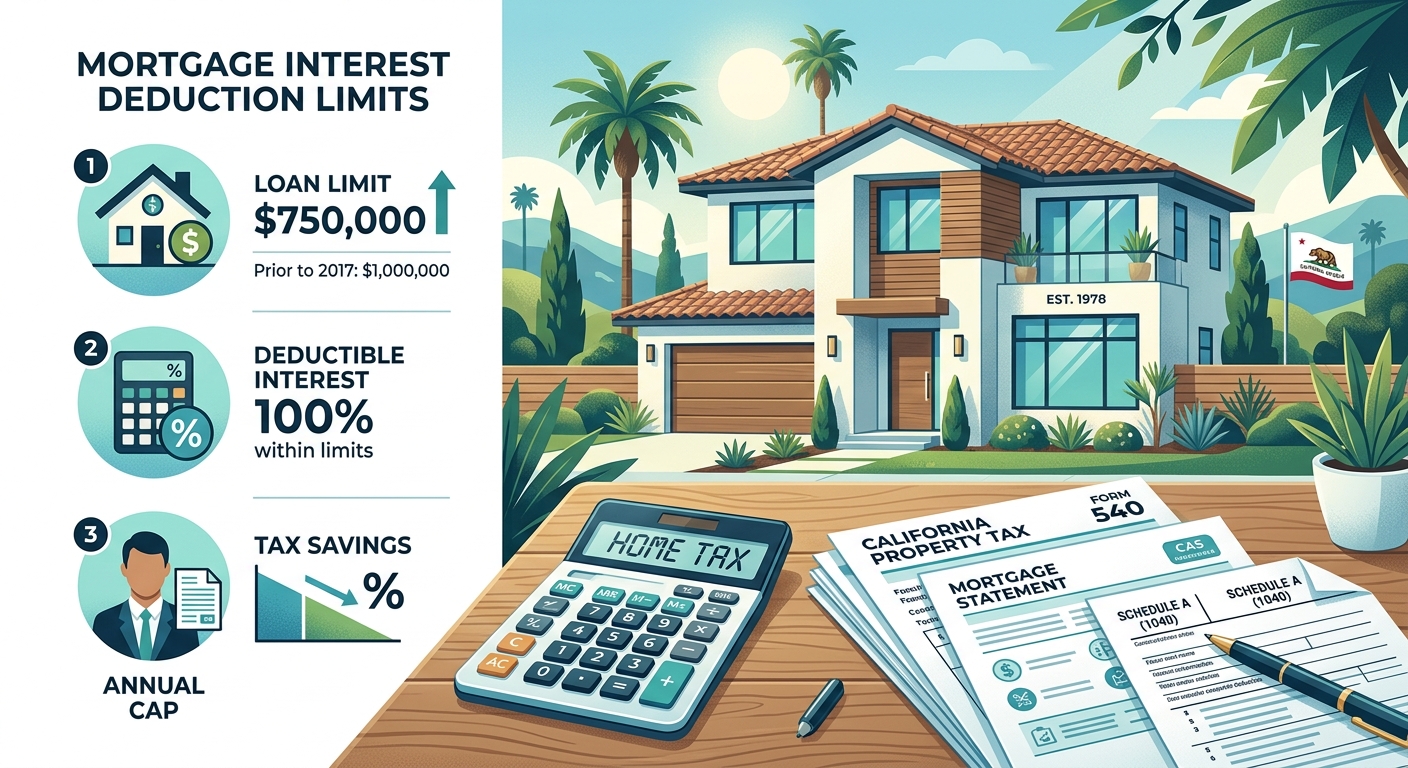
Here’s the thing: the mortgage interest deduction is no longer the golden ticket it used to be. Thanks to TCJA changes still in effect for 2026, the deduction caps out at interest paid on $750,000 of mortgage debt for married couples filing jointly (or $375,000 for single filers). If you bought your home before December 15, 2017, you’re grandfathered into the old $1 million limit. But for most California homeowners who bought in the past eight years, you’re living under the new rules.
And California? Your property values make this hurt more than anywhere else in the country.
Quick Answer
The mortgage interest deduction is limited to interest paid on up to $750,000 of qualified mortgage debt for homes purchased after December 15, 2017. This cap applies to your combined first and second mortgages. If your loan exceeds this threshold, only a portion of your interest is deductible. For California homeowners with high-value properties, this often means leaving thousands in potential deductions on the table.
What Is the Mortgage Deduction Limitation?
Mortgage deduction limitation refers to the IRS cap on how much mortgage debt you can use to calculate your itemized mortgage interest deduction. Under current law, you can only deduct interest paid on up to $750,000 of acquisition debt ($375,000 if married filing separately). This means if you have a $1.2 million mortgage, only the interest attributable to the first $750,000 qualifies for the deduction.
This rule applies to loans taken out after December 15, 2017. If you purchased or refinanced your home before that date, you’re grandfathered into the old $1 million limit ($500,000 married filing separately). The limitation also applies to your combined mortgage debt across all qualified residences, including your primary home and one second home.
For example, if you have an $850,000 mortgage at 6.5% interest, you’ll pay about $55,250 in interest annually. But only the interest on $750,000 of that loan (roughly $48,750) is deductible. The remaining $6,500 in interest payments? That’s just gone. You pay it, but you can’t write it off.
Why This Matters More in California Than Anywhere Else
California median home prices sit well above national averages. In coastal markets like San Francisco, Los Angeles, and San Diego, a $750,000 mortgage doesn’t buy you much. The median home price in Los Angeles County was $885,000 as of early 2026. In San Francisco, it’s over $1.3 million. That means a huge percentage of California homeowners are automatically subject to the mortgage deduction limitation, even on modest single-family homes.
The Double Hit: SALT Cap Plus Mortgage Cap
California homeowners face a compounding problem. Not only is your mortgage interest deduction capped, but the state and local tax (SALT) deduction is also limited to $40,000 for tax years 2025 through 2029 under the One Big Beautiful Bill Act (OBBBA). For many high-earning California taxpayers, that SALT cap eliminates most of the benefit from deducting state income taxes and property taxes.
Between these two caps, California homeowners in the $200,000 to $500,000 income range often find that itemizing barely beats the standard deduction of $31,500 (married filing jointly). If your total itemized deductions (mortgage interest, SALT, charitable contributions) come in under that threshold, you’re better off taking the standard deduction and losing the mortgage benefit entirely.
When Does the Mortgage Cap Actually Cost You Money?
Let’s be specific. You lose money to the mortgage deduction limitation when:
- Your mortgage exceeds $750,000 and you’re itemizing deductions
- You’re in the 24% tax bracket or higher (making the lost deduction worth more)
- You refinanced after December 15, 2017, and lost your grandfathered status
- You took out a home equity loan or HELOC that pushes your total debt over the cap
Here’s the math: If you have a $1 million mortgage at 6.5% interest, you’ll pay $65,000 in interest annually. Under the cap, only interest on $750,000 ($48,750) is deductible. That’s $16,250 in interest you can’t deduct. If you’re in the 32% federal tax bracket, that limitation costs you $5,200 in additional federal taxes every single year.
Real-World Scenario: How the Cap Plays Out
Meet David and Sarah, a dual-income couple living in Irvine, California. They bought their home in 2022 for $1.1 million with a 20% down payment, financing $880,000 at 5.75% interest. Their annual mortgage interest? About $50,600.
Because their mortgage exceeds the $750,000 cap, only $42,840 of that interest is deductible (the portion attributable to the first $750,000). The remaining $7,760 in interest payments is non-deductible. In the 24% federal tax bracket, that limitation costs them $1,862 in additional federal taxes annually.
Add in California’s SALT cap (which limits their property tax and state income tax deduction to $40,000 combined), and their total itemized deductions barely clear the standard deduction threshold. After running the numbers with KDA, David and Sarah discovered they were itemizing for a total benefit of just $3,100 over the standard deduction. Most of their mortgage interest was functionally wasted as a tax strategy.
What We Did
We restructured their approach entirely. Instead of relying on itemized deductions, we helped David maximize his 401(k) and HSA contributions, which reduced their AGI by $31,500. Sarah converted her side consulting income into an S Corp, allowing her to take the 20% qualified business income deduction on $48,000 in net profit, saving an additional $2,304 in federal taxes.
Total first-year tax savings: $8,900. What they paid KDA: $3,200. First-year ROI: 2.8x.
KDA Case Study: Pasadena Real Estate Investor
Jason, a 42-year-old software engineer, bought his primary residence in Pasadena in 2023 for $1.4 million with a $1.12 million mortgage at 6.25%. His annual mortgage interest: $70,000. Problem? Only interest on $750,000 of that debt was deductible, leaving $23,000 in annual interest payments providing zero tax benefit.
Jason came to KDA frustrated that he was “doing everything right” but still getting crushed at tax time. His itemized deductions (mortgage interest, property taxes, and charitable giving) totaled $78,000, but after the SALT and mortgage caps kicked in, his effective deduction was far less valuable than expected.
We took a different approach. Jason had been thinking about buying a rental property. We helped him execute a strategy where he purchased a second property as an investment, structuring it through an LLC to claim depreciation, operating expenses, and the full mortgage interest as business deductions (not subject to the $750,000 cap). His rental property generated a $14,200 paper loss in year one due to bonus depreciation, offsetting other income.
We also advised Jason to prepay his January 2027 mortgage payment in December 2026 to maximize his deductible interest in a year where he had higher income. This strategy alone increased his deduction by $5,800 in a year where it mattered most.
Total tax savings in year one: $11,400. Cost of KDA services: $4,200. First-year ROI: 2.7x.
Ready to see how we can help you? Explore more success stories on our case studies page to discover proven strategies that have saved our clients thousands in taxes.
Strategies to Work Around the Mortgage Deduction Limitation
You can’t eliminate the cap, but you can mitigate its impact. Here are the strategies we use with California homeowners who are losing money to the mortgage limitation.
1. Maximize Retirement Contributions to Lower AGI
The SALT cap includes a phase-out for high earners, and reducing your adjusted gross income (AGI) can keep more of your deductions in play. Max out your 401(k) ($23,500 in 2026 if under 50, $31,000 if 50 or older), contribute to a traditional IRA if eligible, and fund an HSA ($8,550 for family coverage).
By lowering AGI, you reduce your taxable income without needing to itemize. This is especially valuable when your itemized deductions barely exceed the standard deduction.
2. Consider Paying Points at Purchase or Refinance
Mortgage points paid at purchase or refinance are generally deductible in the year paid (subject to the $750,000 cap). If you’re planning to refinance and you’re already over the cap, paying points won’t help. But if you’re under the cap or buying a new home, points can accelerate your deduction into a high-income year.
3. Shift Focus to Business Deductions
If you run a business or have 1099 income, focus your tax strategy on business write-offs instead of personal itemized deductions. Mortgage interest on personal debt is capped. But if you qualify for the home office deduction, you can write off a portion of your mortgage interest, property taxes, utilities, and insurance as business expenses.
Better yet, those deductions come off your Schedule C income before you calculate self-employment tax and QBI deduction. That’s far more valuable than a below-the-line itemized deduction.
4. Review Grandfathered Status If You Refinanced
If you bought your home before December 15, 2017, you were grandfathered into the old $1 million cap. But here’s the trap: if you refinanced after that date for more than the remaining balance on your original loan, you lost that grandfathered status.
Example: You bought a home in 2015 with a $900,000 mortgage. By 2020, you’d paid it down to $800,000. You refinanced in 2021 for $850,000 to pull out $50,000 in cash. That cash-out refinance reset your cap to $750,000, not $1 million.
If this happened to you, there’s no way to undo it. But understanding your status helps you plan more accurately going forward.
5. Use Investment Property Financing Strategically
The $750,000 cap only applies to acquisition debt on your primary and one second home. It does not apply to rental properties or business real estate. If you’re a real estate investor, mortgage interest on rental properties is fully deductible as a business expense on Schedule E, regardless of loan size.
For clients who are considering buying investment property, we often advise putting more cash down on the primary residence (reducing the mortgage below $750,000) and financing the rental property more aggressively. This shifts deductible interest from the capped personal side to the fully deductible business side.
Special Situations and Edge Cases
What About Home Equity Loans and HELOCs?
Home equity debt is only deductible if the funds were used to buy, build, or substantially improve your home. If you took out a HELOC to pay off credit cards, buy a car, or fund your kid’s college, that interest is not deductible. Period.
And even if you used the HELOC for home improvements, the total debt (first mortgage plus HELOC) is still subject to the $750,000 cap. So if your first mortgage is $700,000 and you have a $100,000 HELOC for a kitchen remodel, only interest on $750,000 of that combined debt is deductible.
Married Filing Separately: A Trap to Avoid
If you’re married filing separately, your mortgage deduction cap drops to $375,000 per spouse. This rarely makes sense for California homeowners. Filing separately also disqualifies you from several other tax benefits, including the child and dependent care credit, education credits, and the ability to contribute to a Roth IRA if your income exceeds $10,000.
Unless you have a very specific reason (like isolating one spouse’s business losses or separating liability for tax debts), married filing separately is a losing strategy in California.
What Happens If You Own Two Homes?
You can deduct mortgage interest on your primary residence and one second home. The $750,000 cap applies to the combined debt on both properties. You get to choose which property counts as your second home each year (as long as it’s not rented out more than 14 days).
If you own three or more properties and none are rentals, the third property’s mortgage interest is not deductible at all. This is where converting one property to a rental can actually create a better tax outcome, since rental property mortgage interest is fully deductible on Schedule E.
California-Specific Considerations
California does not conform to federal tax law on many provisions, but the state does follow the federal mortgage interest deduction limits. That means the $750,000 cap applies on both your federal and California state returns.
However, California has its own quirks:
- California does not allow a deduction for points paid on refinances in the year paid. You must amortize them over the life of the loan.
- California property taxes are deductible on your state return without the SALT cap (since the SALT cap is a federal limitation, not a state one).
- If you’re a high earner subject to California’s 13.3% top marginal rate, losing mortgage interest deductions hits harder because your effective tax rate is higher.
Proposition 19 and Property Tax Implications
California’s Proposition 19, which took effect in 2021, changed the rules for property tax reassessment on inherited properties. If you inherited a home from your parents and kept it as a rental, you may have faced a property tax increase. That increase is fully deductible on Schedule E if the property is a rental, offsetting some of the Prop 19 pain.
But if you moved into the inherited home as your primary residence, those higher property taxes are subject to the SALT cap, limiting your federal benefit. This is yet another reason why California homeowners need to plan carefully around federal caps and state-specific rules.
What Happens If You Miss This?
If you overstate your mortgage interest deduction by ignoring the cap, the IRS will catch it eventually. Your lender reports the total interest you paid on Form 1098. If you deduct more than the allowable amount, the IRS may issue a CP2000 notice (a proposed adjustment) months or even years after you file.
That notice will include:
- Additional taxes owed based on the correct deduction
- Interest on the underpayment (currently around 8% annually)
- Potential accuracy-related penalties (20% of the underpayment) if the IRS determines you were negligent
For a $5,000 overstatement in the 32% bracket, you could owe $1,600 in additional tax plus $128 in interest (assuming an 8-month delay) plus a $320 penalty. That’s $2,048 you didn’t budget for.
Red Flag Alert
The IRS matches your mortgage interest deduction against the Form 1098 issued by your lender. If your deduction is significantly higher than the reported amount without a clear explanation (like points paid), expect scrutiny. Always keep documentation showing why your claimed deduction differs from the 1098 amount, especially if you’re calculating the limitation manually.
How to Calculate Your Allowable Deduction
If your mortgage exceeds the $750,000 cap, you’ll need to calculate the allowable deduction manually. Here’s the formula:
(Average mortgage balance ÷ $750,000) × Total interest paid = Deductible interest
Step-by-step example:
- Determine your average mortgage balance for the year – Add your beginning and ending balance, then divide by 2. If you started the year with $880,000 and ended with $870,000, your average balance is $875,000.
- Calculate the limitation percentage – Divide $750,000 by your average balance: $750,000 ÷ $875,000 = 0.857 (or 85.7%).
- Apply the percentage to your total interest – If you paid $50,000 in interest, multiply by 0.857: $50,000 × 0.857 = $42,850.
- Report the deductible amount on Schedule A, Line 8a – This is your allowable mortgage interest deduction.
Keep a copy of your calculation with your tax records. If the IRS questions the deduction, you’ll need to show your work.
Ready to Reduce Your Tax Bill?
KDA Inc. specializes in strategic tax planning for business owners, S Corps, LLCs, and high-net-worth individuals. Book a personalized consultation and walk away with a clear plan.
Frequently Asked Questions
Does the mortgage deduction cap apply to rental properties?
No. The $750,000 limitation only applies to debt on your primary residence and one second home. Mortgage interest on rental properties is fully deductible on Schedule E as a business expense, regardless of the loan amount. This is one reason why converting a second home to a rental property can create better tax outcomes for high-net-worth homeowners.
Can I deduct interest on a mortgage larger than $750,000 if I bought before 2017?
Yes, but only if you have not refinanced for more than your remaining balance. If you bought your home with a $1 million mortgage in 2016, you’re grandfathered into the old $1 million cap. But if you refinanced in 2020 for more than the remaining balance at that time, you lost the grandfathered status and are now subject to the $750,000 cap going forward.
What if my spouse and I own the home jointly but file separately?
If you’re married filing separately, the cap drops to $375,000 per spouse. This means each of you can deduct interest on up to $375,000 of mortgage debt. In practice, this filing status rarely makes sense for California homeowners because it also eliminates access to many other tax benefits and credits.
Are mortgage points subject to the cap?
Yes. Points paid to obtain a mortgage are treated as prepaid interest and are subject to the same $750,000 limitation. If you paid $10,000 in points on a $1 million mortgage, only $7,500 (the portion attributable to the first $750,000) is deductible.
The Bottom Line: Stop Relying on Your Mortgage for Tax Savings
The mortgage interest deduction used to be the centerpiece of homeowner tax planning. In 2026, it’s a diminished benefit, especially in high-cost states like California. Between the $750,000 mortgage cap and the $40,000 SALT cap, most middle- and high-income California homeowners are getting far less value from itemizing than they expect.
The better strategy? Shift your focus to above-the-line deductions (retirement contributions, HSAs, self-employment expenses) and business write-offs. Those deductions reduce your AGI, lower your effective tax rate, and create savings that aren’t subject to caps or phase-outs.
If you’re a California homeowner with a mortgage over $750,000 and you haven’t run a side-by-side comparison of itemizing versus standard deduction in the last two years, you’re likely overpaying. The rules changed. Your strategy should change too.
This information is current as of 3/23/2026. Tax laws change frequently. Verify updates with the IRS or FTB if reading this later.
Stop Leaving Money on the Table
If you’re a California homeowner caught between the mortgage cap and the SALT limit, you need a tax strategy that goes beyond itemizing. Book a strategy session with KDA and we’ll show you where the real savings are hiding. Click here to schedule your consultation now.



