
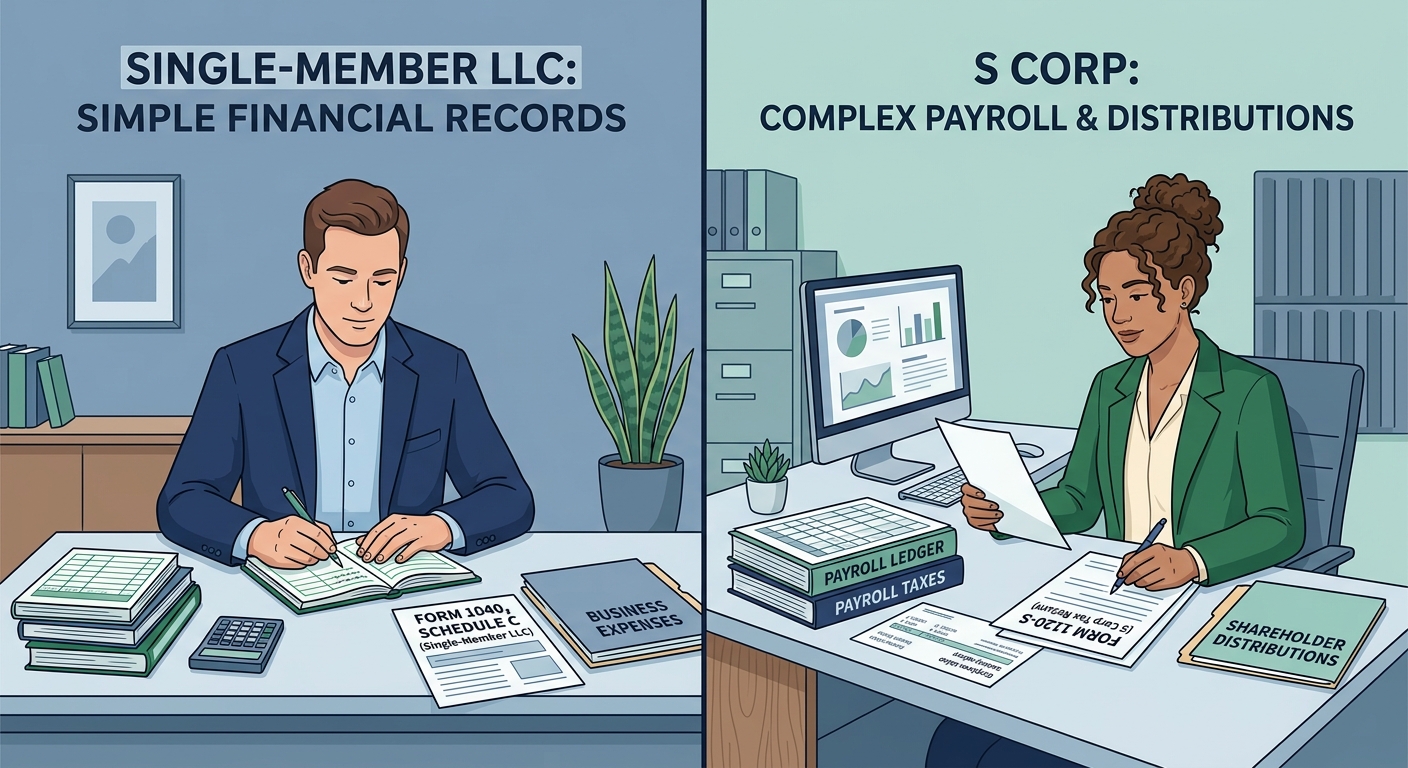
Most business owners who switch from an LLC to an S Corp are surprised by one thing that nobody warned them about. It is not the payroll setup. It is not the reasonable salary requirement. It is the bookkeeping. The financial record-keeping requirements between these two entities are not just different — they operate in entirely separate leagues. And if you are running your S Corp books the same way you ran your LLC, you are likely building a compliance problem that could cost you anywhere from $5,000 to $25,000 when the IRS or California FTB comes looking.
This guide breaks down exactly how bookkeeping for LLCs vs S Corps differs, what those differences mean in real dollars, and how to build a financial system that keeps you clean, compliant, and in position to take full advantage of your entity structure.
Quick Answer
LLCs require minimal financial record-keeping — income in, expenses out, one account. S Corps require a fully separated payroll system, shareholder distribution tracking, basis calculations, and a clean distinction between salary and profit. The bookkeeping complexity of an S Corp is significantly higher, but so is the tax savings potential when managed correctly.
Why Bookkeeping for LLCs vs S Corps Is Not the Same Problem
The confusion starts at formation. When most business owners form an LLC, they open a business bank account, track income and expenses, and hand everything to a tax preparer at year-end. That works for an LLC taxed as a sole proprietorship or partnership because the IRS is primarily interested in your net income number. Schedule C or Schedule E does the heavy lifting.
An S Corp is a different animal entirely. The IRS treats the shareholder-employee as both an owner and a worker. That means you have two financial identities running simultaneously inside the same entity: one as an employee who receives a W-2 salary, and one as a shareholder who receives profit distributions. Bookkeeping for LLCs versus S Corps diverges at exactly this point, and every financial record-keeping decision flows downstream from it.
Here is what that looks like in practice. An LLC owner with $120,000 in net profit books revenue, deducts expenses, and pays self-employment tax on the full $120,000. That is roughly $16,956 in self-employment tax (15.3% on the first $168,600 of net earnings in 2026). An S Corp owner who takes a $60,000 salary and receives $60,000 in distributions only pays FICA taxes — employer and employee — on the salary portion. That is approximately $9,180, saving $7,776 in payroll taxes annually.
But capturing that $7,776 in savings requires bookkeeping infrastructure the LLC never needed. Payroll records. Employer tax deposits. Quarterly Form 941 filings. Year-end W-2 and W-3 reconciliation. Shareholder loan tracking. Basis calculations. California DE 9 and DE 9C forms. If any piece of that infrastructure breaks down, the IRS can reclassify your distributions as wages — wiping out the tax advantage entirely and adding penalties on top.
For a deeper look at how S Corp structures save money across multiple tax levers, see our comprehensive S Corp tax strategy guide, which covers salary optimization, the QBI deduction, and California-specific planning moves.
The Five Core Bookkeeping Differences Between an LLC and an S Corp
1. Payroll Is Required for S Corps — and It Changes Everything
An LLC with no S Corp election has no payroll obligation. The owner draws money from the business account as needed and reconciles it at year-end. Simple, low-maintenance, and inexpensive to manage.
An S Corp with a shareholder-employee must run payroll. That means setting up a payroll system (or hiring a payroll provider), running pay cycles at least quarterly (monthly is recommended by most advisors), depositing employer FICA taxes on a schedule determined by payroll size, and filing Form 941 every quarter and Form 940 annually. In California, add quarterly DE 9 filings with the Employment Development Department (EDD).
The bookkeeping impact: payroll creates a new layer of liability accounts (payroll taxes payable, accrued wages), a new class of expenses (employer-side FICA, state unemployment insurance), and a new reconciliation requirement at year-end. Miss a payroll tax deposit, and the IRS assesses a Trust Fund Recovery Penalty under IRC Section 6672 — which can make individual shareholders personally liable for unpaid taxes even if the entity is dissolved.
2. Distributions vs. Draws: The Account Separation That Matters
In an LLC taxed as a sole proprietorship, owner draws are not an expense. They are a balance sheet movement — equity goes down, cash goes down. No special account needed, no tax reporting required for the draw itself.
In an S Corp, shareholder distributions are also not an expense. But they must be tracked separately, reconciled against basis, and reported on Schedule K-1 (Form 1120-S). Distributions taken in excess of basis are taxable as capital gains under IRC Section 1368. That means every distribution requires a basis calculation before it hits the bank account.
Many S Corp owners skip this step and take distributions whenever cash is available. When the IRS audits and finds distributions without documented basis, they assess tax on the excess — plus penalties and interest. This is one of the most common and most preventable S Corp audit findings.
3. Shareholder Basis Tracking: The Hidden Bookkeeping Requirement
Shareholder basis is the running total of what you have invested in the S Corp, adjusted upward for income and contributions and downward for losses and distributions. The IRS expects you to track this number annually. It affects how much you can deduct in losses, how distributions are taxed, and what you report if you ever sell the business.
LLCs have a similar concept — called outside basis for partnership-taxed LLCs — but it rarely creates the same audit risk for single-member entities taxed as sole proprietors.
S Corp basis tracking requires maintaining a running ledger that accounts for: initial capital contributions, annual ordinary income (from Form 1120-S, Line 1), separately stated income items, non-deductible expenses, and distributions taken. This is year-round bookkeeping work, not a once-a-year calculation.
4. The Chart of Accounts Has to Expand
An LLC’s chart of accounts can be lean. Income accounts, expense accounts, an owner’s equity account. Basic structure that most small business accounting software handles out of the box.
An S Corp’s chart of accounts needs additional structure. You need separate accounts for officer compensation (the salary), employer payroll tax expense, payroll liabilities, shareholder distributions, and accumulated adjustments account (AAA) — which tracks S Corp earnings that have already been taxed at the shareholder level. The AAA balance determines whether distributions are tax-free or taxable when the S Corp has accumulated earnings and profits from a prior C Corp period.
If you are a California business owner who converted from a C Corp to an S Corp, this accumulated earnings and profits tracking is not optional — it is a compliance requirement under IRC Section 1368(c).
5. Two Tax Returns Instead of One
An LLC taxed as a sole proprietor files Schedule C attached to Form 1040. One return. One deadline (April 15, with extension to October 15).
An S Corp files Form 1120-S at the entity level (due March 15, with a six-month extension to September 15) and then each shareholder files their individual Form 1040 with a Schedule K-1 from the S Corp attached. Two returns, two deadlines, two sets of records that must reconcile perfectly. If the Schedule K-1 figures on Form 1120-S do not match what the shareholder reports on Form 1040, the IRS computer matching system flags it immediately.
This is why S Corp bookkeeping cannot be done retroactively. It must be maintained throughout the year so that the year-end close and Form 1120-S preparation are based on clean, reconciled data.
KDA Case Study: S Corp Owner Nearly Loses $14,000 in Tax Savings Due to Bookkeeping Gaps
A San Diego marketing agency owner came to KDA after her third year running as an S Corp. She had elected S Corp status on the advice of a tax preparer who explained the payroll tax savings — and she was taking a $65,000 salary with $75,000 in annual distributions. On paper, her entity structure should have been saving her approximately $10,200 per year in self-employment taxes compared to operating as a single-member LLC.
The problem: her bookkeeper had been using QuickBooks but had never set up the shareholder distributions account correctly. Distributions were being booked as owner draws against equity, but no one was tracking basis. Three years of distributions had accumulated without a single basis calculation. When KDA performed a diagnostic review, we found that in Year 2, she had taken $18,000 in distributions in excess of her calculated basis — which should have triggered capital gains tax of approximately $2,700 she had never reported.
Additionally, her payroll tax deposits had been processed monthly but her California DE 9 filings had a $1,400 discrepancy between wages reported and deposits made — a mismatch that had already triggered an EDD inquiry letter she had not opened.
KDA restructured her chart of accounts, calculated three years of basis retroactively, filed an amended return for the year with the excess distribution, responded to the EDD inquiry, and set up a quarterly bookkeeping review process going forward. Total cost to fix: $4,800. Tax exposure averted: $14,200. First-year ROI from proper S Corp bookkeeping infrastructure: 2.96x.
Ready to see how we can help you? Explore more success stories on our case studies page to discover proven strategies that have saved our clients thousands in taxes.
What Good S Corp Bookkeeping Actually Looks Like Month by Month
Most business owners think bookkeeping is a once-a-month task — download the bank statement, categorize transactions, move on. That level of engagement works for a simple LLC. An S Corp requires a more structured rhythm.
Monthly Tasks
- Process payroll and verify tax deposits against payroll liability accounts
- Reconcile all business bank and credit card accounts
- Categorize all income and expenses with correct account codes
- Record any shareholder distributions taken and update basis tracker
- Review accounts payable and receivable aging
Quarterly Tasks
- File Form 941 (federal payroll tax return) by the last day of the month following the quarter
- File California DE 9 and DE 9C with the EDD
- Prepare quarterly profit-and-loss review to confirm salary-to-profit ratio is defensible
- Make estimated tax payments if needed (Form 1040-ES at federal level; California Form 540-ES)
- Update basis calculations to reflect year-to-date income and distributions
Annual Tasks
- Issue W-2 to shareholder-employees by January 31
- File Form W-3 with the Social Security Administration
- File Form 940 (federal unemployment tax) by January 31
- Close the books, reconcile the AAA account, and prepare Form 1120-S by March 15
- Distribute Schedule K-1 to all shareholders before they need it for their personal returns
- Pay California’s $800 minimum franchise tax (Form 3522) and any additional LLC fee if applicable
Our bookkeeping and payroll services are specifically built around this S Corp compliance rhythm — so nothing falls through the cracks and your entity structure delivers the savings it was designed to produce.
Common Mistakes That Wipe Out the S Corp Tax Advantage
The entire point of electing S Corp status is to reduce self-employment taxes while maintaining pass-through tax treatment. But several bookkeeping failures routinely erase that advantage.
Mistake 1: Mingling Salary and Distribution Accounts
Some owners take money from the business and label it whatever is convenient at tax time — sometimes salary, sometimes distribution, depending on how it looks on paper. The IRS calls this “recharacterization,” and it is one of the top red flags in an S Corp audit. Your payroll register and your distribution ledger must be separate, consistently maintained records.
Mistake 2: Skipping the Reasonable Salary Requirement
The IRS requires S Corp shareholder-employees to pay themselves a “reasonable compensation” for the services they provide before taking distributions. There is no fixed formula, but the IRS uses industry salary data, company revenue, and shareholder time commitment as benchmarks. If your salary is unreasonably low relative to your distributions, the IRS can reclassify distributions as wages under Revenue Ruling 74-44 — assessing back payroll taxes, penalties, and interest.
A common benchmark: salary should represent at least 40%-60% of total S Corp profit in most service-based businesses. If your S Corp nets $180,000 and you are paying yourself $30,000 in salary, that ratio will not survive scrutiny.
Mistake 3: Not Tracking the Accumulated Adjustments Account (AAA)
The AAA is the cumulative total of income that has already been taxed at the shareholder level. When distributions come from the AAA, they are generally tax-free (return of previously taxed basis). When the AAA is depleted and distributions continue, they may be taxable. Most bookkeeping software does not automatically track the AAA — you have to set it up manually and maintain it year over year.
Mistake 4: Missing California-Specific Requirements
California treats S Corps differently than the federal government. California’s S Corp franchise tax is 1.5% of net income (minimum $800 annually). California does not conform to certain federal S Corp rules, including some aspects of the QBI deduction. California also requires its own S Corp election via FTB Form 3560 — a separate filing from the federal Form 2553. Bookkeeping for California S Corps must account for these state-level differences to produce accurate state tax returns.
Do I Need Bookkeeping Software, a Bookkeeper, or Both?
For a single-member LLC with straightforward income and expenses, good software (QuickBooks Online, FreshBooks, or Wave) plus a year-end tax preparer is often sufficient. The transaction volume is manageable, and the compliance requirements are limited.
For an S Corp, the answer almost always involves both. Here is why. Software handles transaction categorization, bank reconciliation, and report generation. But it does not make judgment calls about payroll frequency, distribution timing relative to basis, AAA balance maintenance, or the reasonableness of your officer compensation. Those decisions require human expertise — particularly a bookkeeper or accountant who understands the specific compliance requirements of S Corps under IRS guidelines and California FTB rules.
If you want to see how your S Corp profit and bookkeeping structure affects your overall tax bill, run your numbers through this small business tax calculator to see where you stand before year-end.
Pro Tip: The IRS recommends that S Corp shareholders maintain records sufficient to substantiate basis at any point during the corporation’s existence. That means your bookkeeping records are not just for annual tax prep — they are permanent documentation that may be needed years or even decades later if the business is sold or dissolved.
When Does an LLC Outperform an S Corp on Bookkeeping Cost?
The S Corp structure saves money on self-employment taxes, but it costs more to maintain. If your bookkeeping and payroll compliance costs for an S Corp run $3,000-$6,000 per year (reasonable for most small businesses), you need to be saving at least that much in payroll taxes for the election to make financial sense.
General threshold: If your S Corp net profit after your own salary is consistently below $40,000 per year, the administrative cost of S Corp bookkeeping often erodes much of the tax savings. At $80,000 or more in net profit, the math almost always favors the S Corp election — sometimes by a wide margin.
What Happens If the IRS Finds Bookkeeping Problems in an S Corp?
The consequences scale with the severity of the issue. At the lighter end, the IRS issues a CP2000 notice — a proposed adjustment to income or tax based on information return matching. This usually results in additional tax owed plus interest.
More serious findings — unreasonable salary, undisclosed distributions, misclassified expenses — can trigger a full S Corp audit under IRS Examination procedures. The IRS audits Form 1120-S at a rate that is substantially higher than Schedule C returns when the return shows significant distributions relative to officer compensation. During an audit, the IRS requests payroll records, bank statements, shareholder meeting minutes, and basis calculations going back multiple years.
If those records do not exist or do not reconcile, the IRS has authority to reconstruct income using bank deposits and assess tax accordingly — a process that almost always produces a higher tax liability than what was actually owed.
According to IRS Publication 542, corporations are required to keep records as long as they may be needed to support items on a return — typically a minimum of three years from the filing date, but seven or more years for items related to property or employment taxes.
Ready to Reduce Your Tax Bill?
KDA Inc. specializes in strategic tax planning for business owners, S Corps, LLCs, and high-net-worth individuals. Book a personalized consultation and walk away with a clear plan.
Frequently Asked Questions
Can I use the same bank account for my salary and my business operations?
You should not. Your personal bank account receives your W-2 salary via payroll. Your S Corp business account holds operating funds and distributions. Commingling these creates audit risk and makes reconciliation significantly more difficult.
How often should I run payroll as an S Corp owner?
At a minimum, quarterly. Monthly is better practice and easier to reconcile. The IRS does not specify a frequency requirement for shareholder-employees, but irregular or infrequent payroll relative to large distributions is a red flag during examination.
Does my bookkeeper need to be a CPA to handle S Corp books?
No, but they need to understand S Corp-specific requirements — particularly payroll tax deposits, basis tracking, and AAA maintenance. A bookkeeper who has only worked with simple LLC or sole proprietor returns may not have the technical background needed for S Corp compliance. Ask specifically about their S Corp experience before hiring.
What is the difference between my AAA balance and my shareholder basis?
Shareholder basis is your personal investment in the corporation, adjusted for income, losses, and distributions. The AAA (Accumulated Adjustments Account) is the S Corp’s corporate-level record of undistributed, previously taxed income. Both affect the tax treatment of distributions, but they are maintained at different levels — basis at the shareholder level, AAA at the corporate level.
Book Your Tax and Bookkeeping Strategy Session
If you are running an S Corp without a clear bookkeeping system for payroll, distributions, and basis tracking, you are sitting on a compliance risk that grows with every quarter you delay. Let KDA build a financial record-keeping structure that protects your tax savings, keeps you clean with the IRS and California FTB, and gives you accurate numbers to make better business decisions. Click here to book your consultation now.
This information is current as of March 21, 2026. Tax laws change frequently. Verify updates with the IRS or FTB if reading this later.



