
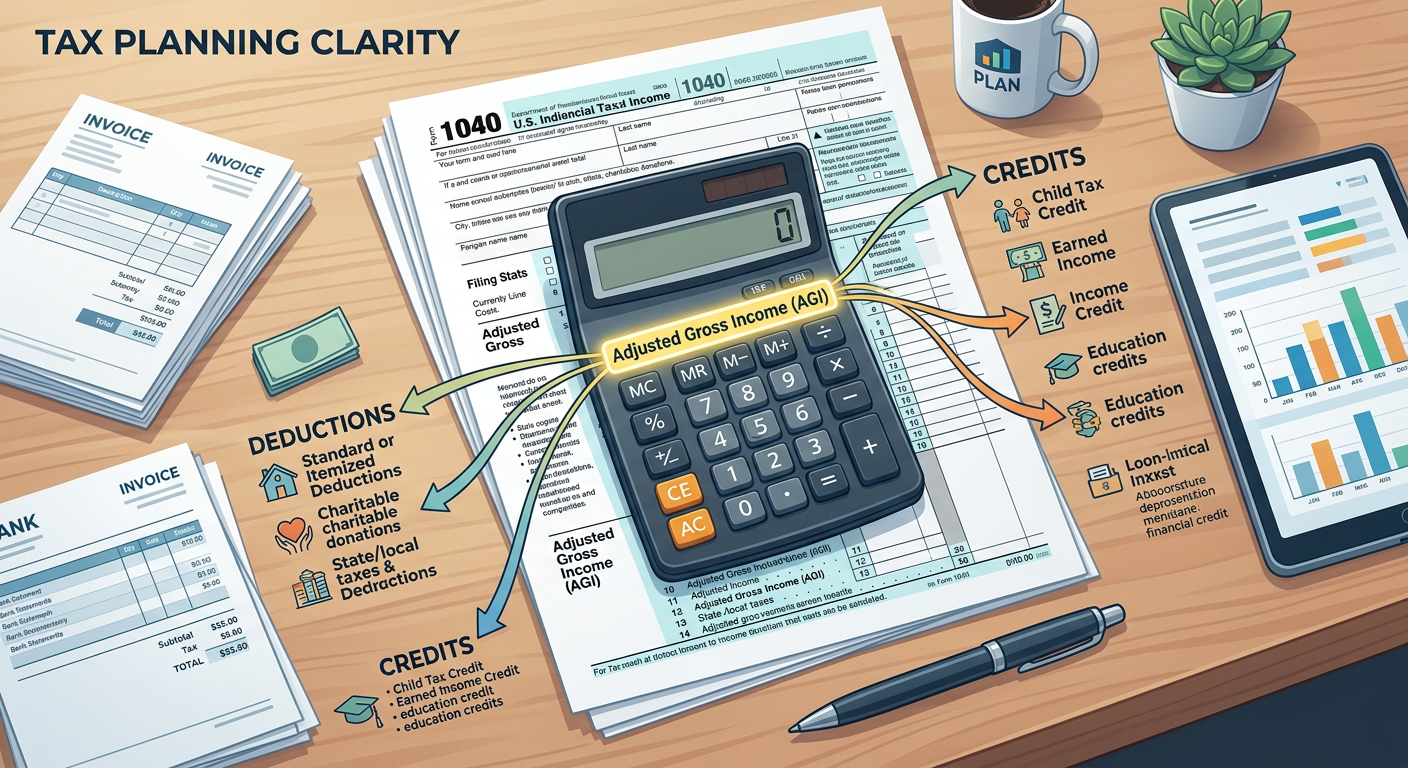
What Is Adjusted Gross Income and Why Does It Control Your Entire Tax Bill?
Most taxpayers focus on their total income or final refund amount, but the number that actually determines your tax liability, deduction eligibility, and credit qualifications sits quietly on line 11 of your Form 1040. It’s called adjusted gross income, and if you don’t understand how it works, you’re likely overpaying by thousands every year.
Here’s the truth: Your AGI is not just a line on a tax form. It’s the gatekeeper that decides whether you qualify for the Child Tax Credit, whether you can deduct your IRA contribution, and whether you’ll pay 12% or 22% on your next dollar of income. In 2026, with new IRS withholding updates reflecting the One Big Beautiful Bill Act and average refunds up 10.6%, understanding your AGI has never been more critical.
Quick Answer
Adjusted gross income (AGI) is your total taxable income minus specific deductions allowed by the IRS before calculating your tax liability. Your AGI determines eligibility for tax credits, deductions, and income-based phase-outs. For 2026 tax year (2025 income), AGI appears on line 11 of Form 1040 and serves as the baseline for nearly every tax calculation that follows.
How Adjusted Gross Income Is Actually Calculated
The IRS calculates your AGI using a two-step process that most taxpayers never see clearly explained.
Step 1: Start With Total Income
Your total income includes everything the IRS considers taxable:
- W-2 wages and salaries
- 1099-NEC income from freelance or contract work
- Business profit from Schedule C
- Interest and dividend income
- Capital gains from investments or property sales
- Rental income from Schedule E
- Retirement distributions (401k, IRA, pension)
- Unemployment compensation
- Social Security benefits (portion may be taxable)
- Alimony received (for divorces finalized before 2019)
For example, if you earned $85,000 in W-2 wages, $12,000 from a side consulting business, and $3,000 in stock dividends, your total income is $100,000.
Step 2: Subtract Above-the-Line Deductions
These are deductions you can claim even if you take the standard deduction. The IRS calls them “adjustments to income,” and they appear on Schedule 1 of Form 1040. For 2026, these include:
- Educator expenses (up to $300)
- Health savings account (HSA) contributions
- Self-employment tax deduction (50% of SE tax paid)
- Self-employed health insurance premiums
- Self-employed SEP, SIMPLE, or qualified retirement plan contributions
- Student loan interest deduction (up to $2,500, subject to income phase-out)
- IRA contributions (traditional, not Roth)
- Alimony paid (for divorces finalized before 2019)
- Moving expenses for active-duty military
Using our example above: If you contributed $6,000 to a traditional IRA and paid $850 in self-employment tax on your consulting income, your adjustments total $7,275. Your AGI would be $100,000 minus $7,275, which equals $92,725.
The Formula
Total Income – Above-the-Line Deductions = Adjusted Gross Income
This AGI of $92,725 now becomes the foundation for every calculation that follows on your tax return.
Why Your AGI Matters More Than Your Total Income
Your AGI controls access to dozens of tax benefits. Here’s what gets determined by your AGI threshold:
Tax Credit Eligibility
Most tax credits phase out based on your AGI, not your total income. For the 2026 tax year:
- Child Tax Credit: Begins phasing out at $400,000 AGI for married filing jointly, $200,000 for single filers
- Earned Income Tax Credit (EITC): Maximum AGI thresholds range from $18,591 to $63,398 depending on filing status and number of children
- American Opportunity Tax Credit: Phases out between $80,000-$90,000 AGI (single) or $160,000-$180,000 (married filing jointly)
- Lifetime Learning Credit: Phases out between $80,000-$90,000 AGI (single) or $160,000-$180,000 (married filing jointly)
- Saver’s Credit: AGI limits are $36,500 (single), $54,750 (head of household), or $73,000 (married filing jointly)
Deduction Limitations
Several deductions are calculated as a percentage of your AGI:
- Medical expenses: Only deductible if they exceed 7.5% of your AGI
- Casualty and theft losses: Must exceed 10% of AGI (for federally declared disasters only)
- Charitable contributions: Limited to 60% of AGI for cash donations to public charities
Let’s use a real example. Say you have $92,725 in AGI and paid $8,500 in medical expenses. The 7.5% threshold equals $6,954. You can only deduct the amount above that threshold, which is $1,546.
IRA Contribution Deductibility
If you or your spouse has a retirement plan at work, your ability to deduct traditional IRA contributions depends on your AGI. For 2026:
- Single filers with workplace retirement plan: Deduction phases out between $77,000-$87,000 AGI
- Married filing jointly (both have plans): Phases out between $123,000-$143,000 AGI
- Married filing jointly (one spouse has plan): Non-covered spouse’s deduction phases out between $230,000-$240,000 AGI
Roth IRA Contribution Eligibility
Your modified adjusted gross income (MAGI, which is AGI plus certain add-backs) determines whether you can contribute to a Roth IRA at all. For 2026:
- Single filers: Phase-out range is $146,000-$161,000
- Married filing jointly: Phase-out range is $230,000-$240,000
Premium Tax Credit for Health Insurance
If you buy health insurance through the Affordable Care Act marketplace, your premium tax credit (which reduces your monthly insurance cost) is calculated based on your AGI as a percentage of the federal poverty level.
Medicare Premiums
High earners pay Income-Related Monthly Adjustment Amounts (IRMAA) for Medicare Part B and Part D. These surcharges are based on your modified adjusted gross income from two years prior. For 2026 Medicare premiums, the IRS looks at your 2024 AGI.
Common Mistakes That Inflate Your AGI Unnecessarily
Every dollar you can shift from taxable income to a deduction lowers your AGI and opens access to more tax benefits. Here are the mistakes that cost taxpayers thousands.
Red Flag Alert: Not Maximizing Pre-Tax Retirement Contributions
Contributing to a traditional 401(k), 403(b), or 457 plan reduces your W-2 wages before they even hit your tax return. For 2026, you can contribute up to $23,500 ($31,000 if age 50 or older). This reduces both your total income and your AGI simultaneously. A $10,000 increase in your 401(k) contribution drops your AGI by $10,000, potentially saving $2,200 in federal taxes if you’re in the 22% bracket.
Red Flag Alert: Forgetting the Self-Employment Tax Deduction
If you have any 1099 income or run a side business, you’re paying self-employment tax (15.3% on net profit up to $168,600 for 2026). The IRS allows you to deduct 50% of that SE tax as an above-the-line adjustment. If you paid $3,400 in self-employment tax, you get a $1,700 reduction to your AGI. Miss this, and you’re overpaying on every AGI-dependent calculation downstream.
Red Flag Alert: Paying Health Insurance Premiums With After-Tax Dollars
If you’re self-employed, you can deduct 100% of health insurance premiums for yourself, your spouse, and your dependents as an above-the-line deduction. This includes medical, dental, and long-term care insurance. A family health plan costing $18,000 per year becomes an $18,000 AGI reduction if you’re self-employed.
Red Flag Alert: Not Opening or Contributing to an HSA
Health savings accounts offer a triple tax advantage, and contributions reduce your AGI. For 2026, you can contribute up to $4,300 (individual) or $8,550 (family), plus an additional $1,000 if you’re 55 or older. A married couple maxing out an HSA at $8,550 drops their AGI by that exact amount. If they’re in the 24% tax bracket, that’s $2,052 in immediate federal tax savings.
Red Flag Alert: Miscalculating Student Loan Interest
You can deduct up to $2,500 in student loan interest as an above-the-line deduction, but it phases out for higher earners. For 2026, the phase-out begins at $80,000 AGI (single) or $165,000 AGI (married filing jointly). Many taxpayers either forget to claim this or don’t realize they can deduct interest paid on behalf of a dependent.
How 2026 Tax Law Changes Impact Your AGI
The One Big Beautiful Bill Act introduced several new deductions that don’t directly lower AGI but do affect how AGI is calculated for certain taxpayers.
No Tax on Tips, Overtime, and Senior Income
While these new deductions appear on Schedule 1-A and reduce taxable income, they are applied after AGI is calculated. This means your AGI includes tip income, overtime pay, and Social Security benefits, but you may get a deduction for them later in the tax calculation process.
As of March 8, 2026, more than 27.5 million returns (nearly 45% of all filings) claimed at least one deduction on Schedule 1-A, according to the U.S. Department of the Treasury. This has driven the average IRS refund up 10.6% to $3,676.
Updated IRS Withholding Estimator
The IRS revised its Tax Withholding Estimator in March 2026 to reflect new tax breaks under the OBBBA. If you want to minimize next year’s AGI impact, use this tool to ensure you’re maximizing pre-tax payroll deductions like 401(k) contributions and HSA deposits throughout the year. You can find it at IRS.gov/Individuals/Tax-Withholding-Estimator.
Higher SALT Deduction Cap
The state and local tax (SALT) deduction cap increased to $40,000 for tax years 2025-2029, with phase-outs for high earners. However, this is an itemized deduction, not an adjustment to income, so it doesn’t reduce your AGI. It reduces taxable income after AGI is calculated.
Modified Adjusted Gross Income: The AGI Cousin You Also Need to Know
Modified adjusted gross income (MAGI) takes your AGI and adds back certain deductions. Different tax benefits use different MAGI calculations, which creates confusion.
Common MAGI Calculations
For Roth IRA contributions, your MAGI is your AGI plus:
- Foreign earned income exclusion
- Foreign housing exclusion or deduction
- Exclusion of income from Puerto Rico or American Samoa
For premium tax credits (ACA health insurance subsidies), your MAGI is AGI plus:
- Tax-exempt interest
- Non-taxable Social Security benefits
- Foreign earned income exclusion
For Medicare IRMAA surcharges, MAGI is AGI plus:
- Tax-exempt interest
Each tax benefit has its own MAGI formula. Always verify which version applies to the calculation you’re making. You can find specific MAGI definitions in IRS Publication 590-A (for retirement accounts) and IRS Publication 974 (for premium tax credits).
KDA Case Study: High-Net-Worth Individual
Marcus Chen, a 52-year-old software engineering director, earned $215,000 in W-2 income plus $28,000 in stock dividends and $15,000 from consulting work in 2025. His total income was $258,000. He was contributing 6% to his 401(k) to get his employer match, but nothing more.
His AGI of $245,100 ($258,000 minus $12,900 in existing 401k contributions) pushed him into phase-out ranges for several benefits. His traditional IRA contribution wasn’t deductible, and he was over the Roth IRA income limit.
What KDA Did: We increased his 401(k) contribution to the $31,000 maximum (age 50+ catch-up included), opened a family HSA and contributed the $8,550 maximum, deducted $1,125 in self-employment tax from his consulting income, and set up a SEP-IRA contribution of $3,000 from his consulting net profit.
Tax Savings Result: His new AGI dropped to $201,425. This moved him below the Roth IRA phase-out threshold (he could now make backdoor Roth conversions more efficiently), reduced his federal tax by $10,098, and lowered his effective tax rate from 26.4% to 23.1%.
What Marcus Paid: $4,200 for comprehensive tax planning and preparation.
ROI: 2.4x first-year return, with compounding benefits in future years as retirement accounts grow tax-deferred and HSA funds accumulate tax-free.
Ready to see how we can help you? Explore more success stories on our case studies page to discover proven strategies that have saved our clients thousands in taxes.
Strategic Moves to Lower Your AGI Before Year-End
If you’re reading this before December 31, these moves can still reduce your current-year AGI.
Max Out Retirement Contributions
Increase your 401(k), 403(b), or 457 plan deferrals before the last payroll of the year. Even one large contribution in December counts for the entire tax year. If you’re self-employed, you have until your tax filing deadline (plus extensions) to make SEP-IRA or solo 401(k) contributions for the prior year.
Make Deductible IRA Contributions
You have until April 15, 2027, to make 2026 tax year IRA contributions (for income earned in 2026). Contribute up to $7,000 ($8,000 if age 50+) to a traditional IRA if you’re eligible for the deduction based on your income and retirement plan status.
Fund Your HSA
If you have a high-deductible health plan (HDHP), contribute to an HSA by December 31 to reduce current-year AGI. Unlike IRA contributions, HSA contributions must be made by December 31, not by the tax filing deadline.
Accelerate Business Expenses
If you have self-employment income, prepaying deductible business expenses in December reduces your Schedule C net profit, which directly lowers your AGI. This includes equipment purchases (potentially eligible for Section 179 expensing), software subscriptions, professional development, and supplies.
Harvest Investment Losses
Capital losses offset capital gains dollar-for-dollar. If you have $10,000 in gains and $15,000 in losses, you can use $10,000 to offset the gains and deduct an additional $3,000 against ordinary income (the annual limit). The remaining $2,000 loss carries forward to next year. This strategy, called tax-loss harvesting, reduces your AGI by up to $3,000 annually.
What Happens If You Don’t Understand Your AGI?
Ignoring AGI optimization costs you in multiple ways that compound over time.
You Overpay Taxes Directly
If your AGI is $5,000 higher than it needs to be and you’re in the 24% tax bracket, you pay $1,200 more in federal taxes. Do this for 10 years and you’ve lost $12,000 plus the opportunity cost of investing those savings.
You Lose Access to Tax Credits
Being $1,000 over the AGI threshold for the American Opportunity Tax Credit costs you up to $2,500 in education credits. Being over the Roth IRA contribution limit by $2,000 means you lose decades of tax-free growth on those contributions.
You Trigger Higher Medicare Premiums
In 2026, single filers with MAGI above $106,000 pay IRMAA surcharges. The first tier adds $81.90 per month ($983 annually) to your Medicare Part B premium. Keep pushing AGI higher and you hit additional tiers, with top earners paying an extra $419.30 per month ($5,032 annually). Those surcharges continue every year for the rest of your life unless your income drops.
You Pay More for Health Insurance
If you buy insurance through the ACA marketplace, every $1,000 increase in AGI can cost you $50-$150 in additional monthly premiums by reducing your premium tax credit. For a family, that’s $600-$1,800 annually.
Special Situations and Edge Cases
Certain taxpayer situations create AGI complications that require strategic planning.
Multi-State Income
If you earned income in multiple states, your federal AGI remains the same, but each state calculates its own state AGI by adding back or removing certain items. California, for example, doesn’t allow the deduction for state income taxes that appears on your federal Schedule A, which can create a higher California AGI than federal AGI in some cases.
Married Filing Separately
When you file separately, AGI thresholds for credits and deductions are often exactly half of the married filing jointly thresholds, but not always. Some benefits, like the Roth IRA contribution, have phase-out ranges of $0-$10,000 for married filing separately if you lived with your spouse at any time during the year, making Roth contributions nearly impossible.
Divorce and Alimony
For divorces finalized before December 31, 2018, alimony paid is an above-the-line deduction (reduces AGI), and alimony received is included in AGI. For divorces finalized after that date, alimony is not deductible and not includable in income, so it doesn’t affect AGI at all.
Kiddie Tax and Dependent AGI
If your dependent child has unearned income above $2,500 (for 2026), they’re subject to kiddie tax rules. Their investment income is taxed at your marginal rate, not theirs. However, their AGI is still calculated separately from yours. Strategic income shifting through custodial accounts requires careful AGI planning to avoid pushing your child into higher tax brackets unnecessarily.
California-Specific Considerations
California uses federal AGI as the starting point for state tax calculations but makes several modifications.
State-Specific Adjustments
California adds back certain federal deductions, including:
- State income tax refunds (if you deducted them federally)
- Certain business incentive deductions allowed federally but not in California
California also subtracts certain items, such as:
- California lottery winnings (not taxable in CA but federally taxable)
- Some pension income for qualifying seniors
Impact on California Credits
Many California tax credits, including the California Earned Income Tax Credit (CalEITC), are based on your California AGI, not your federal AGI. For 2026, CalEITC is available to filers with California AGI under $31,950 (with qualifying children) or under $11,100 (without qualifying children).
Understanding both your federal and California AGI matters if you live or do business in the state. Work with a California-focused CPA who understands both systems. You can explore our tax planning services designed specifically for California residents and business owners.
Ready to Reduce Your Tax Bill?
KDA Inc. specializes in strategic tax planning for business owners, S Corps, LLCs, and high-net-worth individuals. Book a personalized consultation and walk away with a clear plan.
Frequently Asked Questions
Where Do I Find My AGI on My Tax Return?
Your adjusted gross income appears on line 11 of IRS Form 1040. If you’re filing electronically, your tax software will calculate it automatically. If you need your prior-year AGI to e-file this year’s return, look at line 11 of last year’s Form 1040.
Is AGI the Same as Taxable Income?
No. AGI is calculated before you take the standard deduction or itemized deductions. Taxable income is your AGI minus either the standard deduction ($15,750 for single filers or $31,500 for married filing jointly in 2026) or your total itemized deductions. Your tax liability is calculated based on taxable income, not AGI.
Can My AGI Be Negative?
Yes. If your above-the-line deductions exceed your total income, your AGI can be negative. This most commonly happens with business losses on Schedule C or rental losses on Schedule E. A negative AGI means you owe $0 in federal income tax, and the loss may carry forward to offset future income under net operating loss (NOL) rules.
Does Social Security Count Toward AGI?
It depends. Up to 85% of your Social Security benefits can be included in your AGI if your combined income (AGI + nontaxable interest + 50% of Social Security benefits) exceeds certain thresholds. For 2026, these thresholds are $25,000 for single filers and $32,000 for married filing jointly. The formula is complex, but most tax software calculates it automatically using the IRS worksheet from Publication 915.
What’s the Difference Between Gross Income and Adjusted Gross Income?
Gross income is every dollar you earned from all sources before any deductions. Adjusted gross income is gross income minus specific IRS-approved adjustments (above-the-line deductions like IRA contributions, student loan interest, self-employment tax, and HSA contributions). AGI is always lower than gross income unless you have zero adjustments.
Can I Lower My AGI After the Tax Year Ends?
Limited options exist. You can make deductible IRA contributions until the tax filing deadline (April 15, 2027, for the 2026 tax year). You can also establish and fund certain retirement accounts if you’re self-employed, such as SEP-IRAs or solo 401(k)s, up until your filing deadline plus extensions (as late as October 15, 2027, for the 2026 tax year if you file an extension). However, most AGI-reduction strategies like 401(k) contributions and HSA deposits must occur during the tax year itself.
The Bottom Line: Your AGI Is Your Most Important Tax Number
Your adjusted gross income determines your tax bracket, controls access to credits and deductions worth thousands of dollars, and sets the baseline for nearly every tax calculation the IRS makes. Reducing your AGI by $10,000 doesn’t just save you the tax on that $10,000 (potentially $2,200-$3,700 depending on your bracket). It can unlock eligibility for education credits, retirement account contributions, health insurance subsidies, and other benefits that multiply your savings.
The taxpayers who win at taxes don’t just file accurately. They plan strategically around AGI throughout the entire year, maximizing pre-tax contributions, timing income and deductions, and using every above-the-line adjustment available under current law.
Key Takeaway: Every dollar you shift from taxable income to a deductible contribution or adjustment lowers your AGI and creates compounding tax savings across multiple areas of your return, often returning $3-5 in total tax benefits for every $1 in strategic planning.
This information is current as of 3/17/2026. Tax laws change frequently. Verify updates with the IRS or FTB if reading this later.
Stop Guessing About Your AGI and Start Optimizing It
If you’re unsure whether you’re leaving thousands on the table by ignoring AGI optimization strategies, it’s time to stop guessing. Our tax planning team specializes in helping high-income W-2 employees, business owners, and investors reduce their AGI through proven, IRS-compliant strategies. We’ll analyze your income sources, identify missed deductions, and build a multi-year plan to keep more of what you earn. Click here to book your personalized AGI strategy session now.



