
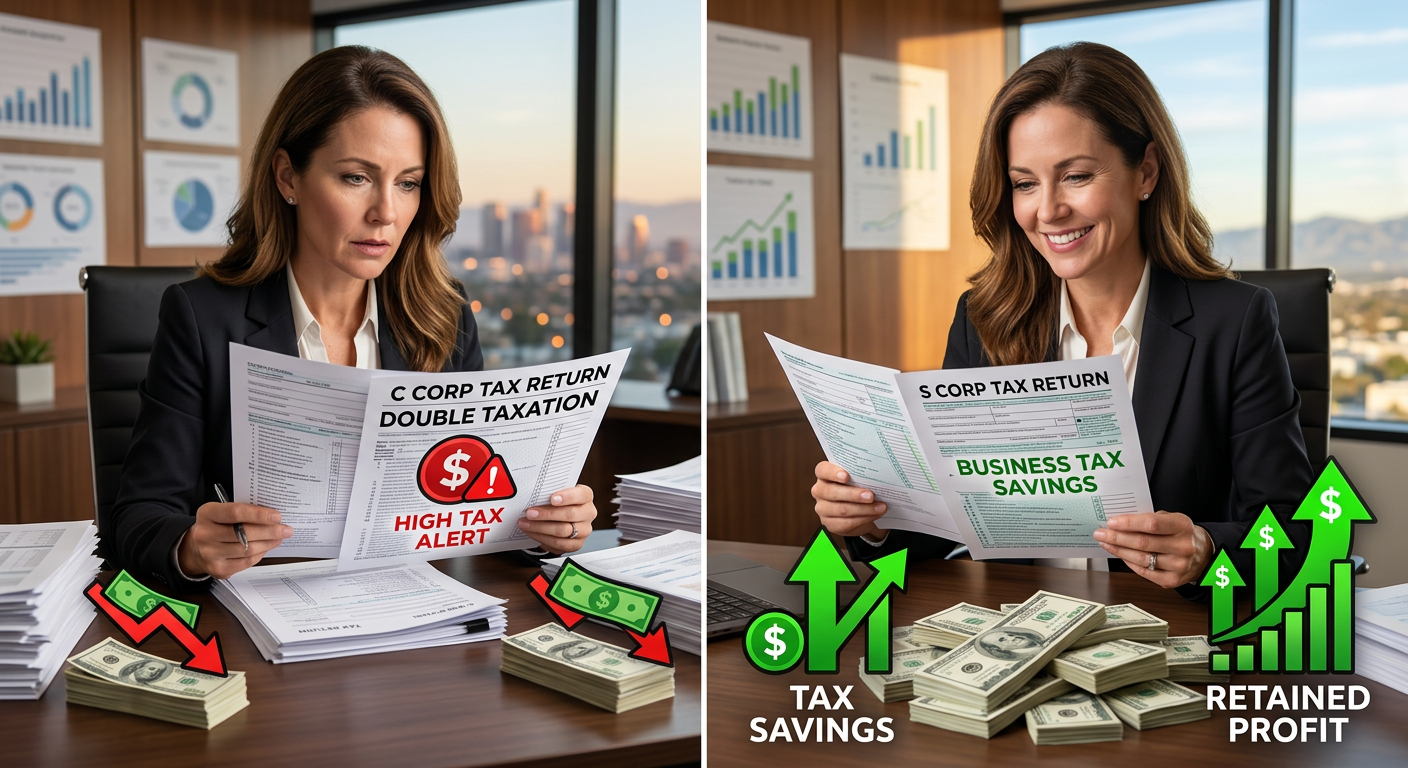
Most California business owners know there’s a difference between S Corp and C Corp — they just don’t know what it’s actually costing them. If you’re running a profitable business and you haven’t made a deliberate entity election, there’s a real chance you’re overpaying taxes by $20,000 to $40,000 every year. That’s not a scare tactic. That’s the math.
This guide breaks down the structural, tax, and compliance differences between the two entity types in plain language — with real California numbers, specific IRS rules, and a decision framework that tells you exactly which entity wins at your income level.
Quick Answer: What Is the Core Difference?
The difference between S Corp and C Corp comes down to one concept: how profits are taxed. A C Corp pays taxes on its profits at the corporate level, and then shareholders pay taxes again when those profits are distributed as dividends. That’s double taxation. An S Corp avoids this — profits pass directly to shareholders and are taxed only once on their personal returns.
In California, that distinction is even sharper because the state imposes an 8.84% franchise tax on C Corps versus only a 1.5% franchise tax on S Corps. On $200,000 of profit, that’s a $14,680 gap just from state tax treatment before you ever account for federal rates.
How C Corp Taxation Actually Works in California
A C Corporation (governed by Subchapter C of the Internal Revenue Code) is treated as a completely separate taxable entity. The corporation files its own return — IRS Form 1120 — and pays federal corporate income tax at a flat 21% rate under the OBBBA’s permanent rate structure.
Here’s where it gets expensive. After the C Corp pays its 21% federal tax, any remaining profit distributed to shareholders as dividends gets taxed again — this time at the shareholder’s qualified dividend rate, which can be as high as 20% federally, plus the 3.8% Net Investment Income Tax (NIIT) for high earners under IRC Section 1411.
Stack California’s 8.84% corporate franchise tax on top of that, plus California’s personal income tax rate of up to 13.3% on dividends received, and a California C Corp owner can face an effective combined rate of 46% to 53% on distributed profits.
C Corp Double Taxation Example
- Business profit: $200,000
- Federal corporate tax (21%): $42,000
- California franchise tax (8.84%): $17,680
- Remaining after state and federal corporate tax: $140,320
- Federal dividend tax on distribution (20% + 3.8% NIIT): $33,277
- California personal income tax on dividend (13.3%): $18,663
- Total tax paid: $111,620 out of $200,000 in profit
That’s a 55.8% effective rate. For many California business owners still operating as C Corps — especially those who incorporated years ago and never made an election — this is the silent tax bill draining their bottom line every year.
For a deeper breakdown of the California entity landscape, see our complete guide to S Corp tax strategy in California.
How S Corp Taxation Works in California
An S Corporation (governed by Subchapter S of the Internal Revenue Code) is a pass-through entity. The corporation itself pays no federal income tax on profits. Instead, profits and losses flow directly to shareholders’ personal tax returns in proportion to their ownership stake. The IRS calls this “pass-through taxation,” and it eliminates the double taxation problem entirely.
In California, S Corps still pay the 1.5% franchise tax on net income (minimum $800 annually), but that’s dramatically lower than the C Corp’s 8.84% rate. The savings on just the franchise tax alone can justify the conversion for many business owners.
The second major advantage is self-employment tax reduction. S Corp shareholders who work in the business must pay themselves a “reasonable salary,” which is subject to payroll taxes (FICA: 15.3% combined for employee and employer). But profit distributions above that salary are not subject to self-employment tax. For a business owner earning $150,000 in profit, structuring $70,000 as salary and $80,000 as distribution can save $12,240 in self-employment taxes annually.
S Corp Tax Example (Same $200,000 Profit)
- Business profit: $200,000
- Reasonable salary: $85,000
- Payroll taxes on salary (15.3%): $13,005
- California S Corp franchise tax (1.5%): $3,000
- Remaining profit distribution: $115,000 (not subject to SE tax)
- Federal income tax on pass-through income (22%–24% bracket): ~$27,600
- California income tax on pass-through income (9.3%–12.3%): ~$12,650
- Total tax paid: approximately $56,255 out of $200,000
Compared to the C Corp scenario, that’s a savings of more than $55,000 on the same $200,000 profit. Even in a more conservative scenario without the high California dividend stack, the difference routinely lands between $25,000 and $45,000 per year for California business owners.
Many business owners discover this gap only after their first profitable year — and at that point, they’ve already left thousands on the table. The best time to make the election is before the tax year begins.
The 2026 Tax Law Updates That Shift This Math
Two federal developments in 2026 make the S Corp vs. C Corp comparison more one-sided than it has been in years.
OBBBA: Permanent QBI Deduction
The One Big Beautiful Bill Act (OBBBA) made the Section 199A Qualified Business Income (QBI) deduction permanent. This deduction allows eligible S Corp shareholders to deduct up to 20% of their qualified business income from their taxable income. On $115,000 in S Corp distributions, a 20% QBI deduction reduces taxable income by $23,000 — saving approximately $5,060 in federal taxes alone at a 22% bracket.
C Corporations do not qualify for the QBI deduction. It is exclusively available to pass-through entities, including S Corps, partnerships, and sole proprietors.
AB 150 PTE Elective Tax
California’s Assembly Bill 150, the Pass-Through Entity (PTE) elective tax, allows S Corp owners to pay California income tax at the entity level and receive a dollar-for-dollar credit on their personal return. This strategy effectively bypasses the federal $10,000 SALT deduction cap, unlocking an additional $3,000 to $15,000+ in federal deductions for California S Corp owners who opt in annually.
C Corps are not eligible for the AB 150 election. This is another stacking advantage that makes the S Corp structure increasingly powerful for California business owners in 2026.
Want to see how these numbers apply to your specific profit level? Run your figures through this small business tax calculator to get a quick estimate before your strategy session.
Key Structural Differences: A Side-by-Side Comparison
| Factor | S Corporation | C Corporation |
|---|---|---|
| Federal Tax Treatment | Pass-through — no corporate-level federal tax | 21% flat corporate tax on profits |
| California Franchise Tax | 1.5% of net income (min. $800) | 8.84% of net income (min. $800) |
| Double Taxation | None | Yes — corporate + dividend tax |
| QBI Deduction (20%) | Eligible | Not eligible |
| AB 150 PTE Election | Eligible | Not eligible |
| Self-Employment Tax Planning | Salary/distribution split reduces SE tax | No SE tax benefit |
| Shareholders Allowed | Max 100; U.S. citizens/residents only | Unlimited; any nationality |
| Stock Classes | One class of stock only | Multiple classes allowed |
| QSBS Exclusion (IRC Sec. 1202) | Not available | Up to 100% gain exclusion available |
| Retained Earnings | Taxed at shareholder level regardless | Can retain earnings at 21% rate |
| Venture Capital Compatibility | VC funds (LLCs) cannot hold S Corp stock | Fully compatible with institutional investors |
Common Mistakes California Business Owners Make When Choosing
Mistake 1: Assuming Incorporation = C Corp Is the Default
When you file Articles of Incorporation in California, you automatically become a C Corporation for tax purposes. Nothing about the state filing makes you an S Corp. To elect S Corp status, you must file IRS Form 2553 with the IRS and Form 3560 with the California FTB. Missing these filings — even by one day past the deadline — means you’re taxed as a C Corp for the entire year. There is late election relief available under Rev. Proc. 2013-30, but it requires demonstrating reasonable cause and filing a corrective election package.
Mistake 2: Ignoring the FTB Form 3560 Deadline
Many business owners know about IRS Form 2553 but forget California requires its own separate election using FTB Form 3560. The California deadline mirrors the federal deadline — generally by the 15th day of the 3rd month of the tax year — but missing the California filing means you pay C Corp rates to the FTB even if the IRS recognizes your S Corp status. That’s 8.84% on your entire net income going to California instead of 1.5%.
Mistake 3: Setting an Unreasonably Low Salary
The IRS knows the salary/distribution split game. If you pay yourself $20,000 in salary on $300,000 in profit, that’s a red flag. The IRS can recharacterize distributions as wages, assess back payroll taxes, and apply penalties under IRC Section 3121(d). A reasonable salary should reflect what the market would pay a third-party employee to perform your role. For many professional services S Corps, that’s $60,000 to $120,000 depending on industry and location.
Mistake 4: Overlooking the Built-In Gains Window When Converting
If you’re converting from a C Corp to an S Corp, be aware of the built-in gains (BIG) tax under IRC Section 1374. Any assets that had unrealized gains at the time of conversion are subject to corporate-level tax if sold within five years of the S Corp election. This doesn’t disqualify the conversion — but it requires planning. Don’t sell appreciated assets during that five-year window without a strategy in place.
Pro Tip: The BIG tax window is five years. If you converted to an S Corp more than five years ago, you’re in the clear to sell appreciated assets without triggering the C Corp-level gain.
When a C Corp Actually Wins: The Three Scenarios
For most small and mid-sized California business owners, the S Corp wins on pure tax math. But there are three specific scenarios where the C Corp structure is the better choice:
Scenario 1: QSBS and Venture Capital
If you plan to raise venture capital or seek institutional investment, your investors may require C Corp structure. VC funds organized as LLCs cannot hold S Corp stock. Additionally, C Corp shareholders who hold Qualified Small Business Stock (QSBS) under IRC Section 1202 can potentially exclude 100% of capital gains on a sale — up to $10 million. For founders building toward an exit, C Corp QSBS exclusion can dwarf years of S Corp self-employment tax savings.
Scenario 2: Retained Earnings Reinvestment
S Corp profits pass to shareholders and get taxed at individual rates — whether or not you distribute the cash. If your business needs to retain large amounts of profit for reinvestment and you’re in a high personal tax bracket (California can push combined rates above 50%), the C Corp’s 21% flat rate on retained earnings may be more efficient. This only holds if you don’t distribute the profits — the moment you take distributions, double taxation applies.
Scenario 3: Qualified Opportunity Zone Investments
Certain C Corp structures can optimize Opportunity Zone investments differently than S Corps. If your business is embedded in a Qualified Opportunity Zone strategy or you’re considering a large-scale capital reinvestment post-sale, a C Corp structure may be worth analyzing with your tax advisor.
KDA Case Study: Sacramento Consultant Saves $31,800 by Closing the Difference
A Sacramento-based management consultant came to KDA earning $195,000 in annual net profit through a C Corporation she had formed six years earlier. She had never made an S Corp election because her original attorney told her “C Corp is cleaner.” She was paying a combined effective rate of approximately 51% on her distributed profits — more than $99,000 per year in federal and California taxes.
After a KDA strategy review, we identified the full scope of the issue: no QBI deduction, no AB 150 PTE election, no self-employment tax planning, and full double taxation on every dollar she distributed. The built-in gains window from her original incorporation had already expired, which meant we could convert cleanly without BIG tax exposure.
KDA filed IRS Form 2553 and California FTB Form 3560 effective January 1 of the following tax year. We established a reasonable salary of $88,000 based on market data for her consulting specialty, set up payroll through Gusto, and structured the remaining $107,000 as a profit distribution. We also elected into the AB 150 PTE tax to unlock the SALT workaround for her California income.
The result in year one: her total federal and California tax bill dropped from $99,450 to $67,650 — a savings of $31,800. Her KDA engagement cost $3,950. That’s an 8x first-year return on investment. She’s now compounding those savings annually with no additional filing complexity.
Ready to see how we can help you? Explore more success stories on our case studies page to discover proven strategies that have saved our clients thousands in taxes.
How to Make the Switch: The Four-Step Conversion Process
If the S Corp structure makes sense for your situation, here’s the process to get there:
- Verify Eligibility: Confirm you have 100 or fewer shareholders, all shareholders are U.S. citizens or residents, and you have only one class of stock. Foreign investors or multiple stock classes disqualify you from S Corp status.
- Determine the Right Start Date: S Corp elections are most effective at the start of a tax year. For a January 1 effective date, you generally must file IRS Form 2553 by March 15th. Late election relief is available but requires more documentation.
- File IRS Form 2553: This is the federal S Corp election form. All shareholders must consent by signing the form. File by fax or mail to the IRS service center for your state. According to IRS Form 2553 guidance, you should receive written confirmation of your election within 60 days.
- File California FTB Form 3560: This is the California-specific S Corp election. File it with the Franchise Tax Board. Do not assume your federal election automatically notifies California — it does not. California requires its own separate form, separate fee, and timely filing.
Once your elections are accepted, set up payroll for your reasonable salary, run quarterly estimated tax payments, and ensure your bookkeeper is separating salary payments from profit distributions on your books. Our tax planning services include the full conversion package — election filing, payroll setup, and an annual tax projection — so you don’t have to coordinate this across multiple vendors.
Ready to Reduce Your Tax Bill?
KDA Inc. specializes in strategic tax planning for business owners, S Corps, LLCs, and high-net-worth individuals. Book a personalized consultation and walk away with a clear plan.
Frequently Asked Questions
What income level makes the S Corp worthwhile?
For most California business owners, the S Corp election becomes financially justified at approximately $60,000 to $80,000 in annual net profit. Below that threshold, the payroll administration costs and California franchise tax ($800 minimum plus 1.5% on net income) can offset the self-employment tax savings. Above $80,000, the math tips decisively in the S Corp’s favor and the advantage compounds as income grows.
Can I switch from C Corp to S Corp mid-year?
Technically yes, but a mid-year election creates a split tax year — part C Corp, part S Corp — which complicates your return significantly. The cleanest approach is a January 1 election date with the Form 2553 filed by March 15th. If you miss that window, file as soon as possible and request retroactive relief under Rev. Proc. 2013-30 if you have reasonable cause for the late election.
Does my LLC need to do anything to become an S Corp?
Yes. An LLC is a state-law entity with no default federal tax election for S Corp status. To be taxed as an S Corp, your LLC must first elect to be treated as a corporation for federal tax purposes (IRS Form 8832) and then file IRS Form 2553 to elect S Corp treatment within the required timeframe. California LLCs must also file FTB Form 3560. Skipping Form 8832 and going straight to Form 2553 is one of the most common errors KDA sees in do-it-yourself elections.
Will converting to an S Corp trigger an audit?
No — electing S Corp status does not itself trigger an audit. However, two behaviors do increase audit risk post-election: paying yourself an unreasonably low salary to maximize distributions, and reporting losses year after year without a corresponding business rationale. Pay yourself a market-rate salary, maintain clean books, and keep your salary-to-distribution ratio defensible with documented market comparisons.
Book Your S Corp Strategy Session
If you’re still operating as a C Corp in California — or if you made an S Corp election years ago but haven’t reviewed your salary structure, AB 150 election, or QBI optimization since — there’s a strong likelihood you’re leaving $15,000 to $40,000 on the table every year. The difference between S Corp and C Corp tax treatment is not a minor accounting detail. It’s a structural decision that compounds for as long as your business is profitable. Let KDA run the numbers for your specific situation and show you exactly where the opportunity is. Click here to book your tax strategy consultation now.
This information is current as of March 15, 2026. Tax laws change frequently. Verify updates with the IRS or FTB if reading this later.



