
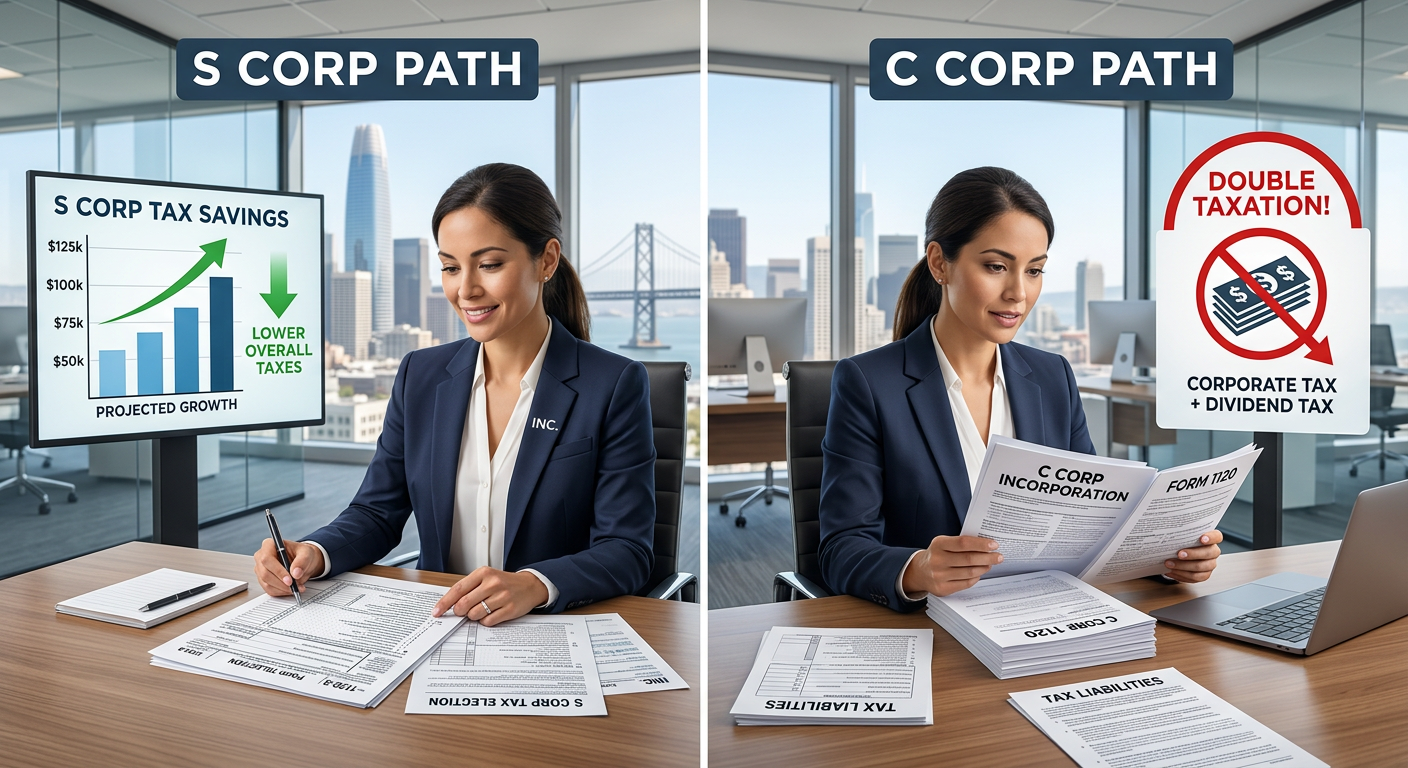
Most business owners who incorporate think the hard decision is over once they file the paperwork. It’s not. The real decision — the one that determines how much of your income the IRS gets to keep — happens right after you form the entity. And most business owners never make it deliberately.
Is inc s corp or c corp is one of the most consequential questions any incorporated business owner faces. The difference between choosing wrong and choosing right can be $20,000 to $50,000 in annual taxes — sometimes more. California adds its own layer of complexity that makes the stakes even higher.
Many founders search is inc s corp or c corp, assuming the “Inc.” label determines their tax treatment. It doesn’t. Under IRS entity classification rules, every corporation defaults to C corporation taxation unless Form 2553 is filed to elect S corporation status. That means thousands of small businesses are operating as C Corps by accident simply because no election was submitted.
This guide breaks down exactly what “Inc.” means when it comes to tax treatment, what you’re actually choosing between, and which structure wins based on your income, goals, and situation.
Quick Answer: What Does “Inc.” Actually Mean for Taxes?
“Inc.” stands for Incorporated. But incorporated alone tells you nothing about how you’re taxed. The IRS treats an incorporated business as a C Corporation by default. To be taxed as an S Corporation, you must file a separate election — IRS Form 2553 — and meet specific eligibility requirements.
A common misunderstanding behind the search is inc s corp or c corp is assuming “Inc.” determines the tax structure. In reality, “Inc.” simply means the business is incorporated under state law. The federal tax classification—S corporation or C corporation—depends entirely on whether the owners file an S election with the IRS.
The technical answer to is inc s corp or c corp depends on whether the corporation filed an S election with the IRS. If no election exists, the entity is treated as a C corporation under Subchapter C of the Internal Revenue Code. Filing IRS Form 2553 moves the company into Subchapter S, converting it into a pass-through structure where profits flow directly to the shareholders’ personal returns.
This is where most business owners get tripped up. They form an Inc., skip the S Corp election, and end up paying C Corp taxes without ever intending to. The IRS doesn’t remind you. The state of California doesn’t remind you. And if you’re running a profitable small business with no plans to raise venture capital, C Corp taxes may be costing you significantly more than they should.
Bottom line: Inc. is a legal designation. S Corp and C Corp are tax designations. They’re different things, and understanding that difference is the foundation of everything that follows.
C Corp vs. S Corp: The Tax Mechanics That Actually Matter
For business owners in California running profitable operations, the gap between C Corp and S Corp tax treatment is not subtle. It’s structural, and it compounds every year you stay in the wrong entity.
How a C Corp Gets Taxed
A C Corporation pays federal income tax at a flat 21% corporate rate on net profits. Then, when the corporation distributes dividends to shareholders, those dividends get taxed again at the shareholder’s individual rate — typically 15% to 20% for qualified dividends, plus the 3.8% Net Investment Income Tax if income is high enough.
In California, the corporate franchise tax rate for C Corps is 8.84% of net income. Stack that on top of the federal 21%, and you’re looking at a combined corporate-level rate around 29-30% before any shareholder-level taxation. When dividends hit the owner’s personal return, you’re paying tax twice on the same dollar. That’s double taxation, and it’s not a myth — it’s the default operating condition for every Inc. that never made the S Corp election.
Example: A California C Corp earns $200,000 in net profit. After federal tax (21%) and California franchise tax (8.84%), roughly $140,000 remains. When distributed as dividends, the owner pays an additional 15-23.8% on that $140,000. Total effective tax burden on the original $200,000 can exceed 45%.
How an S Corp Gets Taxed
An S Corporation is a pass-through entity. The corporation itself pays no federal income tax. Profits and losses flow directly to the shareholders’ personal tax returns, where they’re taxed once at individual rates. In California, S Corps pay a 1.5% franchise tax on net income (versus 8.84% for C Corps) with a minimum of $800.
The major advantage for owner-operators is payroll tax savings. An S Corp owner-employee pays themselves a reasonable salary — say, $60,000 — and takes the remaining profit as a distribution. Self-employment taxes (15.3%) apply only to the salary portion, not the distribution. On a business generating $180,000 in profit, the owner might save $14,000 to $18,000 annually in payroll taxes alone.
For a complete deep-dive into S Corp strategy, see our comprehensive S Corp tax guide for California — it covers salary planning, FTB compliance, and advanced distribution strategies in full detail.

Side-by-Side Comparison
| Factor | C Corp (Inc. Default) | S Corp (Inc. + Form 2553) |
|---|---|---|
| Federal Corporate Tax | 21% flat rate | None (pass-through) |
| California Franchise Tax | 8.84% of net income | 1.5% of net income |
| Double Taxation | Yes (profits + dividends) | No (single-level taxation) |
| Self-Employment Tax Savings | None | $10,000–$25,000+ annually |
| QBI Deduction (20%) | Not eligible | Eligible if income under threshold |
| Shareholder Limit | Unlimited | 100 max, US residents only |
| Investor Flexibility | High (multiple share classes) | Limited (one share class) |
KDA Case Study: Sacramento Consultant Misses $22,400 for Three Years
Marcus is a management consultant in Sacramento who incorporated his business in 2021. He filed his Articles of Incorporation, got his EIN, opened a business bank account, and started operating. What he never filed was Form 2553. For three years, his Inc. was treated as a C Corp by the IRS.
His annual net profit averaged $195,000. As a C Corp, he paid 21% federal corporate tax ($40,950) plus California’s 8.84% franchise tax ($17,238). He never distributed dividends — he just reinvested — but the corporate-level taxes consumed nearly $58,000 annually.
When he came to KDA, we identified the missed S Corp election and filed for late election relief under IRS Revenue Procedure 2013-30. We restructured his compensation to a $75,000 reasonable salary, allowing the remaining $120,000 to pass through as distributions — cutting his self-employment tax exposure by $18,360 annually. We also unlocked the QBI deduction, which reduced his taxable income by an additional $24,000 under the Sec. 199A rules made permanent by the One Big Beautiful Bill Act.
Combined first-year tax reduction: $22,400. Three-year projected savings: $67,200. His KDA engagement cost $4,800. That’s a 4.7x first-year return on the consultation fee alone.
Ready to see how we can help you? Explore more success stories on our case studies page to discover proven strategies that have saved our clients thousands in taxes.
When C Corp Actually Wins (And It’s Not Often for Small Business Owners)
There are genuine scenarios where staying a C Corp makes strategic sense. The mistake is defaulting into C Corp status without evaluating whether it fits your plan. Here’s when C Corp wins.
You’re Planning to Raise Venture Capital or Outside Investment
Most institutional investors, venture capital firms, and angel syndicates will not invest in S Corps. S Corps are limited to 100 shareholders, all of whom must be US citizens or resident aliens, and can only have one class of stock. Preferred stock — the instrument VCs require — is not compatible with S Corp status.
If you’re building a scalable startup with plans to raise capital, a C Corp — specifically a Delaware C Corp — is often the correct structure from day one. The Qualified Small Business Stock (QSBS) exclusion under IRC Section 1202 also only applies to C Corps, allowing eligible shareholders to exclude up to 100% of capital gains on sale if the company qualifies. On a $5 million gain, that exclusion can eliminate $1 million or more in federal taxes.
You Plan to Reinvest All Profits Back Into the Business
If you’re not distributing profits and plan to grow the company for eventual sale, a C Corp can defer the shareholder-level tax on reinvested earnings. The 21% flat rate may be lower than your personal marginal rate (which can reach 37% federally plus 13.3% in California). In this scenario, retaining earnings inside the C Corp at 21% beats passing them through to a high-income owner at 50%+.
This strategy requires careful planning, because retained earnings eventually hit either a sale event or dividend distribution — both taxable. But for specific high-growth scenarios, C Corp can be the right short-term vehicle.
You’re Already a Large Business With Multiple Shareholders
If your corporation already has more than 100 shareholders, shareholders who are non-residents or non-US persons, or if you’ve issued preferred stock, S Corp status is not available. C Corp becomes the default — and in that case, aggressive strategies around compensation structure, fringe benefits, and retained earnings planning become critical.
Want to see how your business profit maps to your actual tax liability? Run your numbers through this small business tax calculator to estimate the tax impact of different entity structures before making a decision.
The S Corp Election: How to Do It, When to File, and What California Adds
Our entity formation services handle this process end-to-end, but here’s exactly what’s involved so you know what you’re working with.
Step 1: Confirm S Corp Eligibility
Before filing, verify your corporation meets all IRS requirements:
- Must be a domestic corporation
- No more than 100 shareholders
- All shareholders must be US citizens or resident aliens
- Only one class of stock is permitted
- No partnerships, corporations, or non-resident alien shareholders
- Not an ineligible corporation (certain financial institutions, insurance companies, and domestic international sales corporations are excluded)
Step 2: File IRS Form 2553
IRS Form 2553 is the S Corp election form. To be effective for the current tax year, you must file it by the 15th day of the third month of the tax year (March 15 for calendar-year corporations). For a new corporation, you have until two months and 15 days after the tax year begins.
For owners still wondering is inc s corp or c corp, the fastest way to verify is by checking whether the IRS has accepted an S election. Corporations that successfully file Form 2553 by the March 15 deadline are treated as S corporations for that tax year. Without that election on file, the IRS will continue taxing the business as a C corporation regardless of the owner’s intent.
If you miss the deadline, you’re not automatically stuck as a C Corp forever. IRS Revenue Procedure 2013-30 provides a mechanism for late S Corp election relief as long as the corporation meets eligibility requirements and demonstrates “reasonable cause” for missing the deadline. KDA has filed numerous late elections successfully — missing the deadline is fixable, not fatal.
Step 3: File California FTB Form 3560
California does not automatically recognize a federal S Corp election. You must separately file FTB Form 3560 — the California S Corporation Election or Termination — with the Franchise Tax Board. Skipping this step means California will continue to tax your corporation at the 8.84% C Corp rate, even if the IRS is already treating it as an S Corp. This is one of the most expensive California-specific mistakes KDA encounters regularly.
Step 4: Establish Payroll for the Owner-Employee
Once you’re operating as an S Corp, the IRS requires that owner-employees receive a “reasonable salary” before taking distributions. The IRS has no fixed formula, but your compensation should reflect what you would pay someone else to perform the same services. Common benchmarks include industry salary surveys, Bureau of Labor Statistics occupational data, or comparable W-2 income data for your profession.
Underpaying yourself to minimize payroll taxes is the most audited S Corp issue. A $30,000 salary on a $400,000 profit business will attract scrutiny. Document your salary rationale in writing, and review it annually.
Common Mistakes That Cost Inc. Owners Thousands Every Year
Red Flag Alert: Defaulting to C Corp Status Without Knowing It
Every single Inc. that does not file Form 2553 is a C Corp by default. This surprises a shocking number of business owners. Many incorporate through an online legal service, receive their incorporation documents, and assume they’re set up correctly — never knowing they’re leaving the S Corp election on the table.
Red Flag Alert: Assuming the Federal Election Covers California
As detailed above, California requires a separate election. Owners who successfully file Form 2553 with the IRS often assume California automatically follows. It does not. FTB Form 3560 is a separate, required filing.
Red Flag Alert: Setting an Unreasonably Low Salary
The IRS is specifically looking for S Corp owners who pay themselves $1 or $0 in salary while taking all profits as distributions. This eliminates payroll taxes — but it also triggers one of the IRS’s highest-scrutiny audit patterns for small business returns. Set a defensible salary, document the methodology, and don’t get greedy on the distribution ratio.
Pro Tip: The QBI Deduction Interplay
Under the One Big Beautiful Bill Act’s permanent QBI deduction (IRC Section 199A), S Corp pass-through income qualifies for a 20% deduction for eligible business owners earning below the threshold ($197,300 single / $394,600 married for 2025). C Corp income does not qualify for the QBI deduction. On $150,000 of S Corp pass-through income, the QBI deduction alone saves roughly $6,600 in federal taxes. C Corp owners get none of this.
The 2026 OBBBA Changes That Make This Decision Even More Consequential
The One Big Beautiful Bill Act, signed July 4, 2025, made several permanent changes that shift the calculus for Inc. owners choosing between S Corp and C Corp:
Permanent QBI Deduction
The 20% Qualified Business Income deduction is now permanent under the OBBBA. Previously set to expire after 2025, this deduction now gives S Corp and other pass-through owners a permanent 20% reduction on qualified business income. C Corps remain ineligible. For an S Corp owner with $200,000 in pass-through income, this deduction eliminates taxes on $40,000 of income — saving approximately $9,600 annually at a 24% marginal rate.
Restored 100% Bonus Depreciation
The OBBBA restored 100% bonus depreciation through at least 2029. For equipment-heavy businesses, this accelerates deductions significantly. S Corp owners can pass those deductions directly to their personal returns, where they offset W-2 income and other sources. C Corp bonus depreciation deductions stay locked inside the corporate entity and don’t provide individual tax relief.
SALT Cap Raised to $40,000
California’s state and local tax burden is one of the highest in the country. The OBBBA raised the SALT deduction cap from $10,000 to $40,000 for married couples filing jointly through 2029. This change primarily benefits individual taxpayers and S Corp owners — not C Corp entities — because it applies at the personal return level where S Corp income flows.
Should You Switch From Inc. (C Corp) to S Corp Now?
Yes, If:
- Your business profit exceeds $50,000 annually after expenses
- You are the primary working owner-operator of the business
- You have no plans to raise institutional capital in the near term
- You want to eliminate double taxation on profits
- You qualify for QBI and want the 20% deduction on pass-through income
- You can establish and defend a reasonable salary
No, If:
- Your business is raising or planning to raise venture capital
- You have non-US shareholders or more than 100 shareholders
- You’ve already issued preferred stock
- Your profit is under $40,000 and the payroll administration costs offset the savings
- You plan to reinvest all profits for a high-growth exit and are in a low corporate tax bracket
What Happens If You Switch Mid-Year?
You can elect S Corp status mid-year under specific conditions. For a calendar-year corporation, the cleanest approach is to file Form 2553 by March 15 for the current tax year, or any time during the prior tax year for the following year. If you incorporate mid-year, you have until two months and 15 days after inception to elect S Corp status retroactive to the date of incorporation.
Mid-year elections that miss the standard deadline can still be retroactively approved through the IRS late election relief procedures. The process requires demonstrating that the failure to file timely was due to reasonable cause and that the corporation operated as an S Corp consistent with its intent (e.g., issuing Schedule K-1s instead of 1099-DIVs, filing consistent state returns).
Ready to Reduce Your Tax Bill?
KDA Inc. specializes in strategic tax planning for business owners, S Corps, LLCs, and high-net-worth individuals. Book a personalized consultation and walk away with a clear plan.
Frequently Asked Questions
If I Incorporate as an LLC, Is That Different From Inc.?
Yes. An LLC is a Limited Liability Company — a separate legal structure from an Inc. (Corporation). LLCs are taxed as disregarded entities (sole proprietorships) or partnerships by default, depending on the number of members. LLCs can also elect to be taxed as S Corps or C Corps, but the legal entity type differs. “Inc.” specifically refers to a corporation.
Does an S Corp Pay California Taxes Differently From a C Corp?
Yes, significantly. California taxes C Corps at 8.84% of net income with a $800 minimum. California taxes S Corps at 1.5% of net income with an $800 minimum. That difference alone — 7.34 percentage points — means a California corporation earning $300,000 in net profit pays $26,520 less in state franchise tax as an S Corp than as a C Corp. This is a substantial, often overlooked reason to make the S Corp election in California specifically.
Will Switching to S Corp Trigger an Audit?
No. Filing Form 2553 is a routine IRS election. What triggers scrutiny is operating as an S Corp incorrectly — particularly setting an unreasonably low salary. The S Corp election itself is a well-established, IRS-sanctioned tax structure used by millions of small businesses. When implemented properly with documented reasonable compensation, it operates exactly as the tax code intends.
Can I Convert From C Corp to S Corp at Any Time?
You can elect S Corp status at any time, but the election is effective for the future (or retroactively under relief procedures). Be aware that a C Corp converting to S Corp may face a built-in gains tax under IRC Section 1374 — a 21% corporate-level tax on any built-in gains realized within five years of the S election if those gains existed at the time of conversion. This is most relevant for C Corps with appreciated assets or inventory. KDA evaluates this before recommending a conversion timeline.
This information is current as of 3/7/2026. Tax laws change frequently. Verify updates with the IRS or FTB if reading this later.
Stop Paying C Corp Taxes by Default — Book Your Entity Review
If your Inc. never filed Form 2553, you’ve been paying C Corp taxes by default — and every year that continues is money you’re handing the IRS that you don’t owe. Whether you need a late S Corp election, a salary restructuring, or a full entity review, KDA’s strategy team has the process dialed in. We’ve helped hundreds of California business owners correct this exact issue and recover significant tax savings in the first year. Click here to book your consultation now.



