
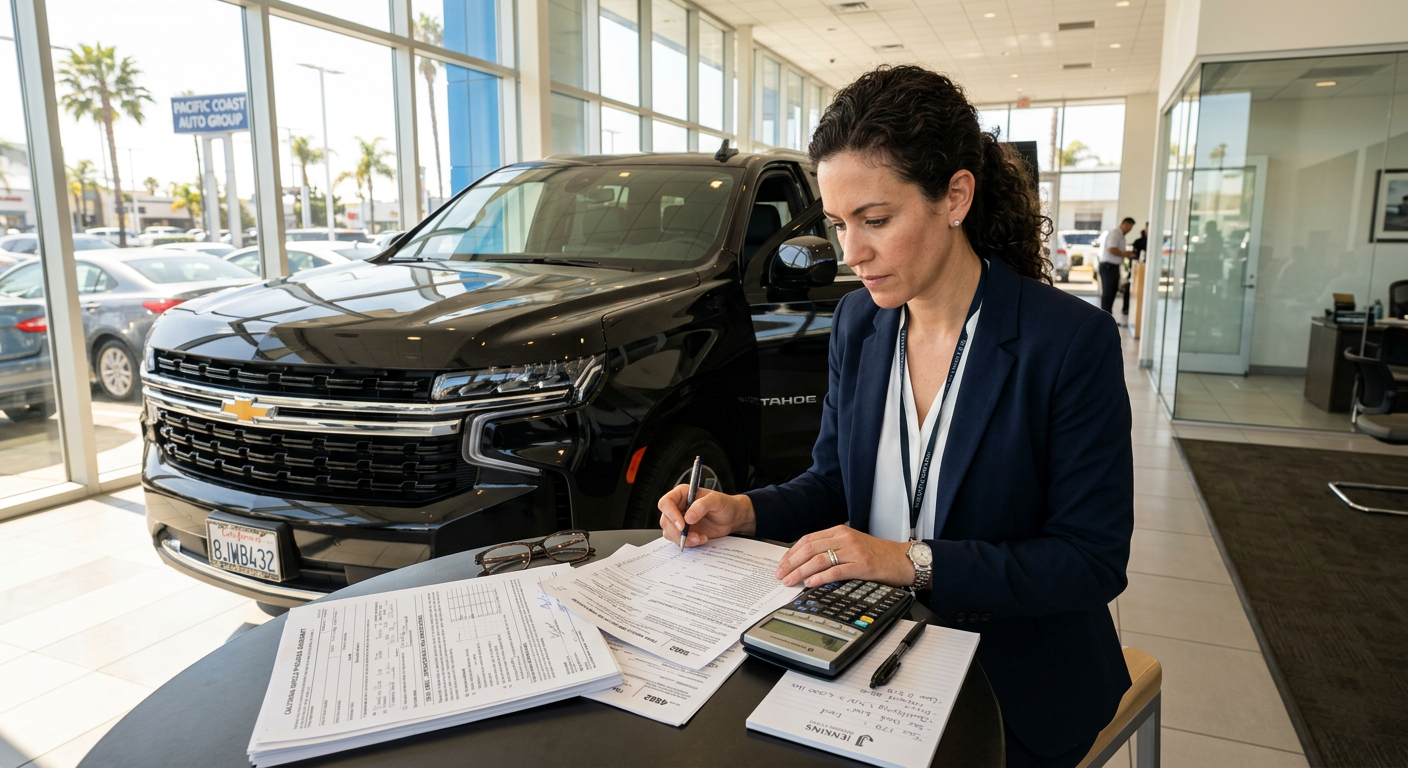
Here’s a scenario that plays out in tax offices across California every single year: a business owner buys a $72,000 SUV, drives it for work 90% of the time, and deducts $18,200. Their neighbor, with an identical vehicle and nearly identical usage, deducts $56,000 in year one. Same truck. Same business use percentage. Dramatically different tax outcomes — because one of them understood how Section 179 vehicle limits 2025 California rules actually work, and the other one didn’t.
This guide breaks down exactly where the gap is, who qualifies for accelerated vehicle deductions, how California’s non-conformity rules create a dual-track trap, and what steps you need to take before December 31st to capture the maximum deduction on your next business vehicle purchase.
Quick Answer: What Are the Section 179 Vehicle Limits for 2025?
For the 2025 tax year, the IRS allows a full Section 179 deduction of up to $1,050,000 for qualifying business property — including vehicles. But that ceiling applies differently depending on the vehicle’s gross vehicle weight rating (GVWR). Here’s the short version:
- Vehicles over 6,000 lbs GVWR (heavy SUVs, trucks, vans): Eligible for up to $31,300 under Section 179’s SUV cap, plus bonus depreciation on the remaining basis
- Vehicles over 6,000 lbs that are NOT SUVs (full-size pickup trucks, cargo vans, box trucks): Can qualify for the full Section 179 up to $1,050,000 — no SUV cap applies
- Luxury passenger vehicles under 6,000 lbs: Subject to the IRS luxury auto limits — $12,400 in year one for 2025, regardless of business use percentage
That single sentence — “no SUV cap applies to heavy trucks and cargo vans” — is where six-figure deduction gaps are born. And in California, there’s an entirely separate layer of rules on top of this that most CPAs gloss over.
The Two-Tier Vehicle Tax System Most Business Owners Don’t Know Exists
The IRS doesn’t treat all business vehicles the same, and it hasn’t for decades. The Internal Revenue Code uses weight class as the primary dividing line between “luxury auto” rules and full expensing eligibility. Understanding which bucket your vehicle falls into is the single most important step in this entire strategy.
Tier 1: Vehicles Under 6,000 lbs GVWR (Passenger Cars, Most Sedans and SUVs)
If your vehicle weighs less than 6,000 lbs, the IRS classifies it as a “listed property” passenger automobile. These vehicles are subject to annual luxury auto depreciation caps under IRS Publication 946. For 2025, the limits are:
- Year 1: $12,400 (without bonus depreciation) or $20,400 (with 40% bonus depreciation)
- Year 2: $19,800
- Year 3: $11,900
- Year 4 and beyond: $7,160 per year
If you bought a $65,000 BMW X3 or Mercedes GLC for your business, congratulations — you’re looking at $12,400 maximum in year one. That’s not a strategy. That’s a slow bleed.
Tier 2: Vehicles Over 6,000 lbs GVWR (The Zone Where Real Deductions Live)
Once a vehicle crosses the 6,000 lb GVWR threshold, it escapes the luxury auto cap entirely. But the rules split again based on vehicle type:
Heavy SUVs (Over 6,000 lbs, but designed primarily for passenger use): Under IRC Section 179(b)(5), the annual Section 179 deduction for heavy SUVs is capped at $31,300 for 2025. This limit exists specifically to prevent business owners from gaming the system by buying personal luxury SUVs and fully expensing them. However, remaining basis is still eligible for bonus depreciation — currently 40% under the federal phase-down schedule for 2025 assets placed in service.
Heavy non-passenger vehicles (Pickup trucks with cargo beds over 6 feet, cargo vans, box trucks, full-size work vehicles): These vehicles are NOT subject to the $31,300 SUV cap. They qualify for the full Section 179 deduction up to $1,050,000 — plus any remaining bonus depreciation on top. A $72,000 Ford F-250 crew cab with a 6.5-foot bed can be fully deducted in year one, subject to business use percentage.
This is the deduction gap that costs California business owners tens of thousands of dollars every year. Many business owners assume their heavy SUV qualifies for full expensing, when in reality the $31,300 cap applies — unless they’ve chosen the right vehicle classification from the start.
California’s Non-Conformity Problem: The Hidden Double-Track Trap
If you think Section 179 vehicle planning ends at the federal level, California has a different opinion. The California Franchise Tax Board does not conform to federal Section 179 expensing limits, and the gap between federal and state treatment in 2025 is substantial.
Federal vs. California Section 179 Limits for 2025
| Rule | Federal (IRS) | California (FTB) |
|---|---|---|
| Section 179 Deduction Limit | $1,050,000 | $25,000 |
| Phase-Out Threshold | $2,620,000 | $200,000 |
| Bonus Depreciation (Vehicles) | 40% for 2025 | Not Conformed |
| Heavy SUV Section 179 Cap | $31,300 | Capped at $25,000 overall limit |
What this means in practice: a California business owner who takes a $56,000 federal deduction on a heavy pickup truck will also need to add back the difference on their California return. You file two separate depreciation schedules — one for federal, one for state — and track the timing difference over the asset’s entire recovery period.
This dual-track requirement catches business owners every year, particularly those who file their own taxes or work with CPAs who specialize in federal returns without deep California FTB experience. For a comprehensive breakdown of how California entity structure interacts with these deduction rules, see our complete S Corp tax strategy guide for California.
The California Add-Back Mechanism
Here’s how the add-back works step by step:
- Federal return (Form 4562): You claim $56,000 in year-one depreciation on your heavy truck (Section 179 + bonus depreciation)
- California return (Schedule CA): You add back the amount above $25,000 — in this case, $31,000
- California depreciation: You then claim the California-allowed portion under California’s slower recovery schedule over the following years
- Tracking: You maintain a separate California depreciation ledger for every asset with a federal/state timing difference
Fail to track this correctly and the FTB will assess additional tax, interest, and potentially penalties when the asset is eventually sold and the gain calculation doesn’t reconcile. Our tax planning services include dual-schedule tracking as a standard deliverable for every vehicle purchase over $30,000.
Which Vehicles Actually Qualify in 2025? The Complete List
Before you walk into a dealership, you need a list. Here are the commonly purchased vehicles that clear the 6,000 lb GVWR threshold and qualify for heavy-vehicle treatment under Section 179 vehicle limits 2025 California rules:
Full Section 179 Eligible (No SUV Cap — Pickup Trucks and Work Vehicles)
- Ford F-250, F-350, F-450 (crew cab and regular cab)
- Chevrolet Silverado 2500HD, 3500HD
- GMC Sierra 2500HD, 3500HD
- RAM 2500, 3500
- Ford Transit 250, 350 (cargo van)
- Mercedes-Benz Sprinter 2500 (cargo configuration)
- Chevrolet Express 2500, 3500 (cargo van)
Heavy SUVs (Subject to $31,300 Section 179 Cap)
- Cadillac Escalade (GVWR 7,100 lbs)
- Chevrolet Suburban (GVWR 7,200 lbs)
- Ford Expedition (GVWR 7,300 lbs)
- Lincoln Navigator (GVWR 7,450 lbs)
- Chevrolet Tahoe (GVWR 7,100 lbs)
- Toyota Land Cruiser (GVWR 6,614 lbs)
- Toyota Sequoia (GVWR 6,900 lbs)
- RAM 1500 TRX (GVWR 7,100 lbs)
- Tesla Model X (GVWR 6,768 lbs)
Not Eligible for Heavy-Vehicle Treatment (Under 6,000 lbs)
- Tesla Model Y (GVWR 5,712 lbs)
- BMW X5 (GVWR 5,765 lbs — borderline, verify current year rating)
- Mercedes GLE (GVWR 5,842 lbs)
- Most luxury sedans and coupes
Pro Tip: Always verify the GVWR on the vehicle’s door jamb sticker or manufacturer specification sheet before purchase — not the curb weight or payload rating. The GVWR is the gross vehicle weight rating and is the only figure the IRS uses to determine eligibility.
The Business Use Percentage Rule: Where Deductions Get Cut Down
Section 179 is not a free pass to deduct your personal vehicle. The IRS requires that business use be documented, and any deduction is prorated to the percentage of actual business use. If you drive a qualifying vehicle 70% for business and 30% for personal use, your deduction is capped at 70% of the vehicle’s cost.
What Counts as Business Use
- Driving to client meetings or job sites (not commuting to your regular office)
- Travel between business locations
- Business errands and deliveries
- Site inspections for real estate investors or contractors
- Travel to meet vendors, suppliers, or prospects
What the IRS Will Look For in an Audit
- A contemporaneous mileage log (not a reconstructed log prepared after the fact)
- Documentation of business purpose for each trip
- Total annual mileage on the vehicle
- Employer-provided vehicle forms if applicable
The IRS specifically targets vehicle deductions in small business audits. Per IRS Publication 463, taxpayers who claim vehicle deductions without contemporaneous records face disallowance of the entire deduction — not just an audit adjustment. Use a mileage tracking app like MileIQ, Everlance, or TripLog to create a defensible record automatically. Want to see how these deductions change your total tax picture? Run your numbers through this small business tax calculator to estimate your actual savings.
KDA Case Study: Riverside Contractor Saves $28,400 by Switching Vehicle Types
In late 2024, a Riverside-based general contractor came to KDA after his previous CPA filed his 2023 return with a $18,200 vehicle deduction on a $67,000 Cadillac Escalade. The contractor used the vehicle 95% for business — site visits, supplier runs, and client meetings — and had impeccable mileage records. The problem wasn’t documentation. It was vehicle selection.
The Escalade is a heavy SUV, which means Section 179 is capped at $28,900 (the 2023 limit). Combined with bonus depreciation at 60% on the remaining basis, the first-year deduction came to approximately $40,200 federal — but only $25,000 on the California return. After KDA reviewed his situation, we modeled a prospective 2024 purchase of a Ford F-250 Super Duty with a long bed. At $71,000 and 95% business use:
- Federal deduction: $67,450 (95% of $71,000 — full Section 179 with no SUV cap)
- Federal tax savings at 32% bracket: $21,584
- California add-back: $42,450 deferred to future years, not lost
- Net first-year benefit: $28,400 when combined with state timing recovery over years 2 through 5
The contractor sold the Escalade and purchased the F-250 before December 31, 2024. KDA also set up a dual depreciation schedule for his California return to properly track the federal/state timing difference. He paid $2,800 for the strategy session and implementation. That’s a 10x first-year return, with continued California deductions flowing through years two through five.
Ready to see how we can help you? Explore more success stories on our case studies page to discover proven strategies that have saved our clients thousands in taxes.
Common Mistakes That Trigger Audits and Disallowed Deductions
Vehicle deductions are one of the top audit triggers for Schedule C filers and small business owners. Here are the mistakes KDA sees most often — and how to avoid them before the IRS comes looking.
Mistake 1: Claiming 100% Business Use Without Personal Use Documentation
Unless you have a second personal vehicle and can document that your business vehicle is truly never used for personal trips, claiming 100% business use is a red flag. The IRS is particularly skeptical of sole proprietors and S Corp owners claiming 100% business use on vehicles they also use as their primary transportation. Keep a second personal vehicle or document precisely why 100% use is legitimate.
Mistake 2: Applying the Section 179 Deduction Before Confirming Business Profit
Section 179 cannot create a business loss. The deduction is limited to your net business income for the year. If your business earned $40,000 before vehicle depreciation, you can only claim $40,000 under Section 179 — not $67,000. The excess rolls forward to future years, but misreading this rule leads to amended returns and penalty exposure. Bonus depreciation, by contrast, can create a loss and potentially be carried back or forward.
Mistake 3: Ignoring California’s Phase-Out for High Property Purchases
California’s Section 179 deduction begins phasing out when total property placed in service exceeds $200,000 in a year. If you purchase $200,000 in equipment and a $60,000 vehicle in the same tax year, you may lose the entire California Section 179 deduction on the vehicle. Federal phase-out doesn’t begin until $2,620,000, so the state threshold is significantly more restrictive for active acquisition years.
Mistake 4: Misidentifying the GVWR
Curb weight and GVWR are not the same. A vehicle might weigh 5,400 lbs unladen but have a GVWR of 6,200 lbs when rated for maximum payload. Always verify the GVWR — not the curb weight — against the IRS 6,000 lb threshold. The vehicle’s door jamb sticker is the authoritative source.
Mistake 5: Forgetting to File Form 4562
Section 179 deductions must be claimed on IRS Form 4562. Missing this form means your deduction is automatically disallowed, even if the vehicle qualifies in every other respect. California requires its own depreciation form as well — FTB Form 3885A for partnerships or Schedule CA for individuals. Both must be filed correctly to avoid FTB notices.
What Changes With the One Big Beautiful Bill Act in 2025?
The One Big Beautiful Bill Act (OBBBA) of 2025 made several adjustments to the broader tax landscape, and while it didn’t fundamentally restructure vehicle depreciation rules, there are two items Section 179 vehicle users need to be aware of for the 2025 tax year:
Bonus Depreciation Phase-Down Continues
Federal bonus depreciation was 60% for 2024 assets and remains on the phase-down schedule. For assets placed in service in calendar year 2025, bonus depreciation is 40%. For 2026, it drops to 20%, and for assets placed in service in 2027 and beyond, bonus depreciation under current law is 0% unless Congress acts to extend or restore it. This is critical for vehicle buyers: every year you wait, the bonus depreciation component of your first-year deduction shrinks. A $71,000 truck placed in service in 2025 captures significantly more first-year depreciation than the same truck purchased in 2026.
New Car Loan Interest Deduction
Under the OBBBA, taxpayers can now deduct qualified passenger vehicle loan interest whether they itemize or claim the standard deduction. This applies to vehicle loans on vehicles primarily used for personal and business purposes, and it compounds the tax benefit of a major vehicle purchase in 2025. Business owners who finance vehicle purchases can now capture both the Section 179 deduction on the asset and a separate deduction for loan interest — two deductions on the same vehicle.
Step-by-Step: How to Maximize Your Section 179 Vehicle Deduction Before Year-End
Use this checklist if you’re planning a vehicle purchase before December 31, 2025:
- Verify the vehicle’s GVWR on the manufacturer spec sheet — must exceed 6,000 lbs to escape luxury auto limits
- Determine vehicle type — pickup truck with 6+ ft cargo bed or cargo van qualifies for full Section 179; heavy SUV is capped at $31,300
- Calculate your net business income before the vehicle deduction — Section 179 cannot exceed this amount
- Apply the business use percentage — multiply the vehicle cost by your actual business use percentage before calculating the deduction
- Run the federal deduction — Section 179 first (up to the applicable limit), then apply 40% bonus depreciation on remaining basis
- Build the California add-back schedule — document the difference between federal and California deductions on a separate tracking sheet
- File Form 4562 federally and the appropriate California depreciation form — missing either form disallows the deduction automatically
- Set up a contemporaneous mileage log starting day one — use an app to create an automatic record the IRS cannot challenge
Do I Need to Own the Vehicle Outright, or Does Leasing Qualify?
This is a common follow-up question, and the answer matters because the deduction rules for leased vehicles are fundamentally different from owned vehicles.
If you own the vehicle, you take the Section 179 deduction or bonus depreciation as described above — claiming basis recovery over the vehicle’s useful life, accelerated to year one if eligible.
If you lease the vehicle, you cannot take a Section 179 deduction or bonus depreciation. Instead, you deduct the business-use percentage of your actual lease payments. For heavy SUVs over 6,000 lbs, the IRS also requires a “lease inclusion amount” to be added back to taxable income — a recapture mechanism designed to prevent lease arrangements from being more favorable than ownership.
In most cases, for vehicles over 6,000 lbs being used heavily for business, ownership produces a larger first-year deduction than leasing. Run the numbers for your specific situation before signing a lease agreement.
Will This Deduction Trigger an Audit?
Vehicle deductions are among the most commonly scrutinized items on Schedule C and Form 1120S returns. But “scrutinized” and “disallowed” are different things. The IRS disallows deductions when documentation is missing — not when deductions are large. A $56,000 vehicle deduction backed by a clean mileage log, a Form 4562 filed correctly, and a consistent business use ratio is defensible. A $12,000 deduction with no log and a 100% personal-use vehicle is not.
The strategy is not to avoid the deduction — it’s to take it correctly. That means documentation first, deduction second.
Ready to Reduce Your Tax Bill?
KDA Inc. specializes in strategic tax planning for business owners, S Corps, LLCs, and high-net-worth individuals. Book a personalized consultation and walk away with a clear plan.
Book Your Vehicle Tax Strategy Session
If you’re buying a business vehicle before year-end and you’re not sure whether your deduction is being maximized — or whether your California return is being handled correctly alongside your federal return — that’s exactly the kind of problem we solve. California’s non-conformity rules, the dual depreciation schedules, and the Section 179 vehicle limits 2025 California framework are not simple. Getting it wrong means leaving tens of thousands of dollars on the table or triggering FTB notices years later when the asset is sold.
Book a personalized consultation with our tax strategy team. We’ll review your vehicle situation, model your first-year deduction under both federal and California rules, and make sure you’re capturing every dollar available before the December 31st deadline. Click here to book your consultation now.
This information is current as of March 7, 2026. Tax laws change frequently. Verify updates with the IRS or FTB if reading this later.



