
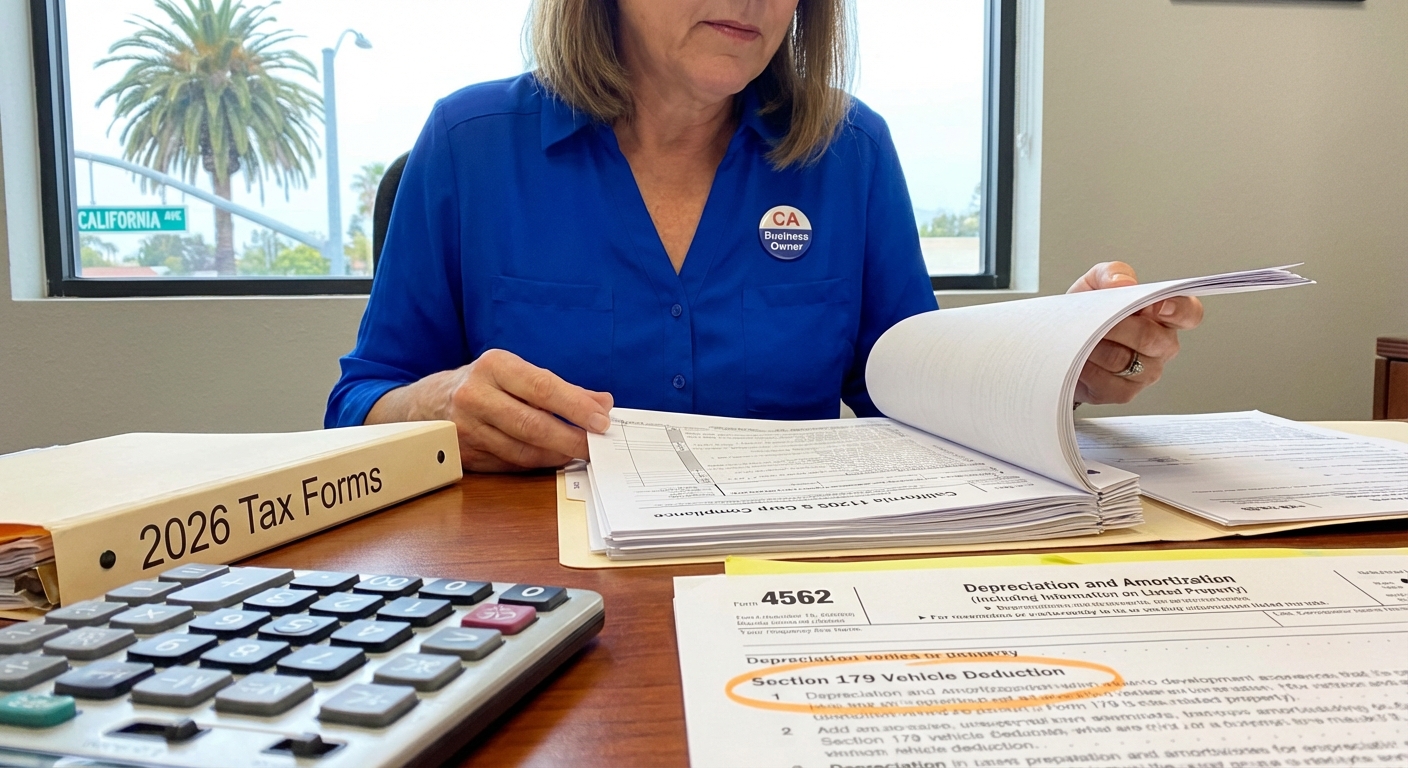
The Unfiltered Truth About Section 179 Vehicle Deduction for 1120S Filers in 2026: What California S Corporations Really Need to Know
Section 179 vehicle deduction for 1120S filers 2024 is one of the most misunderstood—and misused—strategies in the California business world right now. Every March, thousands of S Corp owners attempt to write off a luxury SUV, only to stumble into IRS audit territory or leave tens of thousands on the table. Here’s the direct map to using this rule (legally), with real-world math, persona-driven examples, and the pitfalls that trap even smart founders.
Quick Answer: Can California S Corps Write Off Their Vehicles in 2026?
If your S Corporation (1120S) buys a qualifying business-use vehicle—like a heavy SUV over 6,000 pounds GVWR or a work truck in 2026—you can deduct up to $2,500,000 of the purchase price immediately with Section 179, subject to phase-out rules starting at $4 million in purchases (see IRS Publication 946). But California rules, personal use calculations, and IRS scrutiny make this ripe for errors. The wrong setup means losing both the deduction and audit protection. Details below.
The section 179 vehicle deduction for 1120S filers 2024 is elected at the corporate level on Form 4562, not on your personal return. The deduction first reduces S Corp ordinary income, then flows through to Schedule K-1 under IRC §1366. If the corporation shows a loss after the election, the excess deduction doesn’t create a tax refund by itself—it’s limited by taxable income and then by shareholder basis. Strategic timing of income and equipment purchases determines whether you unlock the full write-off or carry part of it forward.
How Section 179 Vehicle Deduction Really Works for S Corps
Section 179 allows your S Corp to deduct the full business portion of a new or used qualifying vehicle up to the deduction limit ($2.5M in 2026). The car or SUV must:
- Be purchased and “placed in service” by December 31, 2026
- Be used at least 50% for qualified business purposes (personal commuting does NOT count)
- Be financed directly in the business’s name – not the owner’s name
- Have its title AND insurance in the business’s name
- Be a true business asset (think sales, deliveries, customer visits, etc.)
What qualifies? The IRS maintains strict guidelines for vehicle eligibility. Heavy SUVs, pickup trucks, and vans above 6,000 pounds GVWR can usually be written off in full the first year—subject to total Section 179 limits and phaseouts. For passenger vehicles and lighter SUVs, a cap applies (roughly $11,200–$19,200 depending on the year, also called “luxury auto limits”).
Under IRS Publication 946 and IRC §280F, heavy SUVs between 6,000 and 14,000 pounds GVWR are subject to a separate Section 179 limit ($30,500 for 2024) before bonus depreciation is applied. That’s where stacking becomes critical. The section 179 vehicle deduction for 1120S filers 2024 often involves electing Section 179 up to the SUV cap, then applying bonus depreciation to the remaining business-use basis. Done correctly, this bypasses luxury auto limits and accelerates nearly the entire deduction into year one.
For a complete breakdown of S Corp tax benefits, see our comprehensive S Corp tax guide.
If you’re a California business owner with a profitable S Corp, this deduction can swing your taxable income by $60,000–$120,000 in a single transaction. But there’s a catch: if you finance or lease, the terms must be structured correctly, or the deduction is drastically reduced. This is where most taxpayers (and many CPAs) blow it. Read on for precise math, compliance tips, and a KDA case study showing the real-world savings—and red flags.
KDA Case Study: California S Corp Owner Maximizes Section 179 with a $94,500 SUV Purchase
Meet Erica, a Los Angeles-based real estate broker and S Corp owner earning $370,000 per year in commission income through her 1120S entity. In 2026, she purchases a new Mercedes GLE (weighs 6,400 lbs) for $94,500, titled and insured in her company’s name, and uses it for property showings, client meetings, and business errands (70% documented business use).
With careful recordkeeping, KDA runs the full Section 179 strategy:
- Purchase price: $94,500 x 70% business use = $66,150 qualifying basis
- First-year write-off using Section 179: $66,150 (entire amount, below phase-out)
- Tax savings at Erica’s combined federal/CA marginal rate (42%): $27,783
- Cost of tax planning: $4,000 flat project fee to KDA
- Net ROI: 6.9x in the first year alone
Here’s the kicker: Erica avoided the common FTB red flag that flags vehicles titled or insured personally but expensed by the S Corp. The result: $27,783 back in year one, plus ongoing mileage deductions for business use in future years.
Ready to see how we can help you? Explore more success stories on our case studies page to discover proven strategies that have saved our clients thousands in taxes.

Red Flag Alert: The Most Common Mistakes S Corp Owners Make
Most S Corp owners fail one of these three compliance traps—any one of which can wipe out the Section 179 deduction and trigger an audit:
- Personal Title and Insurance: If you title the vehicle personally, or maintain personal insurance, the IRS can and will deny the deduction. The vehicle must be a business asset.
- Insufficient Business Use: You must demonstrate more than 50% business use (generally through a mileage log). If you can’t, the deduction is lost—retroactively, with recapture penalties.
- No Shareholder Basis: For S Corps, the deduction flows through to the shareholder’s K-1. If you don’t have sufficient basis, you’ll lose some or all of the deduction (see IRS K-1 basis guidance).
The section 179 vehicle deduction for 1120S filers 2024 is worthless if you lack sufficient stock or debt basis. Under IRC §1366(d), deductions exceeding basis are suspended until basis is restored through profits or capital contributions. High-income owners often overlook this after taking large distributions earlier in the year. Advanced planning may involve restructuring shareholder loans or adjusting distribution timing before December 31 to preserve deductibility.
Pro Tip: Want to see your exact tax effect? Plug your business profit into this small business tax calculator and see how Section 179 impacts your 2026 return instantly.
Strategic vehicle purchases can be game-changers if done right. But the IRS and FTB are wise to the most common errors—especially among California S Corps. Our tax prep and filing services ensure bulletproof compliance and optimized savings.
Who Actually Gets the Full Write-Off: Persona-by-Persona Breakdown
The Section 179 vehicle deduction isn’t just for “big companies.” It can be leveraged by a range of taxpayer types:
- S Corp Consultants / 1099s: If you converted to an S Corp for self-employment tax savings and you frequently visit clients, this is your single biggest first-year deduction. Example: $72,000 Range Rover, 80% business use = $57,600 immediate write-off, saving $22,000+ in 2026.
- Real Estate Investors: If your S Corp manages multiple rentals, a heavy-duty work vehicle can be deducted up front—as long as it’s not for personal errands. Track your mileage and business purposes.
- W-2 Employees (Caution): Standard employee wages via a corporation generally cannot use Section 179 directly. If you are both owner and W-2, you must structure reimbursements correctly—don’t try to expense a personally-owned vehicle through payroll.
- LLC Owners Taxed as S Corps: The rules apply exactly the same. The vehicle must be company property, and deductions go through the S election.
Need guidance for your specific business purpose? Get tax help tailored for business owners.
How to Structure Your Section 179 Deduction in California
Your timeline, documentation, and entity setup all matter. Here’s a proven client workflow:
- Estimate your 2026 projected profit (e.g., $190,000 S Corp income).
- Shop only vehicles above 6,000 lbs GVWR (check manufacturer sticker).
- Finance in your S Corp’s name; make all payments from business checking.
- Title and insure the vehicle under the business. This is non-negotiable.
- Track all mileage for the year, keeping a logbook (paper or app-based).
- Have your tax advisor calculate business-use % and Section 179 basis before December 31.
- If using bonus depreciation (100% expensing—reinstated for 2026), coordinate with Section 179 to maximize your total write-off.
- Deduct the business-use portion on your 1120S, flowing through to K-1.
- Keep records for 3+ years in case of audit (logs, purchase docs, FTB compliance files).
Pro Tip: You can combine Section 179 and bonus depreciation for qualified vehicles. For example, if your deduction exceeds the Section 179 limit, the balance may be expensed with bonus depreciation, up to the total cost.
According to the IRS depreciation rulebook, these steps ensure maximum audit defense and savings retention.
Common Myths and What the IRS Won’t Say (But You Need to Know)
Myth 1: “You can write off any car purchase through your S Corp.” False. Personal vehicles, luxury cars, or assets not used at least 50% for business are severely limited by “luxury auto limits.”
Myth 2: “The deduction is unlimited.” False. Section 179 is capped at $2.5M in 2026 and phases out dollar-for-dollar after $4M in equipment purchases. Most S Corps won’t hit this, but investors might with fleets.
Myth 3: “You can deduct payments on a lease under Section 179.” Mostly False—leases might qualify for standard business deduction but rarely for Section 179. Owned vehicles provide full deduction potential.
IRS Fact: You must keep business-use records for the entire recovery period, or the deduction could be “recaptured” (reversed) later. Details: IRS Publication 463.
FAQ: Your Section 179 Deduction Questions Answered
Do electric vehicles qualify?
Many do—if they meet the 6,000-pound requirement. Some models may stack Section 179 with the federal clean vehicle credit. Always check eligibility based on the IRS vehicle list by year.
What mileage records do I need?
The IRS prefers contemporaneous logs (paper or app). You need to track date, business purpose, starting and ending odometer, and total miles. FTB and IRS may deny deductions without this proof.
How does this impact my personal taxes?
The deduction will lower your S Corp’s federal taxable income, reducing your flow-through income on Schedule K-1. You’ll pay less in federal and California income taxes proportionate to your ownership and business use.
Will Section 179 rules change for 2027?
Deductions are indexed for inflation and subject to Congressional changes. Always check with a CPA or IRS guidance each tax year.
This information is current as of 2/11/2026. Tax laws change frequently. Verify updates with the IRS or FTB if reading this later.
Bottom Line: Section 179 Is a Big Win—When Done Right
If you use Section 179 vehicle deduction for your 1120S or S Corp in 2026, you can see 30%-43% cash-on-cash returns—if you document and structure everything perfectly. The traps for California S Corps are real (title, insurance, and basis), but when handled by a professional, the deduction often pays for your new business vehicle up front.
Key Takeaway: Section 179 is not just a deduction—it’s a compliance minefield and opportunity rolled into one. Follow the workflow, mind the details, and bank the savings before audit season arrives.
Social-shareable line: The IRS isn’t hiding these write-offs—you just weren’t taught how to claim them the right way.
Book Your Section 179 Tax Strategy Session
If you’re thinking about buying a business vehicle in 2026, don’t take chances with cookie-cutter advice. Book a Section 179 consultation and get a step-by-step plan tailored to your S Corp, projected profit, and California compliance needs. Book your Section 179 strategy session now and secure your deduction before year-end.



