
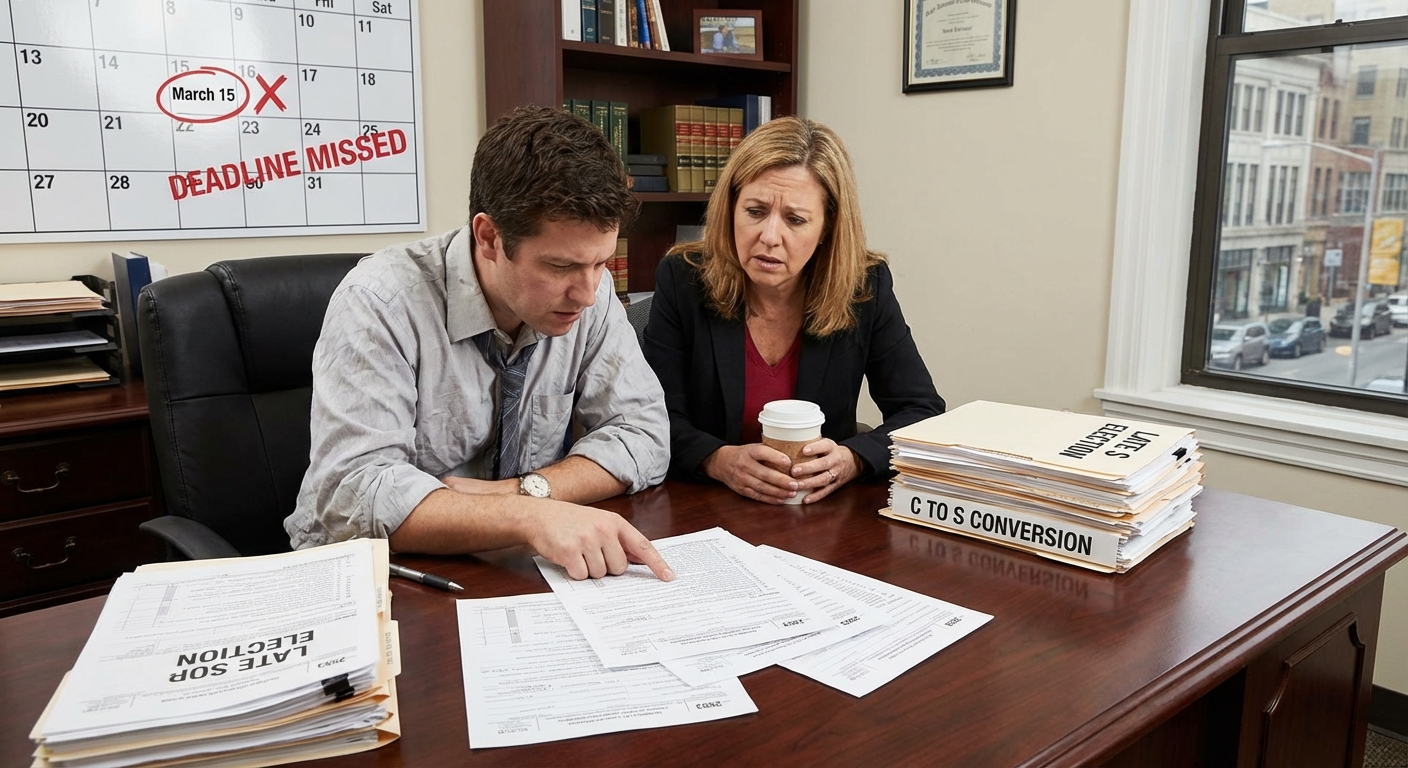
Late Filing to Convert C Corp to S Corp: The High-Stakes 2026 Playbook for Owners Under Pressure
Every year, thousands of C Corporation owners wake up—far too late—to the tax ramifications of missed S Corp election deadlines. They realize too late that defaulting to C Corp status means double taxation and a tangle of penalties that can easily reach five or six figures. Yet, the IRS provides a narrow, high-stakes path for “late filing” conversions. For 2026, understanding the process, requirements, and hidden risks in late filing to convert C Corp to S Corp isn’t just a compliance issue—it’s the difference between hemorrhaging profits and reclaiming tens of thousands of dollars for your business, yourself, and your future exit plan.
When owners ask whether a late filing convert c corp to s corp strategy is still viable, the answer hinges on IRS relief rules—not timing alone. Under Revenue Procedure 2013-30, the IRS can treat Form 2553 as timely if the corporation intended S status, remained eligible, and shows reasonable cause for missing the deadline. This is not forgiveness—it’s a discretionary fix that must be documented precisely or the IRS defaults you back into double taxation.
Quick Answer: What Happens If You Miss the S Corp Election Window?
If a C Corp tries to file for S Corp status after the IRS deadline (no later than 2 months and 15 days after the start of the tax year), it usually remains a C Corp for that year—unless it qualifies for late election relief by proving reasonable cause. The process involves filing IRS Form 2553, attaching a reasonable cause statement, and meeting all eligibility requirements. Approval allows retroactive conversion for the intended year, but mistakes or weak documentation can result in denial, penalties, or forced double taxation for that tax year. The late-election window is a one-shot, high-stakes play: get it wrong and your business may face avoidable tax liabilities and audit risk.
The Mechanics: How Late Filing S Corp Conversion Really Works in 2026
The demand for late S Corp conversions is surging in 2026 for a reason: more C Corp owners, especially in California, are discovering the long-term tax pain of missing the standard election window. Here’s what the process involves—no theory, just critical steps and math you can use now.
- Deadline Recap: For calendar-year corporations, S Corp election is due by March 15 of the tax year. Miss this, and you default to C Corp for the year.
- IRS Relief: The IRS offers late election relief under Revenue Procedure 2013-30 if you can show “reasonable cause”—a legitimate, documented reason for missing the deadline.
- What to File: You must submit Form 2553 (S Corp election), attach a detailed explanation (reasonable cause statement), and all required shareholder consents. Missing shareholder signatures? Incomplete form? Your relief is dead in the water.
- Timeline: You may request retroactive relief for up to 3 prior tax years, but every month you wait increases penalty risk and IRS scrutiny.
- Penalty Math: If denied, you remain a C Corp, which means at least 21–29% federal tax at the entity level, then new tax on personal dividends. A $150,000 profit could see $31,500 in entity tax, then $18,000+ as personal tax.
A successful late filing convert c corp to s corp election is less about filing late and more about proving continuity. The IRS looks for uninterrupted S Corp eligibility from the intended effective date—meaning no ineligible shareholders, no second class of stock, and consistent tax reporting behavior. If dividends were issued or books reflect C Corp intent, late relief under Rev. Proc. 2013-30 is far more likely to be denied.
Pro Tip: IRS late S Corp election is usually granted for legit “reasonable cause,” but the IRS will not accept ignorance of the law or procrastination as reasons. Document everything—and expect to be audited if your story sounds vague or weak.
Persona Playbook: Who Should (and Should Not) Attempt a Late S Corp Election?
This tactic is not for every taxpayer or business owner. Below, see who should aggressively pursue late conversion, and who is better off sticking with C Corp status (or another reset strategy).
- Best Candidates:
- LLC or C Corp owners with $80,000–$900,000 in annual net profit
- Businesses paying distributions (dividends) to shareholders, AND planning long-term owner draws
- Tech, consulting, medical, legal, or creative firms where owners are active participants (1099 income, not pure investors)
- California and high-tax state owners battered by state entity taxes
- Do Not Attempt If:
- Your entity’s net income is under $40,000 annually (benefits rarely outweigh the hassle)
- There are ownership changes or pending exits this year
- Major compliance issues exist (unreported income, payroll issues, etc.)
If you’re in the best candidate group and operate as an LLC, you’ll want to know what entity restructuring makes sense. KDA specializes in tailored entity guidance for business owners mapping out multi-year savings and exit plans.
If you’re unclear if this fits, get tax planning help before you risk an audit. See details on our entity formation service for step-by-step support on entity restructuring, Form 2553 filings, and IRS audit defense.
KDA Case Study: Founder Escapes $42K Double Tax Hit With Late S Corp Conversion
“Grant,” a California C Corp owner (software consulting, $370,000 in profits), believed his CPA had filed his S Corp election on time for tax year 2025. Instead, due to a preparer oversight, his company failed to file Form 2553 until August—five months past the IRS deadline. He discovered the error during his personal tax preparation, as he faced projected double taxation on year-end profits: $77,700 company-level tax, then $29,900 additional tax on dividend income—over $42,000 extra he could have avoided.
KDA used Revenue Procedure 2013-30 to construct a compelling reasonable cause narrative, highlighted CPA documentation error, and obtained late consents from all shareholders. We prepared and filed an updated Form 2553 package to the IRS, including all attachments and tracked delivery confirmation. Within 11 weeks, his late S Corp election was accepted—fully retroactive to January 1 of the prior year. The result: $38,900 in combined tax savings, with ongoing $14,700 per year in net tax reduction. Grant paid KDA $3,750 for the rescue, realizing a 10.3x first-year ROI.
Ready to see how we can help you? Explore more success stories on our case studies page to discover proven strategies that have saved our clients thousands in taxes.

Red Flag Alert: 3 Mistakes That Kill Late S Corp Relief (and Trigger Audits)
- 1. Poor Documentation: “We didn’t know” is not a valid excuse. The IRS wants details: dates, events, and proof of oversight out of owner’s control—especially if relying on outside CPA or attorney.
- 2. Missing Consents: Every shareholder must consent to the S Corp election—even those not actively involved. The IRS will invalidate the entire election if just one form is missing or unsigned.
- 3. Non-Compliance Elsewhere: If your business has payroll errors, late tax payments, or prior entity issues, the IRS may deny late S Corp status and audit prior years.
Key Takeaway: Most IRS relief is denied for incomplete forms, missing shareholder signatures, or “do it yourself” filings without professional guidance.
Step-by-Step: How to File a Late S Corp Election the Right Way
- Verify Entity and Shareholder Eligibility: Confirm all owners are U.S. individuals/eligible trusts, entity is domestic, and only one class of stock exists (see IRS Publication 542 for requirements).
- Complete Form 2553: Use the latest IRS version and fill all sections. Double-check names, EINs, dates, and the effective tax year requested.
- Draft a Detailed Reasonable Cause Statement: Use clear, persuasive facts: What happened, why it wasn’t willful neglect, and the steps taken to prevent recurrence. Reference errors from outside professionals (with proof if possible).
- Collect All Shareholder Consents: Each shareholder must sign and date; missing any voids the relief.
- Attach Supporting Documents: Include CPA communications, emails, and any previous IRS correspondence.
- Send via Certified Mail with Return Receipt: Always track and keep proof—a lost application can’t be refiled after IRS denial.
- Monitor IRS Processing: Typical turnaround is 10–16 weeks, but prepare for possible IRS follow-up, requests for clarifications, or even a compliance phone call.
For a hands-on approach, see our deep-dive guide to late S Corp election at our complete S Corp strategy hub.
What If You Don’t Get Relief? Can You Try Again?
If denied, you remain a C Corp for that tax year. Once the IRS denies relief, refiling is generally not allowed for the same year. This locks in C Corp taxation—no retroactive fix possible until the next tax year. A failed attempt almost always increases future audit risk.
California-Specific Red Tape: Unique Hurdles for Golden State Entities
California adds another layer of pain, requiring both FTB consent and—for corporations—Form 100S filings to be amended retroactively. If you’re caught mid-year, expect compliance notices, penalty assessments, and delays in reconciling state and federal matching records.
- The $800 minimum franchise tax for S Corps applies retroactively if your late relief request is granted.
- If relief is denied, expect C Corp state taxes plus mandatory entity-level fees on gross receipts.
These “split year” scenarios trip up even the most seasoned accountants. Our entity formation and restructuring services handle these coordination headaches—especially for multi-entity groups with real estate or e-commerce income spread across states.
What Documents Do You Need for State Matching?
- Copy of IRS acceptance letter (or certified mail receipt if the IRS is delayed)
- All amended California state forms (100S, 199F, state shareholder consents)
- Clear documentation showing exact effective dates and periods of S Corp treatment
Pro Tip: Use Federal and State Business Tax Calculators (Before You File)
Estimate your tax impact before taking action. Want to see how a successful S Corp election will change your payroll, owner draw, and end-of-year liability? Plug real numbers into a small business tax calculator to project outcomes and avoid last-minute tax shocks.
What If the Election Is Late, But Shareholder Structure Changed?
The IRS requires all individuals who were shareholders at any time during the period the S Corp election is to be effective to sign the consent. Failure to get even “former” owner signatures may endanger the election.
Can You Switch Back to C Corp Later?
Yes, but IRS “conversion back” is tightly monitored. If you switch back from S Corp to C Corp (voluntarily or for noncompliance), you cannot re-elect S Corp status for five tax years (unless IRS grants a unique exception).
Follow-Up FAQs: Navigating the Pitfalls and Hidden Benefits
What Are “Reasonable Causes” the IRS Accepts?
- Professional preparer or advisor error (with documentation)
- Filing process breakdown outside of owner’s direct knowledge/control
- Business reorganization or merger during election period
- Severe illness or “force majeure” impacting ability to comply timely
Note: “Did not know about the deadline” is not accepted.
How Long Does the IRS Take to Respond?
Plan on 10–16 weeks, though processing may take longer in peak tax season. Always follow up if you have not received a response after 12 weeks.
How Much Can I Really Save With a Successful S Corp Election?
Savings depend on profit, owner/employee salary, and state taxes avoided. For an owner with $200,000 profit, the S Corp status may reduce total taxes by $16,000–$34,000 annually.
Is There Any Downside to a Successful Late Election?
Yes—S Corps have strict compliance, payroll, and reporting requirements. You must run owner payroll, file quarterly payroll tax returns, and maintain detailed minutes and documentation. Noncompliance revokes your S Corp status automatically.
Bottom Line: The 2026 Owner’s Checklist for Late S Corp Election
- Act quickly—every month past the deadline shrinks your chances of retroactive relief.
- Prepare an airtight reasonable cause statement, backed by documentation.
- Obtain all shareholder consents—past and present owners matter.
- Keep all supporting documents, certified mail receipts, and IRS communications.
- Coordinate federal and California filings for retroactive state tax compliance.
This information is current as of 2/9/2026. Tax laws change frequently. Verify updates with the IRS or FTB if reading this later.
Book Your Late S Corp Election Rescue Session
If you’ve missed the S Corp election window and face a punitive C Corp tax bill, strategic action now can save your business tens of thousands of dollars. Book a personalized session with KDA’s top entity strategists and get a battle-tested, IRS-compliant plan before it’s too late. Click here to book your consultation now.



