
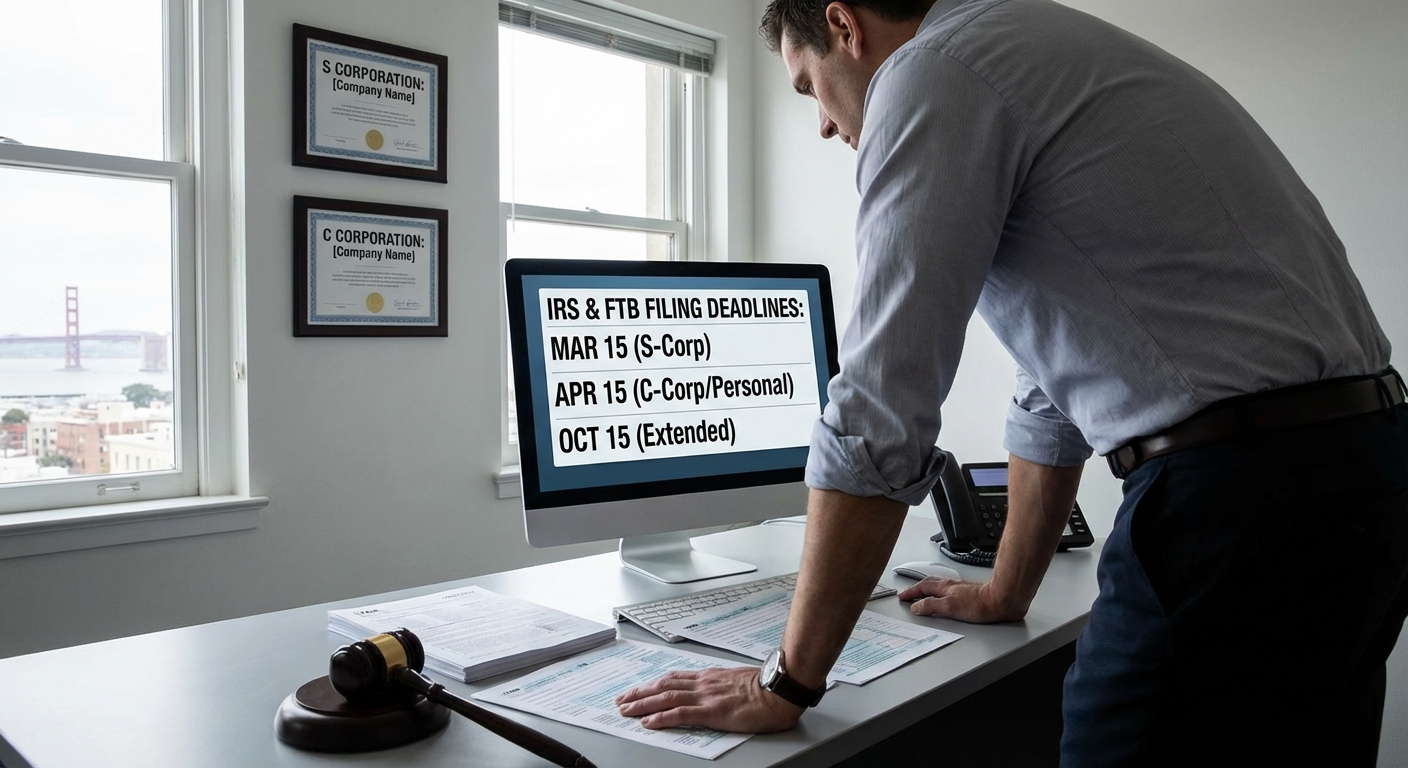
When an S Corp Turns Into a C Corp: The Costly Triggers California Owners Overlook in 2026
If you walk into almost any CPA’s office this tax season and ask about S Corps, you’ll get the same answer: “You’re fine unless you blow the basics.” That advice is exactly why so many California business owners, high-income W-2s, real estate investors, and even 1099 consultants are blindsided by one of the worst surprises in tax—when their S Corporation is automatically reclassified as a C Corporation by the IRS or FTB. This isn’t just an annoyance. Get reclassified for even a single year and your business could face double taxation, blown deductions, and up to $22,000 extra in California/franchise taxes—all with little warning.
Quick Answer
When does an S Corp turn into a C Corp? It happens if your entity breaks certain ownership, stock, or compliance rules outlined by the IRS or the California Franchise Tax Board—sometimes by accident, sometimes by oversight. Typical triggers include taking on the wrong shareholder, issuing a second class of stock, missing key deadlines, or ignoring new state tax changes. The result: You’re taxed as a C Corp until you file corrective action and sometimes can’t re-elect S status for five years. (Get the full S Corp strategy guide here.)
This topic matters in 2026 more than ever. New tax law changes, tighter audit analytics, and shifting California rules have put thousands of S Corps at risk of accidental reclassification. Here’s how to protect yourself—and what to do if you’ve already triggered a conversion.
The High-Stakes Triggers: Why S Corps Become C Corps Without Warning
S Corps in California can become C Corps by accident. These are the top triggers for 2026:
- Violating shareholder rules: S Corps can only have 100 eligible shareholders, all of whom must be U.S. citizens or resident aliens. Bringing in a foreign investor or an entity (LLC, partnership, some trusts) instantly blows S status.
- Issuing a second class of stock: Granting stockholders different voting, dividend, or liquidation rights—even in a shareholder agreement—means you now have a C Corp.
- Missing IRS or FTB communications: The FTB and IRS both require ongoing compliance—think annual filings, statements of information, and franchise fees. Miss even one, and the state may revoke your S status.
- Late or incomplete S election: If Form 2553 isn’t filed correctly, on time, or with the right supporting documents, the IRS defaults your company to a C Corp for the tax year.
For a specific example: A successful California software startup had all individual U.S. shareholders—but one founder moved to Canada and became a non-resident. The IRS sent a letter, revoked S status retroactively, and the company saw a $38,000 double-taxation hit. The problem? Their CPA never audited the cap table after the move.
If you’re running a business or own rental properties in California, you need to be proactive. Many business owners and tech professionals overlook these risks until it’s too late—and the cost can dwarf even serious annual profits.
KDA Case Study: High-Income 1099 Consultant Hit by S to C Corp Reclassification
Chris (not his real name) is a Los Angeles-based 1099 consultant who netted $270,000 in 2025. He had an S Corp and thought everything was set—until he tried to bring his spouse (a Canadian national) onto the cap table for a minority interest. His CPA approved it, but less than three months later the IRS sent a notice: The S Corporation election was revoked, and his entity would now be taxed as a C Corp retroactively from the date of the transfer.
Chris faced an immediate $32,000 federal-tax hit and $6,400 in extra California franchise taxes. Family health insurance, which was fully deductible as an S Corp, became a partial deduction. He lost QBI (Section 199A) deduction eligibility and a five-year waiting period before he could re-elect S status. Chris hired KDA; our team filed for retroactive relief with a Private Letter Ruling (PLR), showed reasonable cause for the breach, and negotiated IRS approval. Net result: $26,800 in direct tax savings versus doing nothing, all for a $4,100 service fee.
Ready to see how we can help you? Explore more success stories on our case studies page to discover proven strategies that have saved our clients thousands in taxes.
How to Prevent an S Corp from Becoming a C Corp: Proactive Defense in 2026
To keep your S Corp classification safe under 2026’s tougher scrutiny, use these defense tactics:
- Annual shareholder audit: Each year, verify that every shareholder remains a U.S. citizen or resident—watch for moves, estate changes, and trust updates.
- No second-class stock (ever): Review bylaws, investment docs, and profit-sharing arrangements. Even “phantom” classes buried in side agreements can kill S status.
- On-time filings: Pay both IRS and California FTB franchise fees, franchise taxes, and file all statements on time (Form 100S, FTB 3522, etc.).
- Surplus checks: Issuing special dividends or distributions can accidentally create new stock classes. Run every distribution by your tax strategist.
Strategic year-end moves can save thousands. Our tax planning services help identify these risks and build compliance checklists for your business. For a complete breakdown of S Corp strategies, see our comprehensive S Corp tax guide.
What If My S Corp Was Already Reclassified? The Reversal Paths
If you’re hit with an S-to-C switch, you’re not stuck forever—timing, speed, and honest disclosure are everything. Here’s how to take action:
- Identify the violation quickly: Review IRS and FTB notices. Find the incident date, and the specific rule broken.
- Gather documentation: Prove reasonable cause (death, bad legal advice, honest mistake).
- PLR request (Private Letter Ruling): For recent violations, filing a request with the IRS (alongside Form 2553) may restore S status retroactively—especially if you act within a year of the violation. See IRS Form 2553 instructions.
- Correct the breach: Remove ineligible shareholders, fix documentation, and stop further violations immediately.
- California coordination: If the FTB has revoked your status, you’ll need to submit a separate appeal. The California FTB S Corporation guidance provides step-by-step instructions.
Plug your business profit into this small business tax calculator to estimate how S Corp vs C Corp status could affect your annual liability this year.
This defense often works for small business owners who acted in good faith and didn’t intend to break the rules—but you need to act fast. If denied, you might have to wait five years before you can file for S Corp status again.
Common Mistake: Thinking You’ll Get “Warning” Before IRS or State Revokes S Status
The biggest myth: “I’ll get a heads up if my S Corp is at risk.” Wrong. Many IRS and FTB computer systems automatically reclassify your entity without notice if a prohibited shareholder comes on board, distributions are misclassified, or filings are missed. By the time a letter arrives, you may have already triggered thousands in double taxes and lost deduction eligibility. Don’t trust generic software or inattentive tax preparers to protect you—S Corp clients should demand proactive compliance reviews each year.
Pro Tip: Keep documentation of all shareholder citizenship/residency and annually review your bylaws and equity agreements. “Accidental” stock classes or legacy agreements can quietly haunt your S status for years.
California-Specific Complications and 2026 Tax Trends
California cracks down on S Corps even harder in 2026. Here’s what stands out:
- Annual FTB S Corp statement penalty: Miss this and your status is at risk—penalties now start at $2,000 per year after recent changes.
- Franchise tax increases: The minimum tax on C Corps is higher and seldom waived, while S Corps still owe the $800 floor. Once reclassified, you may pay both depending on timing.
- State-level audits: The FTB’s audit analytics target businesses with cap table changes, international owners, amended returns, and missed franchise statements. California-specific guidance is available here.
This information is current as of 2/3/2026. Tax laws change frequently. Verify updates with the IRS or FTB if reading this later.
FAQ: Your Next Questions Answered
How quickly does the IRS revoke S status after a violation?
Usually, as soon as the violation is detected via returns or a triggered audit cycle. You may not find out until months later—ignoring a notice can make status loss permanent for the year and harder to reverse.
Can an estate or trust own S Corp stock?
Only certain types of trusts (QSST, ESBT) and estates are eligible shareholders. Regular living trusts or ineligible trusts will cause immediate S status revocation. See IRS S corporation rules.
Does this affect real estate LLCs that elected S Corp status?
Yes. Any LLC taxed as an S Corp faces the same triggers—mixing investment and active shareholders, trust issues, or dividend changes will blow S status even faster with an LLC.
What about reverting from C to S later—can I do this anytime?
No. In most cases, you must wait five years after losing S status before re-electing, unless you win an IRS private relief ruling.
What forms do I need to review if I suspect a breach?
Start with your IRS Form 1120S, Form 2553, cap table, bylaws, and all California FTB filings (including Statement of Information and FTB 3522 payments). Engage a pro for a line-by-line review if you’re unsure.
Book Your S Corp Compliance Audit
If you’re not 100% sure your S Corp is safe, or you think you may have already triggered a C Corp reclassification, schedule a personalized strategy session. Our team will review your full compliance, cap table, and filings to lock in savings and prevent catastrophic tax hits. Click here to book your consultation now.



