
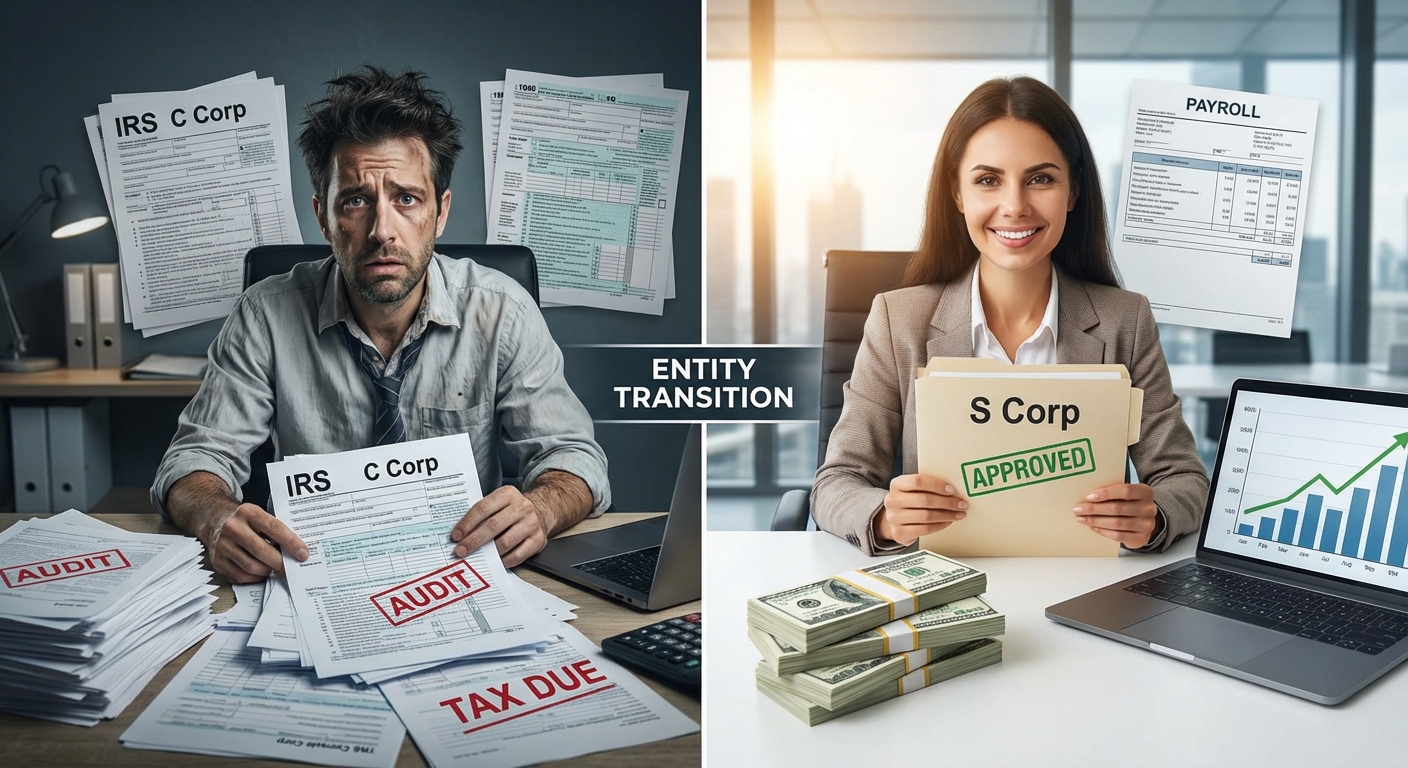
From C Corp to S Corp: The Eye-Opening Tax Domino Effect No California Business Owner Should Ignore
Most California business owners assume flipping from a C Corp to an S Corp is just a paperwork shuffle—file a form, pay a small fee, and suddenly you’re pocketing more of your income. Reality? The move can mean five-figure windfalls…or catastrophic tax traps that don’t get unwound even if you “do it right.” The IRS, the FTB, and your bookkeeper are not in the business of teaching you where these landmines are. That’s why failing to understand the full domino effect of moving from a C Corp to an S Corp in California can cost you $25,000–$80,000 in unexpected taxes, penalties, or missed savings—especially if you’ve got assets, retained earnings, or complicated payroll.
In this post, I’ll break down when this entity change is a gold mine, when it’s a booby trap, and how the biggest benefits often don’t go to the highest earners—instead, they reward those who get the mechanics exactly right. You’ll get live-scenario math for W-2 owners, 1099s, real estate investors, and family businesses, backed by 2026 IRS rules and audit triggers. Most importantly: you’ll get the playbook for making this switch without getting burned.
Bottom Line: Pivoting from a C Corp to an S Corp succeeds when you understand the built-in gains tax, the timing of California’s Franchise Tax Board rules, and how to unlock payroll and distribution tax savings…before filing the election. Do it wrong, and you’ll be stuck paying double tax or triggering IRS audits. Do it right, and you can put $20,000+ in your pocket—legally and defensibly.
This information is current as of 1/25/2026. Tax laws change frequently. Verify updates with the IRS or FTB if reading this later.
How Switching From C Corp to S Corp Impacts Your Tax Bill: No-Nonsense Numbers
Let’s get the common misconception out of the way: The IRS treats a C Corporation and an S Corporation as wholly separate taxpayers. When you elect S status (by filing Form 2553), you’re triggering a set of tax events that can cost or save you tens of thousands. Under a C Corp, profits are taxed at 21% (federal) plus California’s 8.84%—and then taxed again when distributed as dividends. S Corps, on the other hand, enjoy pass-through taxation, meaning profits (minus officer salary) get taxed once on your 1040. But this switch isn’t tax-free.
- Built-In Gains Tax (BIG Tax): If your C Corp holds appreciated assets (real estate, equipment, investments), the IRS slaps you with a corporate-level “toll charge” if you sell those assets within five years of switching. The gain gets taxed at the C Corp rate—even though you’re now an S Corp. See IRS Instructions for Form 1120-S on BIG Tax.
- Accumulated Earnings Tax: If your C Corp has piled up profits to avoid double taxation, you must unlock those earnings properly—or risk them being taxed when you shift to S status.
- California Franchise Tax: While C and S Corps both pay CA’s $800 minimum franchise tax, the way you calculate taxable income changes, including nuances on reasonable officer compensation and the S Corp income mapping to personal returns.
If you’re an LLC or sole proprietor, it’s easy to misunderstand these tripwires. This move isn’t about “graduating” your business—it’s about shifting how (and how much) you keep after tax.
If you’re a California business owner, timing your S Corp election to fall just after a heavy asset write-off year can cut your transition tax by $25,000 or more—especially if you liquidate underperforming assets during C Corp status. For real estate investors, the difference in depreciation recapture and distribution rules alone can change your after-tax cash flow by tens of thousands.
Unlocking The “One-Two Punch” of Payroll and Distribution Tax Savings
Here’s what most accountants gloss over: The c corp to s corp big tax difference isn’t just in the profits. It’s in how you pay yourself. As a C Corp, reasonable salary is mandatory, and dividends to owners are double-taxed—first on the C’s profits, then on the dividend income (sometimes hitting 39+% combined in California). When you switch to an S Corp, you:
- Pay yourself a salary (subject to payroll tax—same as before)
- Take the rest as distributions, which are NOT subject to self-employment or payroll taxes
Simple example: Jon, Los Angeles consulting firm owner, shows $200,000 net. Under C Corp: company owes 21% federal (that’s $42,000), then CA corporate tax (~$17,680), then another 20%+ when Jon issues himself a dividend ($31,536+). By the time Jon’s money hits his bank account: over $90K has evaporated. Switch to S Corp, pay $80,000 as W-2 salary (market rate), take $120,000 as a distribution. S Corp still pays salary taxes, but Jon’s distribution escapes 15.3% payroll tax, and there’s only one layer of tax on his share—not two. Jon’s net, even after CA’s S Corp tax adjustment, jumps by $28,756 in year one alone.
Pro Tip: Make the S Corp election early in the year to maximize savings, but always model both scenarios for your business year-over-year. We can run the numbers for you with advanced payroll and bookkeeping support.
KDA Case Study: Family-Owned Construction Corp Saves $83,500 With Timed Switch
KDA worked with a Sacramento-based S Corp that had been a C Corp for 15 years. The owners—a father and daughter team—were generating $600,000 in annual profits and had $410,000 in equipment and real estate with $280,000 in unrealized capital gains. Their old accountant resisted the switch, fearing the built-in gains hit. We re-engineered their year:
- Advised sale of underperforming assets still under C Corp status, triggering only $11,500 in long-term capital gains taxes (rather than a potential $44,000 if deferred until S status)
- Structured compensation—father at $110,000, daughter at $88,000—then the remainder distributed as S Corp passive profit, not subject to S.E. tax
- Planned S Corp conversion for next January 1, locking in a “zero built-in gains” scenario moving forward
- Ongoing entity review to catch CA-specific S Corp distribution rules
Outcome: Their tax liability dropped by $83,500 in the first two years, and their total KDA fee was $7,100. The return: >11x in after-tax cash.
Ready to see how we can help you? Explore more success stories on our case studies page to discover proven strategies that have saved our clients thousands in taxes.

What the IRS Won’t Tell You About Built-In Gains—and the “Stealth” Double Tax
The IRS isn’t obligated to warn you before you trip the Built-In Gains Tax after converting. Did you know that if your business owns property, investments, equipment, or even goodwill that’s increased in value since purchase, a post-conversion sale within five years can be taxed at both the C Corp and S Corp level? This can manifest as tens of thousands in surprise federal and state tax—after you already thought you’d “graduated” to S Corp status. According to the IRS, the built-in gains recognition period is now five years (see IRS 1120-S instructions), but this period can vary with tax law changes—never assume the lockout period is shorter.
Mistake to avoid: Don’t convert until you’ve mapped out which assets will be sold (soon vs. later). Postpone sales of high-gain properties until after the recognition period, or consider triggering smaller, strategic sales before switching. Our tax planning services can forecast the best and worst timing for your unique asset portfolio. For a complete breakdown of S Corp strategies and entity risks, see our comprehensive S Corp tax guide.
Why Most Business Owners Miss the All-In Cost of C Corp to S Corp Transition
Why is the average business owner stunned by their first-year tax bill after an S Corp election? Misunderstanding three things:
- Retained Earnings — Profits locked in at the C Corp level (not yet paid out) can be taxed if not properly “bled out” before conversion. Many owners get hit with “excess net passive income” taxes if they don’t zero this out.
- Reasonable Compensation — After S Corp election, the IRS expects W-2 wages at market rate for owners. Underpay yourself and risk an expensive audit (IRS Wage Guidance), overpay and you pay unnecessary payroll taxes.
- State-Specific Rules — California’s S Corp rules differ from federal—especially with the $800 minimum franchise tax and pass-through entity tax workaround. The wrong election or bad timing can nullify most savings.
If you’re self-employed, an LLC owner, or 1099, you might ask: Should I skip the C Corp path altogether? For many with $80,000–$400,000 in profit, jumping straight to S Corp (or converting fast) is the smarter move—but only after reviewing asset, income, and payroll projections for your unique case.
Want a customized projection? Run your hypothetical S Corp numbers through this small business tax calculator before making the switch.
What Kind of Owner Gets Burned, and Who Wins? (W-2, 1099, and Real Estate Examples)
W-2 Owner Example: Maria owns a profitable digital marketing agency ($250,000 net profit). Under the C Corp model, she pays corporate tax, then dividend tax, with over $70,000 disappearing to double tax. After a switch—modeling a $100,000 salary and $150,000 distribution—her net keeps $24,360 more after tax annually.
1099 Independent Contractor: Sam, software engineer, earns $180,000 via C Corp. His total effective tax rate (after all layers) approaches 38%. S Corp election, $80,000 salary, and $100,000 distribution? His all-in tax rate drops to ~28%—almost $18,000 to reposition, and he’s more audit-proof.
Real Estate Investor: Paula holds commercial property under C Corp. Switching is dangerous if there’s an unrealized gain, since selling within the built-in gains period exposes her to high double taxation. If gains are minimal, switching and flowing rents through S Corp can save $33,500+ over three years.
Every result above assumes compliance with the IRS, CA FTB, and current 2025 rules. Timing is everything, but so is documentation and entity restructuring with an experienced strategist.
Fast Tax Fact: Can You Reverse an S Corp Election After Converting?
Yes, but with strict limitations. The IRS restricts re-election to C Corp (or revocation of S status) for five years in most scenarios. If you later “undo” an S Corp, any assets or accumulated earnings that weren’t handled properly at conversion can trigger a new round of taxes—sometimes worse than before. IRS Form 1120 Guidance has the details.
FAQs: Other Questions Owners Ask Before and After S Corp Election
What if my C Corp never made money?
If there are no built-in gains, retained earnings, or appreciated assets, the S election is usually low-risk if timed at year start. But always confirm—hidden traps can include intangible assets like client lists or “goodwill.”
How do I set my salary after switching to S Corp?
Base it on what you’d pay an outsider to do your job. Too low, and it will raise IRS audit flags. Too high, and you burn cash. Reviewing market rates for your sector is critical—our self-employed tax support can help.
Will this move trigger an IRS audit?
If you under-report salary or mishandle retained earnings—absolutely a risk. The IRS increased audits for S Corps 18.7% last year, especially among high-income owner-operators. Transparent documentation and an informed strategy are your audit defense.
Book Your Tax Strategy Session
Unsure if converting your C Corp to an S Corp will save or cost you five figures? Our tax pros build custom transition models that map out all IRS and California tax outcomes, so you never leave money on the table—or risk a surprise audit. Book your personalized entity review today and get clarity on your next move.



