
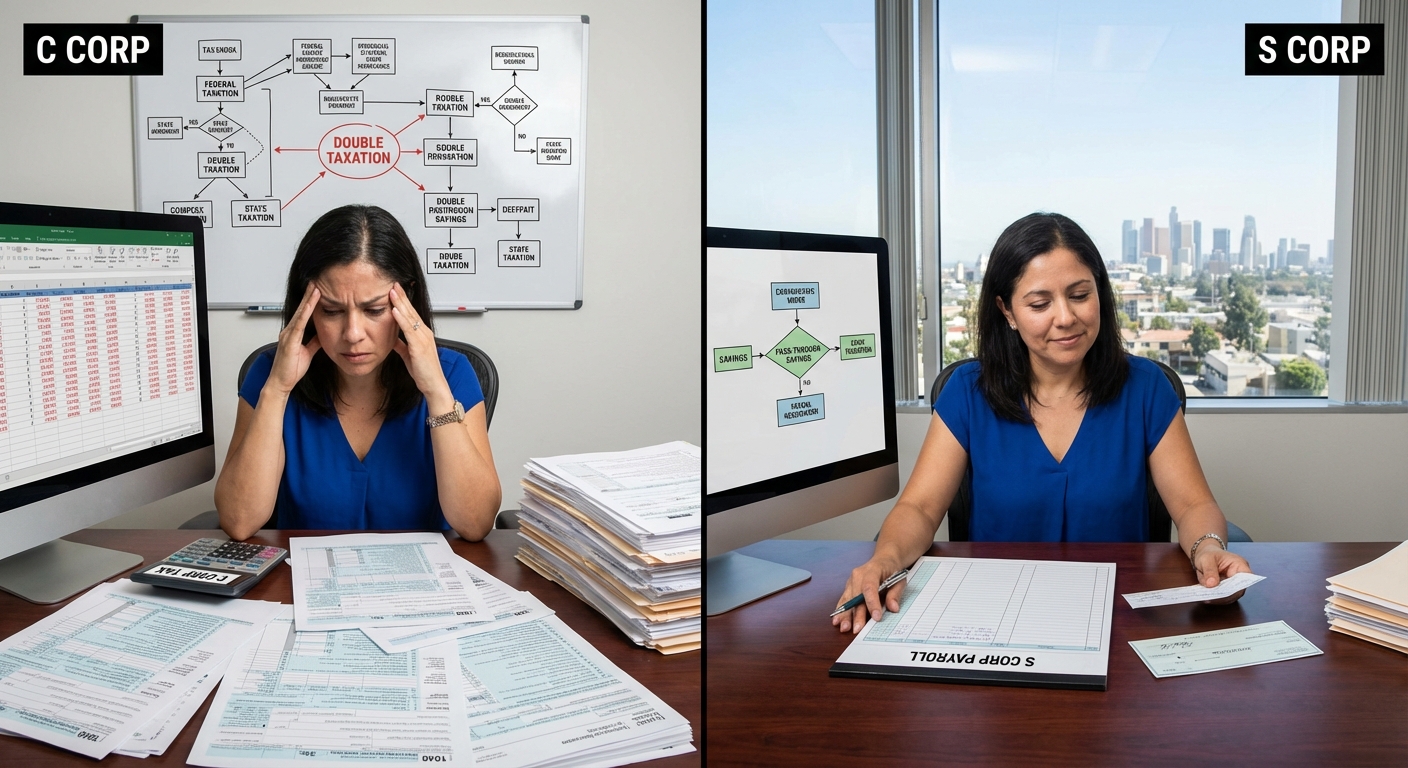
“C S Corp” at a Crossroads: The Entity Truth California Business Owners Can’t Afford to Ignore in 2026
If you’re still unsure whether a c s corp structure lands you in a tax saving paradise or a compliance trap, you’re not imagining it. Every month, California business owners and high earners leave thousands on the table because they never stopped to truly compare these choices side-by-side—or worse, trusted generic advice that doesn’t work for today’s IRS and FTB rules. One number, one election, one missed payroll run, and you’re either pocketing $28,000 more or paying it direct to Sacramento and the IRS.
Quick Answer: Does Entity Type Change Your 2026 Tax Bill?
Yes. Choosing between a C Corporation and an S Corporation can move your effective tax rate by double digits and completely shift your audit and compliance risk profile. For the 2026 tax year, S Corp status lets you pass profits straight through without facing double-taxation, but piles on strict salary/upline rules for owners. C Corps offer more leeway on fringe benefits, but make you pay corporate tax—then again when you take money out personally. If you’re a California LLC considering S Corp election, this decision controls everything from how you take money home to whether or not your next IRS envelope is friendly.
How the “C S Corp” Decision Impacts 2026 Owner Tax Bills—With Real Dollar Examples
The biggest myth about picking a C Corporation or S Corporation is that it’s just about paperwork. Wrong. What you’re really choosing is how every dollar of income, payroll, and profit gets taxed—and whether you’re stacking or dodging layers of federal and state tax. Here’s the reality for real world owner income:
- On $200,000 in net profit—running as a c s corp in S Corporation mode can drop your combined tax bill by $21,480 vs. a C Corp, if you strategize your salary and distribution split right (assuming $80,000 W-2 reasonable comp).
- Miss the “reasonable salary” threshold with your S Corp and watch both the IRS and FTB come after 20%-plus penalties—and invalidate your election.
- Take all profits from your C Corp as dividends without planning? Expect up to 45% effective tax rate when you combine entity-level tax, state, and personal rates in 2026.
If you’re a California owner, this is not hypothetical. You are required by the FTB to pay a franchise tax on C and S Corps, while the IRS vigorously checks for owner salary fraud in S Corps. For a comparison chart and step-by-step tax math for each structure, check our entity formation service page—we break down real, current year figures and FTB rules for 2026 entities.
S Corp Owners: Salary Games, Compliance Nightmares, and the $28K Payoff
The number one blunder for S Corp owners? Misunderstanding the required “reasonable salary” law. The IRS and FTB mandate that S Corp owners working in their business must pay themselves a fair W-2 wage before taking any distributions. This is not a trivial number—they regularly audit the 1120S and 940/941 filings and issue penalties up to 25% of owed payroll taxes plus interest. If you own a 1099 consulting business or a profitable LLC that’s elected S Corp status, the upside is real: pay yourself $70-100K on W-2, distribute $80K, and save $10K–$28K annual in employment taxes compared to all wages or all draws. But fail the documentation or underpay yourself relative to market, and the audit letter will be swift. For engineers or advisors, market data sets the ‘reasonable’ bar high—and the IRS uses labor statistics as proof.
If you’re navigating these S Corp salary rules, our business owner tax insights page features tailored breakdowns for different industries and business sizes.
KDA Case Study: Tech Startup Shifts from C Corp to S Corp—$46,000 Saved First Year
Meet Lisa, a 37-year-old former W-2 product manager who launched her own software firm in San Diego. In 2025, Lisa formed a C Corp to pursue outside funding and keep her options open for future equity incentives. With $455,000 in first-year revenue and $200,000 in profit, she paid a corporate tax bill of $42,000 to the IRS, $8,800 to California, then faced another $24,200 in personal tax on the dividend—the classic double-tax scenario.
With KDA’s guidance, she restructured as an S Corp for 2026, setting her salary at $95,000 and taking $105,000 as owner distribution. This move slashed social security and Medicare taxes, cut state pass-through tax, and legally kept $46,720 compared to the prior year. Her effective tax rate dropped from 39% to 23%. All compliance reporting was handled by KDA for a fixed $7,200 annual fee—ROI: 6.5x first year, and peace of mind with IRS/FTB-proof records.
Ready to see how we can help you? Explore more success stories on our case studies page to discover proven strategies that have saved our clients thousands in taxes.

Red Flag Alert: When “C S Corp” Triggers More IRS and FTB Notices
Most agencies see a spike in S Corp and C Corp IRS and FTB notices around Q2 of every year—and for good reason. The biggest audit flags in California for both entity types in 2026:
- Missing the California minimum $800 franchise tax—applies to both S Corps and C Corps (see FTB Form 100).
- Reporting no owner salary at all on an S Corp—instant audit trigger and cause for FTB/IRS to revoke your S election retroactively.
- Pure personal cash withdrawals from a C Corp without payroll or substantiation.
- Late-filed forms 1120, 1120S, 941, 940, or California Form 100—each can stack thousands in penalties and lose your liability shield if you’re late or incomplete.
According to IRS Form 1120S instructions, penalties often reach $205 per shareholder per month after 60 days late. FTB can bar your right to do business if unfiled after 6 months. Don’t risk retroactive tax status reversal—keep all filings on time, every time.
How to Actually Switch: Practical Steps for Changing Your Entity Status in California
This is where theory becomes dollars: changing from one corporate status to another is neither quick nor risk-free for California business owners. Here’s the real-world checklist for moving from a C Corp to an S Corp (or the other direction) in 2026:
- Run a profit/loss projection and owner compensation forecast. Get granular on salary, distributions, and projected cash needs—this dictates if S Corp saves or costs you.
- Obtain unanimous shareholder approval (IRS requires it on Form 2553 for S Corp election).
- File IRS Form 2553 by March 15, 2026 for S Corp status retroactive to January 1. Late? There are ways to fix, but you’re playing with fire, especially in California.
- For C Corp to S Corp, manage retained earnings: improper conversion can create double-tax traps (consult a tax pro on how to distribute prior-year profits first).
- Update payroll systems, officer registers, and state filings to reflect new status.
- Notify shareholders and update corporate bylaws—legal documentation is just as critical as the tax filing.
For a complete breakdown of S Corp strategies, see our comprehensive S Corp tax guide. We cover every deadline, dollar impact, and FTB/IRS interaction you’ll face.
Pro Tip: Don’t Confuse LLC, C Corp, and S Corp Language—The IRS and FTB Won’t Cut You Slack
The term “S Corp” is a tax status—NOT a business type. You can have an LLC taxed as an S Corp or as a C Corp, depending on IRS election. Many California CPAs see new LLCs file as S Corps, but then they forget to run W-2 payroll or issue necessary forms. Others keep their businesses in C Corp status for years, missing out on thousands in payroll, retirement, and health plan deductions only open to S Corps. If you’re eyeing a reclassification, update your business documents, payroll providers, and file every form—from entity status change letters to IRS/FTB returns—on time.
Social-Shareable Hook: The delta between C Corp and S Corp isn’t paperwork—it’s $28,000 per year for a 6-figure owner, and one form letter away from an IRS audit.
Common Questions for “C S Corp” Owners in 2026
What if I File My S Corp or C Corp Forms Late?
Late S Corp or C Corp filings mean penalty shock: $205 per shareholder per month, plus FTB assessments and risk of taxable status loss. There are late election forgiveness procedures, but IRS and FTB are tightening them each year. When in doubt, consult a pro before missing a deadline.
Can I Revoke S Corp Status If I Change My Mind?
Yes. File a revocation statement with the IRS—ideally before the start of your next tax year. However, once revoked, you can’t re-elect S Corp status for five years, and all built-in gains may become taxable. Plan with your CPA before pulling this trigger.
How Do I Decide If an S Corp Is Worth It for My LLC?
Have your advisor run side-by-side 3-year projections comparing W-2 wages, profit distributions, payroll tax savings, added compliance costs, and your withdrawal habits. Most owners with over $80,000 profit benefit from an S Corp—but only with bulletproof documentation and annual salary reviews.
Pro Shortcut: “Small Business Tax Calculator” for C and S Corp Profit/Stakes
You can plug your business numbers into this small business tax calculator to see how your take-home stacks up under C Corp and S Corp rules. Test your 2026 strategy before you file—the difference might be $15,000 or more for most California small business owners.
Next Steps: Making the “C S Corp” Decision Count for 2026
This isn’t just paperwork—it’s the core profit machine for your business. Review your net income, owner labor, distribution expectations, and risk tolerance before making the move.
This information is current as of 1/22/2026. Tax laws change frequently. Verify updates with the IRS or FTB if reading this later.
Book Your Entity Strategy Session—Stop Overpaying and Start Taking Home More
If you’re a California business owner, freelancer, or investor unsure whether you’re leaving thousands on the table with your C Corp or S Corp setup—or risking an audit by missing a required step—schedule a custom strategy session with our KDA pros. We’ll show you exactly how to structure your salary, distributions, and compliance steps for maximum after-tax profit and minimum headache. Click here to book your entity strategy consult and safeguard your 2026 profits now.



