
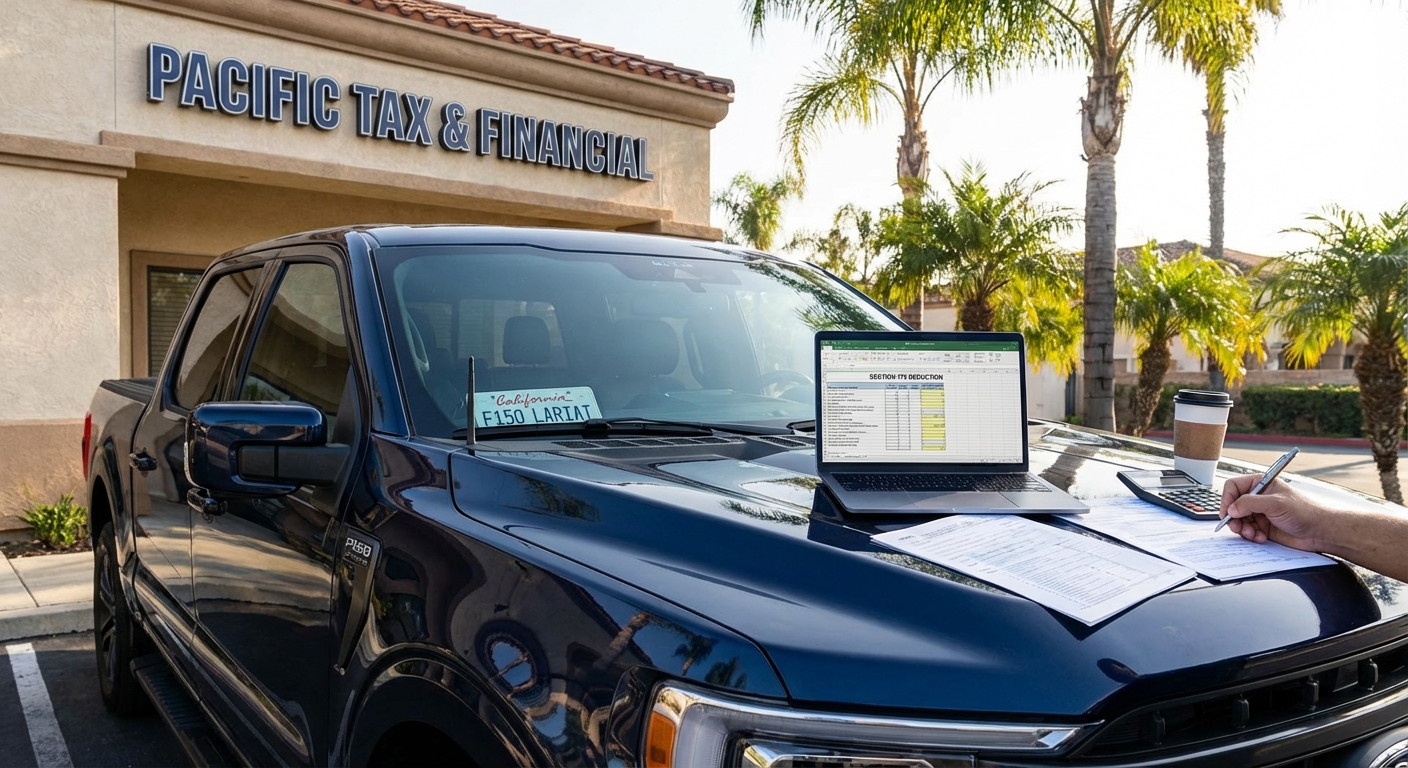
Section 179 and the 2024 Ford F-150: Why Most California Business Owners Overpay Taxes by $17,000+
The moment you drive a new Ford F-150 off the lot, you could be missing out on five figures in immediate tax savings. California businesses purchase more pickups than any other vehicle type, yet most owners never fully claim the break that Congress designed specifically for them. The Section 179 deduction is not theoretical—it’s a line-item strategy proven to put huge cash back in your account, but the details are make-or-break. In this guide, we reveal the real requirements, most-missed traps, and ROI stories behind chasing Section 179 with a Ford F-series in 2024.
Quick Answer: How Does Section 179 Work for a 2024 Ford F-150 in California?
For tax year 2024, if you purchase a Ford F-150 that qualifies as “over 6,000 pounds Gross Vehicle Weight Rating (GVWR)” and place it in service for business, you can deduct up to $28,900 under Section 179—plus take bonus depreciation for the remainder. However, strict use, documentation, and state-specific rules apply. Miss them, and you’ll lose the deduction or risk audit penalties. (See IRS Publication 946 for authoritative depreciation guidance.)
The real leverage in section 179 ford f150 2024 california planning comes from understanding that California does not fully conform to federal expensing rules. While federal law allows higher total depreciation through bonus, California caps Section 179 at $28,900 and disallows most bonus depreciation entirely. That mismatch creates timing differences that must be tracked on FTB Form 3885—or you risk underreporting state income later.
Who Really Qualifies for Section 179 on Trucks in 2024?
To claim Section 179 on a new F-150 this year, your business type and usage must hit four marks:
- Business Use Over 50%: The truck must be used for business more than half the miles driven in the year.
- Eligible Entity: Applies to LLCs, S Corps, sole proprietors, and partnerships. (W-2 employees without Schedule C or business income are not eligible.)
- Placed in Service in 2024: It must be purchased and used for business before December 31, 2024.
- GVWR Over 6,000 lbs: Most F-150 models qualify, but check your specific VIN/door sticker for proof.
For section 179 ford f150 2024 california claims, GVWR is only half the qualification test—the payload configuration matters too. Certain F-150 trims barely clear 6,000 lbs and fall into the “luxury auto” depreciation rules if improperly documented. Experienced CPAs confirm eligibility using the manufacturer’s certification and IRS Pub 946 guidance before filing Form 4562.
This deduction is the real deal for business owners, real estate agents, construction contractors, and 1099 sales professionals working in California. For other vehicles or hybrid situations, Section 179 rules get much stricter—and so does state review by the FTB, California’s version of the IRS.
What If I Use My Truck for Both Work and Personal Trips?
You can still claim Section 179 if business use exceeds 50%—but deductions decrease if your business percentage is lower. Carefully log all mileage, as both the IRS and the California FTB can require proof years later. A simple spreadsheet or app can protect thousands in deductions.
For mixed-use vehicles, section 179 ford f150 2024 california planning hinges on one number: average business use for the year. If that percentage ever drops below 50% in a future year, the IRS can trigger depreciation recapture under IRC §179(d)(10). That means prior tax savings get clawed back as ordinary income—an expensive surprise for owners who stop tracking mileage once the return is filed.
Unlock deeper tax playbooks with our entity formation services—we’ll show you how to structure business ownership for vehicle write-offs and more.
KDA Case Study: California Construction LLC Steps Up to Section 179
Oscar, a general contractor in Sacramento, was ready to upgrade his 10-year-old truck but didn’t realize the immediate tax advantage available. He operates as an LLC, bringing in around $280,000 a year. In May 2024, KDA guided Oscar on selecting a Ford F-150 XL SuperCrew with a 7,050-lb GVWR—a model fully eligible for the Section 179 deduction. He used the truck 92% for business, tracked every mile, and tagged expenses in his accounting app.
KDA processed Oscar’s paperwork and properly filed IRS Form 4562, enabling a $24,500 deduction under Section 179, then an additional $3,200 using bonus depreciation. This reduced his federal and California taxable income by $27,700 in year one—worth $7,485 in real tax savings after combined rates. Net result: Oscar’s total after-tax cost for the new F-150 dropped to $27,000 on a $54,000 sticker price. KDA charged $2,150 for consultation, paperwork, and support—Oscar’s ROI was 3.5x in a single filing season.
Ready to see how we can help you? Explore more success stories on our case studies page to discover proven strategies that have saved our clients thousands in taxes.

Pro Tip: Upload This to the IRS—Not Just Your Bookkeeper
To bulletproof your deduction:
- Snap photos of the GVWR sticker (located on the driver’s door jamb).
- Save your full purchase contract and financing docs (no partial leases—must be a purchase or Section 179-eligible capital lease).
- Keep a mileage log (paper log or mileage tracking app are both valid—just be consistent).
The fastest way section 179 ford f150 2024 california deductions get disallowed is poor substantiation—not incorrect math. The IRS and California FTB both require contemporaneous records, meaning logs created as miles are driven, not reconstructed at tax time. In audits, clean logs routinely preserve $20,000–$30,000 deductions that otherwise would be reversed with penalties.
California adds a twist: Unlike federal law, California only allows Section 179 deductions up to $28,900 for 2024—federal limits are higher. Don’t depend on your dealership’s tax advice; always cross-check with a CPA familiar with both California and IRS vehicle expensing.
The Mistakes That Cost CAL Business Owners the Deduction
The #1 error: Owners forget to track actual business vs. personal mileage. Without a log, the IRS—and more often the California FTB—will deny or reduce your deduction. Penalties for improper Section 179 claims can exceed $5,000 per year, according to FTB Form 3885. Another common trap: Buyers assume any truck qualifies, but only certain F-150 configurations have a high-enough GVWR.
For a deeper look at how this fits into broader entity tax strategy, see our complete S Corp tax guide.
What About Leasing an F150 or Buying Used?
Traditional leases nearly always disqualify you from Section 179—because you don’t own the vehicle. Used trucks can qualify for Section 179 if it’s the business’s first time placing the particular vehicle in service and all rules above are followed. Be extra cautious: audit rates on used vehicle deductions run higher than new in California filings.
Should You Bonus Depreciate or Section 179? The Great Debate
Section 179 typically acts as an up-front write-off, allowing you to deduct the purchase in the year placed in service. Bonus depreciation lets you write-off a portion of the remaining cost—even after Section 179 has lowered the basis. For the 2024 tax year, bonus depreciation is at 60% (down from 100% in 2022), and it phases out annually. Most California LLCs and S Corps start with the maximum Section 179 ($28,900) then bonus depreciate the rest for optimal savings on a new (or qualifying used) F-150.
Curious what these combined write-offs could do for your next tax bill? Try plugging the numbers into this small business tax calculator to estimate the deduction for your own F-150 purchase.
What if My Business Has a Loss This Year?
Section 179 can only offset active business income—it can’t create or increase a business loss. If your business has a net loss for the year, the deduction is limited—but unused Section 179 can be carried forward to future profitable years. Planning the purchase as part of a bigger strategic move (e.g., after a lucrative contract or sale) is often the smartest play.
Red Flag Alert: IRS and FTB Are Watching—Proof Matters
The IRS and the California Franchise Tax Board have increased scrutiny on vehicle deductions over $10,000 since 2023. Audit notices often demand:
- Proof of business mileage (not just estimations)
- Original purchase paperwork showing business ownership
- Verification of business use (client invoices, contracts, calendar entries)
Responding with partial records can lead to retroactive assessment of taxes, penalties, and interest. According to the IRS guideline on business vehicle expenses, thorough, contemporaneous records are required. Build your folder now rather than scramble later.
What About Claiming Gas, Insurance, and Maintenance?
After Section 179/bonus depreciation, you can still deduct ongoing business expenses—fuel, registration, insurance—proportional to your business use percentage. So, if you use your F-150 85% for work, you get 85% of all eligible operating costs as business deductions, too.
FAQ: Four Buyer Questions the Dealership Can’t Answer
Can I Write Off a Truck I Bought in December?
Yes, as long as you placed it in business use before December 31, 2024, and meet all Section 179 criteria, you can deduct it for 2024.
Do I Need to Title the Vehicle in My Business’s Name?
No, but the IRS prefers it. If the business pays, deducts, and insures the vehicle, you’re generally fine. Avoid mixing personal and business funds.
What if I Trade In My Old Truck?
You can still claim Section 179, but your basis (for depreciation) will change—work with a CPA to recalculate your net deduction and impact on future tax years.
Is an F-150 the Best Write-Off for My CA Business?
It’s one of the best because nearly all configurations cross the 6,000-lb threshold, but always check specs. Strategize based on business use, cost, and timing—not just the sticker price or dealership pitch.
KDA’s Bottom Line: Leverage the Ford F-150 for 2024 but Play by California’s Own Rulebook
In the hands of a strategic business owner, Section 179 turns the F-150 into a tool for paying less tax, not just moving equipment. But California’s state limit, substantiation demands, and entity requirements catch many filers off guard. The key is to stack federal and state rules the right way, file properly, and bulletproof your deduction dossier with receipts, logs, and documentation.
Book Your Section 179 Deduction Review
If you’re considering a vehicle purchase this year, don’t let dealership rumors or generic advice put your deduction at risk. Book a personalized consultation with our team—we’ll outline your optimal write-off strategy, handle all compliance, and show you exactly how much you can legally save with a 2024 Ford F-150 in California. Click here to book your Section 179 consultation now.



