
The Unfiltered Truth: Difference Between S Corp, C Corp, and LLC for California Owners
Difference between S Corp C Corp and LLC is the phrase that unlocks real savings — and makes or breaks audit risks — for California business owners in 2025. Most entrepreneurs think the secret is picking an entity type and forgetting it. The real risk? IRS and FTB penalties that quietly stack up, and a business structure that leaks five figures in preventable tax. If you’ve been told “LLC is always safest” or “S Corps are for the big guys,” you’re burning thousands in lost deductions or using the wrong compliance checklist. I’ll show you how one decision made the difference between a $12,000 refund and a $7,200 tax bill for two owners earning the same income — and how you can spot the traps before your next filing.
Quick Answer: S Corp vs C Corp vs LLC in Plain English
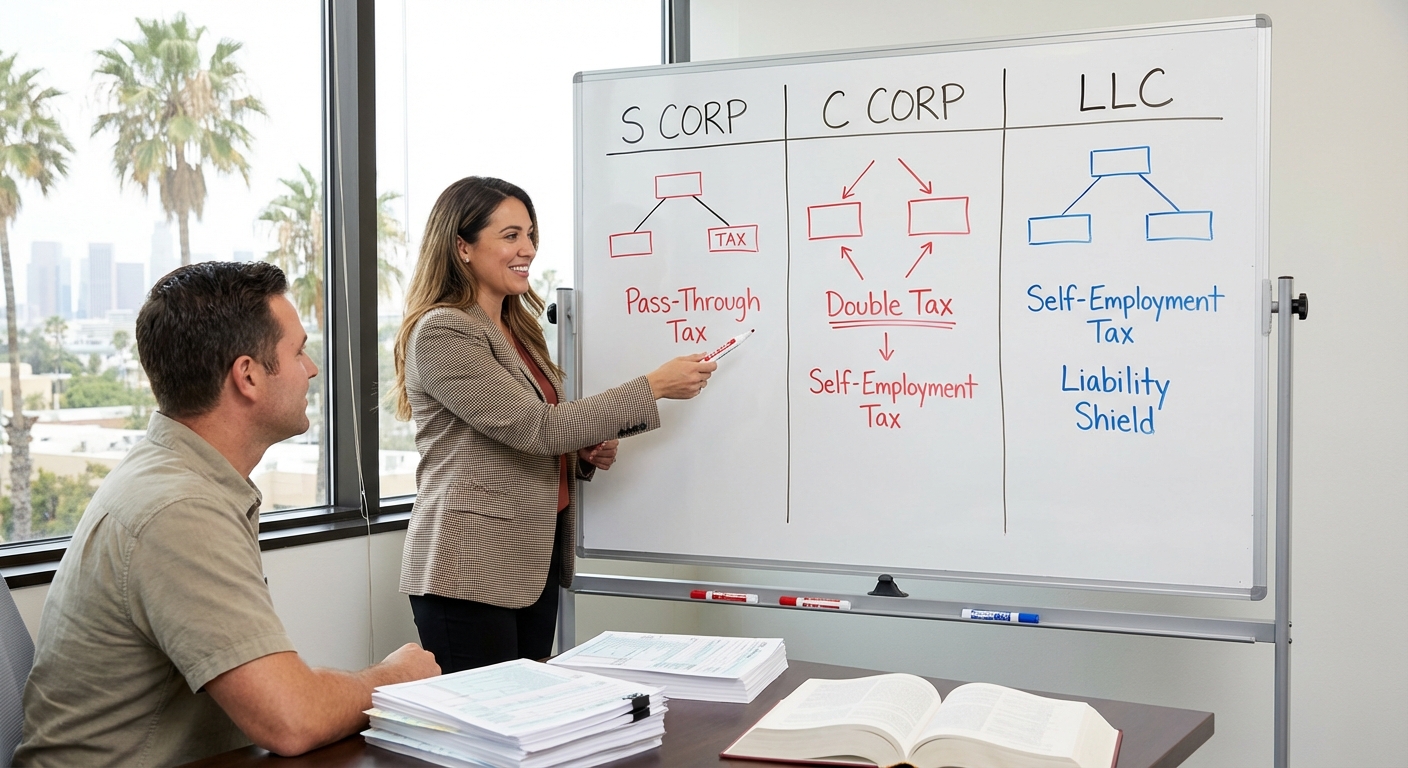
Let’s clarify the heart of the comparison: S Corps offer pass-through taxation and allow you to split salary/distributions for potentially lower self-employment tax, but come with wage compliance and eligibility requirements. C Corps are taxed separately from owners, may result in double taxation, but open up more aggressive fringe benefits and retained earnings without immediate personal taxes. An LLC is a legal shield with tax flexibility—by default it’s pass-through, but you can elect S Corp or C Corp taxation with the right filings. The right choice? Depends on your income, industry, growth goals, and — critically — how you want to pay yourself now and exit later. For specifics, see our comprehensive S Corp tax guide for California.
Section 1: How Each Entity Impacts Your Tax Bill (With Dollar Examples)
Imagine two business owners in Los Angeles, both making $250,000 net profit in 2025. Owner A forms a single-member LLC taxed by default (Schedule C), paying 15.3% self-employment tax (SECA) on nearly all business profit, plus federal and CA income tax. Their total SE tax alone? $38,250. Owner B elects S Corp status — after running payroll ($120K), they pay SE tax only on W-2 wages (=$18,360), and the rest ($130K) comes as distributions exempt from those payroll taxes. That’s a $19,890 federal savings every year. Factor in CA’s annual $800 LLC fee and 1.5% entity tax, plus the cost of S Corp payroll compliance, and the savings hold for anyone netting $60,000+ and comfortable with new admin rules. If you’re a business owner, the S Corp route is usually your first big move above sole proprietor status. C Corps? They pay 21% federal and 8.84% CA tax as a company, then dividends to you are taxed again on your individual return—a pain unless you plan to reinvest profit long term or offer employee stock benefits.
What if you don’t pay yourself a salary?
For S Corps, this is a red flag. The IRS is clear: “Reasonable compensation” must be paid to officers who materially participate (see IRS S Corporation guidance). No salary, or one that’s obviously too low, is an audit magnet. LLCs? No such rule—but you miss out on splitting wage/distribution for SE tax savings.
Section 2: The Compliance Traps Nobody Warns You About
Here’s where theory meets reality. C Corps come with strict protocols (annual meetings, corporate minutes, detailed state filings). Many high-income owners see “the big company model” and overlook the double tax regime or the FTB’s scrutiny of retained earnings (CA audits C Corps aggressively if accumulations exceed business needs without a plan). An LLC looks hands-off, but solo members may trigger IRS “disregarded entity” rules—making you a sole proprietor for tax, with less protection than you think. And S Corps? The administrative bar is higher: you have to run payroll, file quarterly forms (941s, DE-9s), and issue yourself a W-2. Miss a single step or Form 2553 window, and you’re back to LLC default mode (or, worse, facing retroactive taxes). Our tax prep and filing services have rescued S Corps that misfired these basics, saving repeat penalty victims $5,000+ per year.
What if you want to switch entity types later?
You can convert an LLC to an S Corp or C Corp, or even dissolve and restart — but timing and paperwork matter. Miss the S Corp election cutoff? You may owe thousands in back taxes. California has unique dissolution and re-registration rules—get guidance before acting.
KDA Case Study: LLC Owner Saves $13,700 By Converting to S Corp
Anna owns a small design agency in San Diego. She started as a single-member LLC, reporting $180,000 profit per year on her personal return, paying $27,540 in self-employment taxes plus $800 CA franchise fee. She was told “LLC is flexible, change taxes anytime.” But she missed the S Corp election window and lost the chance to split her earnings between salary and distributions. By the time she came to KDA, she faced a $6,000 FTB penalty for late election and an audit letter questioning her business expense allocations. We fast-tracked her S Corp election (Form 2553), set a $90,000 W-2 salary, and implemented real payroll: her SE tax dropped to $13,770, saving $13,770 per year. After $2,700 in KDA costs (set up, filings, payroll onboarding), her first-year ROI was over 5x. Ongoing? She spends about $1,200/year for compliance — but saves nearly $14K every year she keeps profits high. Moral: the right entity, filed at the right time, pays for itself dozens of times over.
Ready to see how we can help you? Explore more success stories on our case studies page to discover proven strategies that have saved our clients thousands in taxes.

Section 3: “LLC Versus Corporation” — Legal, Tax, and Audit Risk Side-by-Side
From the California FTB’s viewpoint, the biggest red flag with any entity is mismatch: Are your filings, salary payments, and distributions all in line with your stated type? If not, the IRS or FTB will recharacterize your activity—which almost always costs you more. S Corps can only have 100 shareholders (all must be US persons), must pay out at least market wage to owner/officers, and can only have one class of stock. LLCs can issue different share classes, add partners flexibly, and, if taxed as a partnership, split income across members. C Corps are the only game for VCs and outside equity, but the owners often realize their after-tax take-home is lower unless exit plans involve mega-losses, major reinvestment, or a qualified small business stock (see IRS Publication 587). LLCs can be taxed as “disregarded” (Schedule C), partnership, S Corp, or C Corp, but each election has pros and cons—what’s best depends on the size of your profit, whether you want payroll, and future plans to raise capital or sell.
Bottom line for audit risk:
An LLC incorrectly claiming S Corp treatment without an accepted Form 2553, or a C Corp owner pocketing company cash without salary/dividends, often faces reclassification. Red flag? Business owners treating LLCs like expense silos or using company assets personally. Clean books and entity-specific filings are key.
Section 4: When Each Entity Makes Sense (Real Use Cases)
Let’s lay out three archetypes:
- S Corp: Best for single-owner or tightly held businesses netting $60,000+ who want self-employment tax savings and don’t plan to raise outside capital in the next year. Example: Freelancer/consultant, agency, or local service business. Savings: $8K–$20K/year after admin cost.
- LLC, default taxed: Best for first-year side hustles, new landlords, or groups wanting to split risk without payroll hassle. Simplicity of Form 1040, but less room for strategic tax planning. Example: Airbnb property, Etsy store, family-run investments. Savings: Administrative time.
- C Corp: Optimal for those seeking equity investors, startups expecting outside funding, or companies planning major reinvestments and using fringe benefits. Example: Tech companies targeting VCs, firms needing stock compensation, or businesses holding intellectual property. Tradeoff: Potential for double taxation unless profits reinvested.
Tip: Use this small business tax calculator to see the after-tax impact of each entity choice on your expected profit.
Which is best for your exit or estate?
C Corp structure allows for Qualified Small Business Stock (QSBS) exclusion after five years—potential to eliminate $10M+ in capital gains for tech founders. S Corps allow asset basis step-ups on owner exit. LLCs? Flexible, but may face “phantom income” on debt relief or asset sales.
Red Flags and Common Mistakes With Entity Setup
Most costly mistake: Setting an LLC, then forgetting it. Many California owners skip annual Statement of Information filings or let registered agent status lapse, triggering $250–$900 penalties or even FTB suspension. Another trap? DIY S Corp election attempts, often missing critical deadlines or reporting zero salary, both audit targets (About Form 2553). C Corps that never declare dividends but transfer cash to owners often face FTB “constructive dividend” assessments, turning tax-free returns into expensive mistakes.
Pro Tip: Always keep a copy of your signed Form 2553 and payroll reports for S Corp compliance. Satisfy all annual filings for your chosen entity to maintain corporate veil and tax treatment.
Common Q&A: Choosing the Best Entity Type
How do I switch from LLC to S Corp or C Corp?
File IRS Form 2553 (for S Corp) within 75 days of the start of the tax year or from forming your LLC. To become a C Corp, file articles of incorporation and elect C Corp status for tax. For major transitions, consult an advisor to avoid missed elections or reclassification penalties (see instructions in About Form 2553).
Can a non-U.S. citizen own an S Corp?
No, only U.S. citizens or residents may be shareholders in an S Corp. If you have investors or partners who are not U.S.-based, LLC or C Corp will be your only options.
What are the admin costs and annual fees in California?
LLCs pay $800 franchise fee (even with zero income), plus a gross receipts fee if revenue exceeds $250,000. S Corps pay $800 and 1.5% of net income. C Corps pay the same franchise fee and 8.84% state income tax. All entities face separate costs for payroll, tax compliance, and registered agents.
Final Expert Take: The Entity You Pick Now Affects Audit Risk, Cash Flow, and Long-Term Exit
Your business entity is not a “set and forget” choice. LLCs, S Corps, and C Corps each offer dramatically different tax, compliance, and growth outcomes — and California’s rules layer on distinctive penalties and traps. For most profitable solo or small business owners, S Corp delivers the best mix of legal protection and tax savings — if, and only if, you follow strict wage and filing rules. C Corps are tailor-fit for tech, outside funding, and QSBS exclusion, but almost always increase a founder’s tax bill without careful planning. LLCs provide flexibility and legal shield at low admin burden but are often the costliest when ignored or under-managed. If your profit swings above $60K or your ownership circle changes, the “cheapest” option upfront is rarely the winner long term.
This information is current as of 12/21/2025. Tax laws change frequently. Verify updates with the IRS or FTB if reading this later.
Booking The Next Step: Entity Review for California Business Owners
If your entity choice still feels like a question mark, or you’re worried you’re leaking five figures in avoidable Southeast tax, payroll, or FTB penalties, schedule a personalized entity review with our expert CA tax team. Real money is at stake — get the strategy right from the beginning, or let us rescue an LLC, S Corp, or C Corp before you’re hit with an IRS or FTB letter. Click here to secure your session today.



