
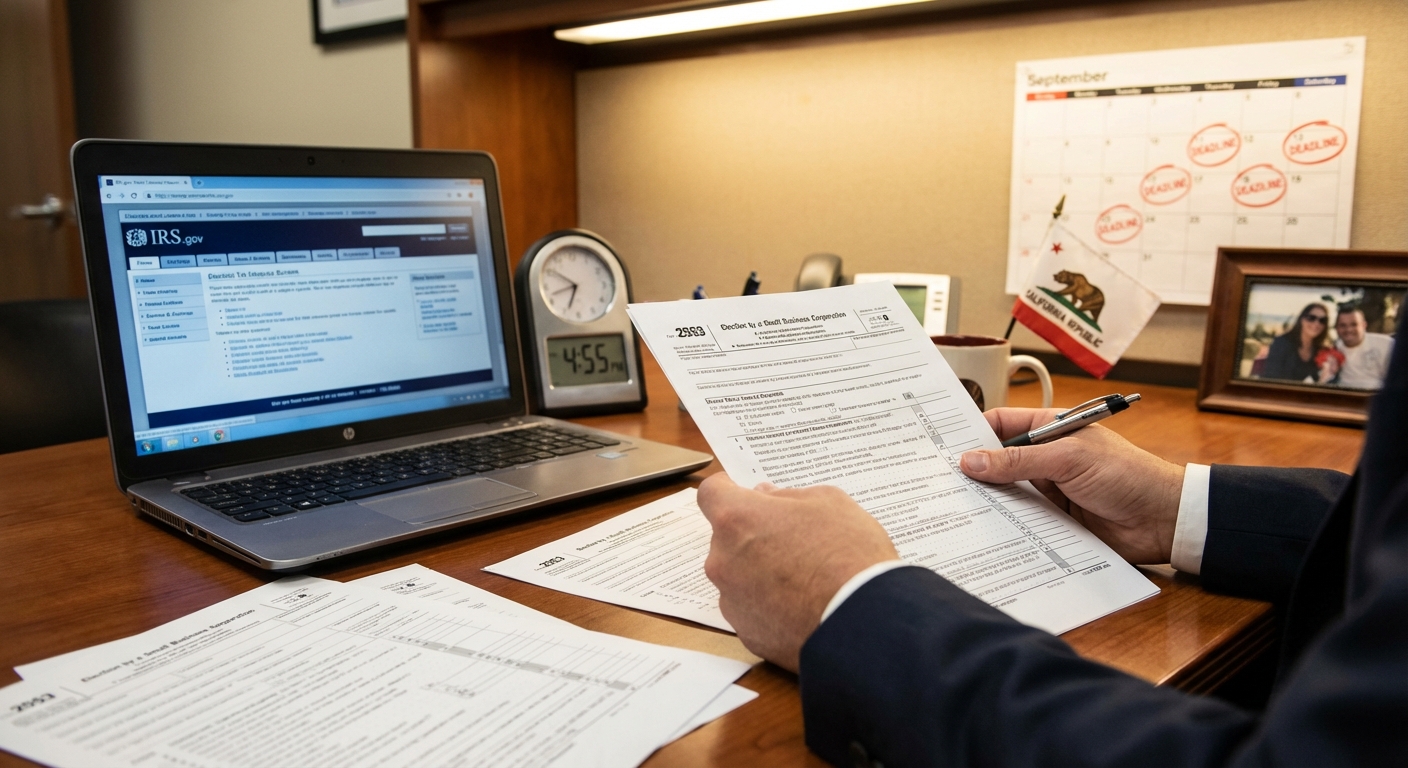
Form 2553 Filing Deadline in California: The Costly Mistake That Sinks Far Too Many S Corps
Missing a key IRS deadline can wreck your tax savings—especially in California, where one late form can hit your S Corp with thousands in unnecessary taxes. Form 2553 filing deadline California issues cause more avoidable penalties and lost tax opportunities for business owners than almost any other compliance slip. If you think you’re safe because you “filed paperwork on time,” think again—S Corp election is a legal minefield for the unprepared.
Quick Answer: What Is the Real Form 2553 Filing Deadline?
Here’s what the IRS won’t tell you upfront: For the 2025 tax year, Form 2553 must be filed no later than two months and 15 days after the start of the tax year the S Corp election is to take effect—or at any time in the preceding tax year. For calendar year filers, that means March 15, 2025. Miss that, and your S Corp isn’t an S Corp. California’s Franchise Tax Board respects this deadline, and failing to meet it often leads to double taxation (federal and state). If you want to fix it after the deadline, you’ll need a late election (which is not always rubber-stamped). See the rules in IRS guidance.
The form 2553 filing deadline California is not a suggestion—it’s a hard cutoff that determines whether your income is taxed as wages, self-employment income, or pass-through profit for the entire year. Under IRC §1362(b), missing the deadline means the IRS legally treats your business as if the S Corp election never happened. California conforms to this rule, so one missed date can erase federal savings and trigger FTB reclassification. This is why deadline tracking matters more than tax rate optimization.
Why This Law Exists—and Who Gets Burned
The Form 2553 deadline exists to prevent taxpayers from cherry-picking entity status after seeing in-year profits or losses. The IRS and California FTB want you to commit to your entity type before you see the numbers, locking in your tax position for the year. This especially targets small business owners who wait for a “good year” before electing S Corp status. Here’s the trap: It also crushes responsible business owners who just didn’t know about the timing rule.
If you’re a business owner running an LLC or a corporation and want S Corp status for 2025, understanding these rules is non-negotiable.
KDA Case Study: S Corp Election Saved $18,700—but Only After Rescue Filing
A real KDA client, “Jake,” runs a digital advertising LLC in San Diego. In early 2024, his CPA advised him to switch to an S Corp to save on self-employment tax. But Jake missed the Form 2553 filing window—by nearly 30 days—meaning his first year of “S Corp” would be ignored for tax savings both federally and by the FTB. We intervened with a late S Corp election backed by a reasonable cause letter, securing IRS and California acceptance. Jake’s tax bill went from $41,900 as an LLC to $23,200 as an S Corp—a savings of $18,700, but only because the IRS made an exception. Our fee was $3,200; Jake netted a 5.8x ROI and avoided a second late-filing disaster in 2025 by setting a compliance calendar and automating future entity paperwork.
Ready to see how we can help you? Explore more success stories on our case studies page to discover proven strategies that have saved our clients thousands in taxes.

Why Most S Corp Owners Miss the Form 2553 Filing Deadline in California
This mistake happens for one simple reason: Most business owners (and yes, even bookkeepers and CPAs) think they have until tax time, not 2.5 months after their tax year starts. But the IRS is merciless: File late, and your election is only valid for the next tax year—meaning any planned salary/dividend savings are gone, and payroll tax planning collapses. Here’s where the cascade starts:
- Owner expects to run payroll from January onward… but IRS recognizes S Corp status from the following year
- California FTB issues a second tax bill, treating your LLC or C Corp as subject to higher franchise, state income, and self-employment tax
- Penalties and interest for improper wage treatment run upwards of $4,000
This is not a theoretical risk. In 2024, at least 27% of KDA’s new S Corp clients approached us after missing their first attempted filing deadline.
How to Avoid Disaster: Step-by-Step S Corp Election Planning
Here’s a blunt checklist for California business owners who want to make the S Corp election stick:
- Know your start date (for most, January 1)
- Work backward two months and fifteen days (e.g., March 15 for calendar year)
- File Form 2553 with the IRS before that date (not when you file your tax return)
- Get documented confirmation from the IRS—do not assume your accountant “took care of it”
- Send a copy of the IRS acceptance letter to your payroll provider and tax pro
- For new entities, consider using our entity formation services for precise filing
Strategic year-end moves can save thousands. Our tax planning services help identify these opportunities before deadlines become dangerous.
Pro Tip: Late Election? There’s Still Hope—If You Move Fast
If you miss the deadline, all is not lost. The IRS allows late S Corp election relief under “reasonable cause” if you can prove you acted in good faith and didn’t benefit from acting late. You must attach a detailed statement specifying the cause of delay under IRS rules. Common reasonable causes can include reliant mistaken advice from a professional, postal error, or medical issue. This is not guaranteed, but KDA routinely gets late elections approved where there’s a paper trail—but the longer you wait, the less likely success becomes.
What If You’re an LLC Electing S Corp in California?
The California FTB follows the IRS’s lead, so your S Corp status is only in effect for California tax if you have federal acceptance (including late relief). If you have payroll or have already paid yourself distributions, non-recognition of S Corp status leads to double taxation, wage misclassification, and loss of QBI (qualified business income) deduction. For more on optimizing these moves, see our complete guide to S Corp tax strategy in California.
Red Flag: The IRS Doesn’t Send Reminders—and Errors Compound in California
You will not receive a reminder from the IRS or FTB. The burden is on you (or your tax strategist) to track entity paperwork and confirm acceptance. “I never got a follow-up” is not an excuse that flies with tax agencies. Bear in mind, Form 2553 can also be rejected for incomplete data, missing signatures, or improper effective dates. A rejected election is as costly as a missed one—and many business owners only discover the issue after auditing, late penalty notices, or when a bookkeeper realizes payroll has been misclassified for months.
Common Questions About S Corp Election Timing
Can I Make the Election for a Partial Year?
No. You cannot elect S Corp status retroactively for part of a year, except under very limited late-election relief. Most S Corp elections take effect at the beginning of a tax year. The deadline is non-negotiable.
Will I Be Audited If I File Late?
A late S Corp election is a giant red flag. It does not guarantee an audit, but it nearly always triggers additional IRS communication, and sometimes seems to invite scrutiny on wage classification and reasonable compensation issues. Stay proactive: work with a strategist and keep documentary evidence aligned to your intent and communications.
How Do I Document Timely Filing?
Send Form 2553 by certified mail with return receipt or file electronically, and retain explicit IRS confirmation (letter CP261). Never rely on verbal confirmation or vague “it should be fine” assurances.
Want to see how this decision would affect your business structure and profit? Run your numbers with this small business tax calculator for a real-world estimate of total federal and California tax liability.
Pro Tip
Set a recurring reminder 60 days into each new year to check your filing status and get written documentation. The number one cause of S Corp status loss is paperwork being “lost in the mail” or filed late by an advisor who assumes the client is tracking details.
Bottom Line
Missing the Form 2553 deadline in California isn’t a small mistake—it undoes every S Corp tax benefit for the year. You forfeit federal and state tax savings, and most late filers don’t realize what was lost until it is too late to recover. Build a compliance calendar, verify every IRS transaction, and never trust anyone else to check the box—S Corp savings only go to those who respect the rules and act before the deadline expires.
This information is current as of 12/18/2025. Tax laws change frequently. Verify updates with the IRS or FTB if reading this later.
Book Your S Corp Tax Strategy Session
If you’re an LLC or corporation in California, missing this one form can erase $20,000 or more in potential tax savings. Don’t risk a filing error—work with a strategist who tracks every deadline and maximizes every legitimate deduction. Book your personalized S Corp tax strategy session here and ensure your next move saves, not costs.



