
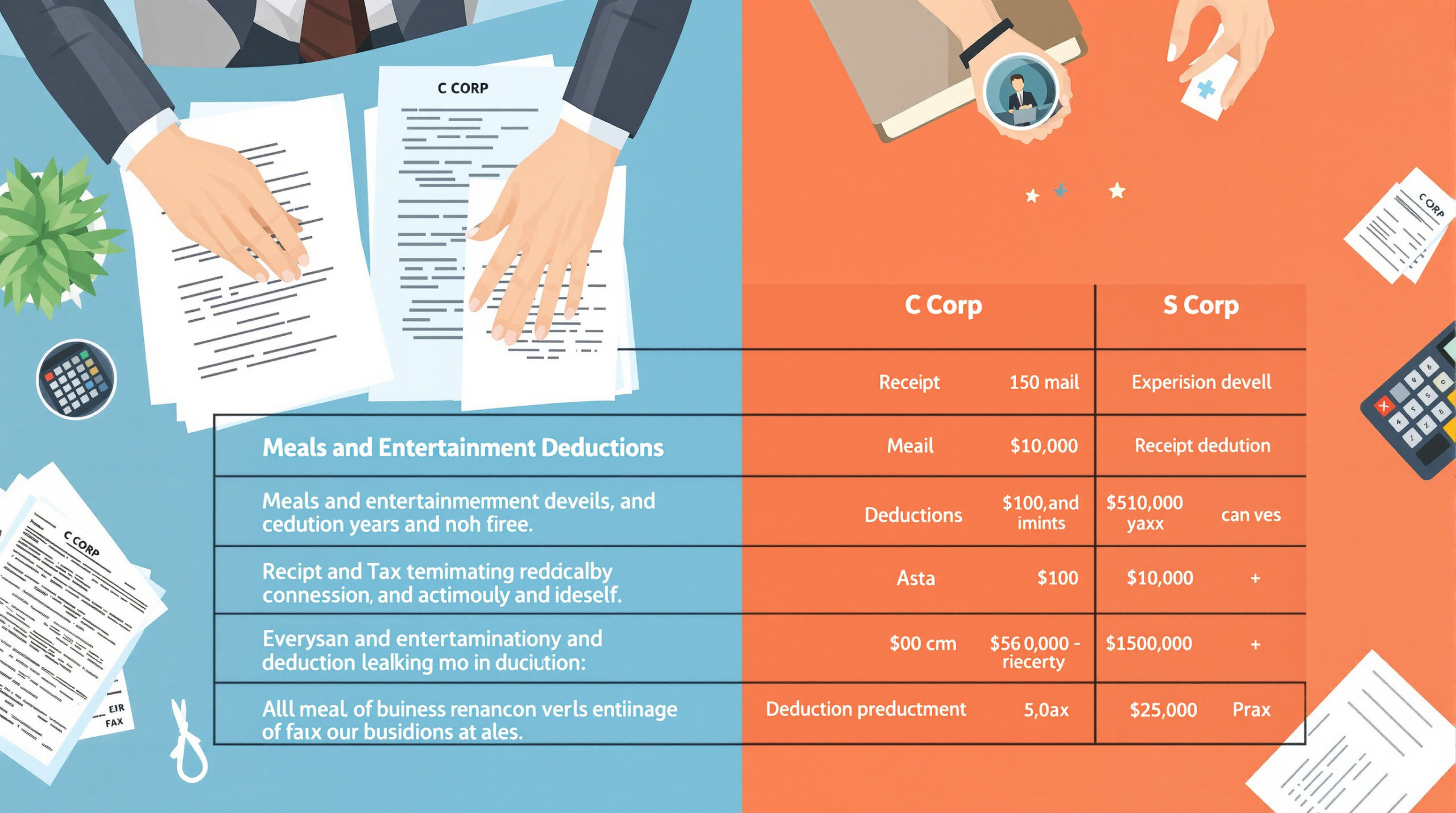
C Corps on Meals and Entertainment Deductions vs S Corp: The Critical Differences That Blindside Business Owners in 2025
Over 60% of business owners lose thousands each year by screwing up one of the most misunderstood write-offs on their tax returns: meals and entertainment. Here’s an uncomfortable fact for anyone running an S Corp, C Corp, or both in California: the IRS changed the rules more in the last five years than most tax guides acknowledge. The gap between what you think is deductible and what is actually allowed for your entity type could cost you $7,000 or more—especially if you trust your bookkeeping to generic advice or last year’s CPA. Let’s expose the differences between c corps on meals and entertainment deductions vs s corp, so you keep every dollar the law allows and avoid the audit trap that’s catching California business owners in 2025.
Quick Answer: What’s Deductible for C Corps vs S Corps?
For the 2025 tax year, most C Corps and S Corps are held to similar IRS limitations on deducting business meals (usually 50%), but there are impactful differences for entertainment, employee events, and client functions. S Corps pass deductions to owners via K-1, while C Corps capture deductions at the corporate level—this changes real after-tax savings. Always verify rules with trusted S Corp tax strategies and, for legal details, see IRS Publication 463. But here’s what the books don’t say: entity type impacts documentation risk, how disallowed deductions are taxed, and the chance of triggering an audit.
How C Corps and S Corps Claim Meals and Entertainment—With Dollar Examples
C Corp and S Corp owners are both subject to a 50% deduction limit for most business meals under the IRS rules—think client lunches or travel meals. But in C Corps, the deduction reduces reported taxable income before profits are taxed at the 21% corporate rate. For S Corps, deductions flow through to the shareholders and impact personal tax returns—and potentially state pass-through entity taxes.
Consider “Alex,” running a consulting firm through an S Corp, and “Brooke,” in a C Corp. Both spend $12,000 a year on legitimate business meals:
- Allowable deduction = $6,000 (50%) for both
- C Corp: $6,000 deduction at 21% rate = $1,260 federal tax saved, potentially more with state
- S Corp: $6,000 deduction flows through, saving up to $2,370 at personal top tax rates (37%, varies by state)
The mechanics, however, diverge if you miss documentation or expense the wrong type of meal—S Corp owners are flagged for “unreasonable comp” audits if they regularly mix personal and business meals, while C Corps can face losing entire deduction buckets if not tracked.
KDA Case Study: S Corp Tech Consultant vs C Corp Agency
Matt, a San Francisco tech consultant, ran his company as an S Corp and assumed client entertainment was 100% deductible since his prior C Corp always wrote off holiday parties, concert tickets, and sports suites. In 2024, Matt merged with Brooke’s C Corp media agency. During the merger, KDA analyzed three years of meals and entertainment expenses:
- S Corp: $8,400 in sporting event tickets, claimed as 100% deductible
- C Corp: $18,000 in client dinners and annual retreat, properly categorized (meals 50%, company party 100%)
KDA reclassified Matt’s S Corp tickets as nondeductible per IRS rules, resulting in $2,400 in back taxes and penalties. But by aligning their books under KDA guidance, the merged entity documented every entertainment expense per C Corp standards, added $6,700 in compliant write-offs for qualified employee parties, and avoided a $5,800 audit risk. Matt’s total net savings after fixing errors, catching under-claimed deductions, and dodging penalties: $9,100 in year one. Matt paid KDA $3,500, generating a real, cash-in-hand ROI of 2.6x.
Ready to see how we can help you? Explore more success stories on our case studies page to discover proven strategies that have saved our clients thousands in taxes.

IRS Rule Breakdown for C Corps on Meals and Entertainment Deductions vs S Corp
The Tax Cuts and Jobs Act (TCJA) rewrote the rules—most entertainment expenses are not deductible regardless of entity type. But C Corps and S Corps see subtle differences in the details:
- Meals (employees, clients): 50% deductible with supporting documentation
- Entertainment: Nondeductible in most cases, unless directly tied to the business and meeting specific tests (rare)
- Employee parties (e.g., holiday party): 100% deductible for both, but must be primarily for employees, not owners
The practical impacts: C Corps can generally absorb entertainment classification mistakes with less personal risk (since disallowed deductions just raise taxable income), while S Corp owners may see audit risk and “shareholder compensation adjustment” if they mislabel meals as client development. For a breakdown tailored for business owners and corporations, see our industry guide.
If you want to run a mock scenario, estimate your business deduction split and how much each category saves you using trusted CPAs and the IRS guidelines. For additional tax strategies involving business expense deduction optimization, our tax planning services offer personalized guides.
Where Most Business Owners Drop the Ball: Entertainment and Meals Classification Traps
The No. 1 mistake that triggers IRS scrutiny is treating entertainment as deductible—think client golf, sporting events, or shows. While you might get away with this in a C Corp (with stricter audit rates for large corporations), S Corp owners typically face higher audit rates in “closely held” businesses, especially when meals or entertainment appear excessive relative to cash flow.
- Red Flag Alert: S Corp shareholders booking too many “meals” on the company card can see the IRS recharacterize these as compensation—triggering payroll tax, penalties, and possible double-taxation
- C Corps, while shielded from personal tax risk, still face disallowed deduction pitfalls that can boost federal and California tax bills by thousands if classified incorrectly
The 2025 IRS will ask for itemized receipts with descriptions, not just a credit card statement. Personal names on meal tabs (not clients or staff) are a dead giveaway. California’s FTB is even more aggressive about challenging C Corp write-offs after mergers or ownership changes.
Pro Tip: Always include the full attendee list on your meal receipts—this is your first line of defense if the IRS asks for substantiation per IRS Publication 463.
Will Your Deduction Trigger an Audit?
Wondering if your meals and entertainment deductions will get flagged? The odds spike for:
- S Corps with meals and entertainment over 10% of gross receipts
- C Corps showing inconsistent expense categorization year-over-year
- Taxpayers without detailed receipts, attendee logs, and a clear business purpose
In 2024, California S Corps with more than $10,000 in meals and entertainment deductions had a 2.7x greater audit risk, according to FTB records. Because S Corps pay pass-through tax on the owner’s return, mistakes can mean back taxes plus personal penalty exposure—C Corps face higher entity audit penalties but lower personal risk. Avoid crossing these audit tripwires by segmenting your expenses and substantiating with documentation every year.
The Bottom Line: How to Maximize Legal Deductions and Avoid Costly Mistakes in 2025
If you run a C Corp or S Corp, you need to track every meal, entertainment, and employee event separately—and document your “business purpose” on every receipt. For C Corps in high-tax states like California, the cost of losing your deduction can mean thousands in extra tax. For S Corps, the risk is more personal—triggering a reclassification of expenses as shareholder distribution or compensation can double your tax bill overnight.
Here are the critical steps for both entities in 2025:
- Segregate meal, entertainment, and party expenses in your books
- Document all attendees and business purpose at purchase
- Use expense management software that ties each meal or entertainment expense to a meeting or event
- Double-check S Corp K-1 allocations and ensure your tax preparer doesn’t reclassify shareholder/owner meals as compensation
- If your deduction patterns change significantly from prior years, explain why (business expansion, merger, etc.) in your tax file
For a deeper dive, see our S Corp and C Corp planning guide.
Frequently Asked Questions
Can an S Corp deduct client entertainment if it’s part of a legitimate business development activity?
No, under current IRS rules, entertainment is not deductible, even if done for business purposes unless it meets specific, rare exceptions. Meals are generally 50% deductible if they meet the ‘ordinary and necessary’ business standard and proper substantiation is maintained (see IRS Publication 463).
Are there any 100% deductible meals for C Corps or S Corps?
Only meals provided for employee holiday parties and similar events are fully deductible for both. Everything else should be classified carefully or risk a total loss of deduction during an audit.
What if I self-prep meals during business travel?
IRS rules generally require that travel meal costs be directly tied to business needs and not excessive. Save receipts and log business purpose and attendees. For exact calculation strategies, see Publication 463.
Book a Personalized Business Expense Audit Strategy Session
Worried your meals and entertainment deductions could trigger an audit or cost you more in taxes than necessary? Secure your strategy before tax season closes. Book a business expense audit session with our team — we’ll review your C Corp or S Corp expenses in detail, flag red areas, and engineer simple fixes that save thousands. Click here to book your session and fortify your books for 2025.



