
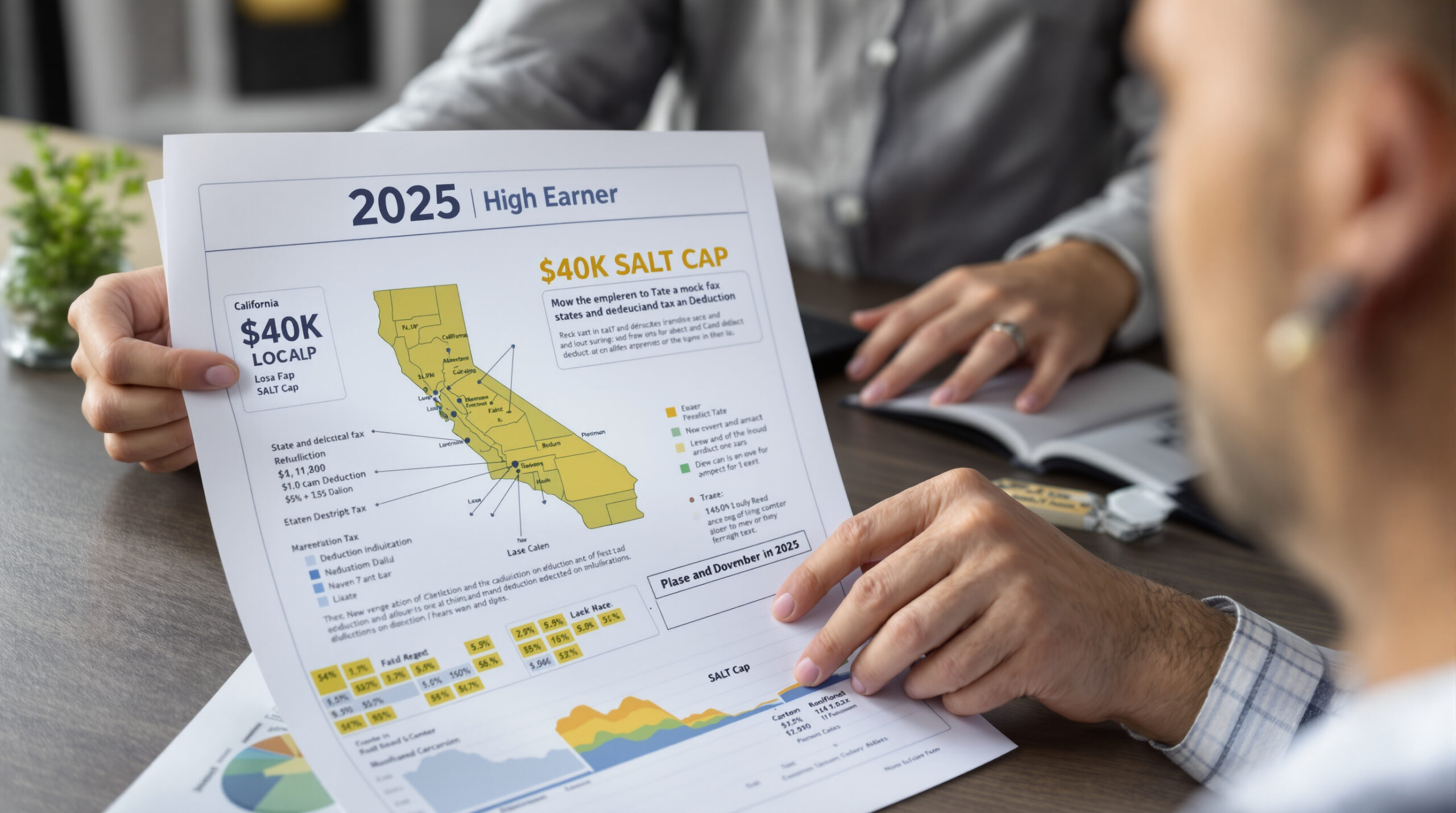
2025 California SALT Deduction: How High Earners Can Capture the $40,000 Window Before It’s Gone
In 2025, many California high earners are waking up to an unexpected tax opportunity—and an even bigger risk. Most believe the state and local tax (SALT) deduction cap will keep limiting their deductions to $10,000, but Congress has thrown a curveball: for 2025 through 2029, the cap spikes to $40,000. If you earn over $500,000, this creates a rare multi-year window to recoup tens of thousands, but only if you act before AGI phaseouts bite. The downside? A single filing error or wrong timing—and you’ll watch the deduction slide away.
Quick Answer: For 2025, the SALT deduction cap in California jumps to $40,000, but phases out completely by $600,000 AGI. High-income W-2 filers can bunch property tax and prepay income taxes to capture up to $30,000 more in deductions over the next four years—if they start planning immediately (see IRS Pub 17). This guide shows how.
The New $40,000 SALT Deduction Window: How It Works and Who Qualifies
The salt deduction california 2025 change isn’t a rumor. Under the One Big Beautiful Bill Act (OBBBA), Congress temporarily raised the limit on deductible state and local taxes from $10,000 to $40,000 through 2029. But there’s a catch: if your adjusted gross income (AGI) exceeds $500,000 (single/married filing jointly), the benefit begins phasing out and shuts off entirely at $600,000.
- Scenario: Emma, a Los Angeles tech executive, has $430,000 W-2 income and pays $16,000 in California income tax and $21,000 in property tax. In 2024, she capped out at $10,000. In 2025, she can now deduct the full $37,000—an increase of $27,000.
- Real savings: At a 37% federal marginal rate, that’s $9,990 more kept after-tax—just in year one.
- Phaseout trap: If Emma’s income rises above $500K, she loses $400 of deduction per $1,000 AGI, vanishing at $600K.
This cap is not automatic. If you don’t itemize deductions or correctly report eligible taxes, you’ll get nothing extra.
Strategic Moves: Bunch, Prepay, and Time Your State and Property Taxes
High earners should not rely on autopilot payroll withholding or property tax installment dates. For the 2025 salt deduction california 2025 window, strategic tax “bunching” is key:
- Bunching: Pay two years of property tax in one calendar year if possible—for instance, pay both December 2024 and April 2025 property tax bills early, maximizing your deductible total in a high-income year.
- Prepaying CA income tax: Increase state estimated payments before year-end to pull forward the deduction, especially if you expect a bonus or windfall in early 2025.
- Phaseout awareness: Project AGI carefully. If you expect a big liquidity event (e.g., stock vesting, business sale), shift as much deductible tax into a year when AGI is below the $500,000 phaseout start.
For a deeper dive into advanced tax minimization strategies for high earners, read our complete high-income tax strategy hub.
Thinking beyond standard deduction planning? See how our premium advisory services integrate SALT cap strategies into a unified plan for California’s top earners.
KDA Case Study: W-2 High Earner Captures $40K SALT Break
Marcus, a San Francisco-based sales executive with $470,000 in salary and equity comp, came to KDA after hearing about the upcoming SALT cap increase in 2025. He paid $15,800 in state income tax and $22,600 in property tax on his Marin County home every year. Previously, his deduction for these taxes was capped at $10,000, costing him thousands annually.
KDA ran an AGI projection and realized he would trigger RSUs that could push him to $525,000 in some years (> $500K phaseout). We advised Marcus to prepay two years of property tax before a vesting event, and he made a $30,000 state tax payment in December 2025 to lock in the window. That year, Marcus captured $35,800 of deductible SALT, saving $9,289 in federal tax he otherwise would have lost. KDA’s all-in fee: $3,500. Marcus’s after-fee ROI in year one exceeded 2.6x—and we’ve set him up for four more years of optimized timing.
Ready to see how we can help you? Explore more success stories on our case studies page to discover proven strategies that have saved our clients thousands in taxes.

Why Most High Earners Waste the SALT Deduction: Four Tax Traps to Avoid
Trap 1: Not Itemizing—If you default to the standard deduction, you won’t benefit from the higher SALT cap. Double-check which is best every single year (see IRS Pub 501 instructions).
Trap 2: Ignoring AGI Phaseouts—Every $1,000 over $500K will trim $400 off your SALT deduction allowance. Many W-2 employees trigger phaseouts accidentally by vesting stock or receiving large bonuses.
Trap 3: Misclassifying Taxes—Only income, property, and certain sales taxes qualify. Mislabeled taxes or fees (such as transfer taxes or DMV fees) are not eligible.
Trap 4: State/Federal Mismatch—Your California tax liability may differ from what you can claim federally. Don’t assume CA’s rules always match IRS guidance. FTB Form 540 instructions clarify state reporting.
Pro Tip: Maximize Your Charitable “Bunching” with SALT Timing
Pro Tip: For high-income years with limited AGI maneuvering, combine your increased SALT deduction with “bunched” charitable gifts (such as a donor-advised fund contribution) to leap past the standard deduction and unlock even more itemization benefit in one tax year.
Mic Drop Insight
The IRS isn’t hiding these write-offs—you just weren’t taught how to time them around the changing SALT caps.
Combining SALT Deduction Moves with Other 2025 Tax Opportunities
The One Big Beautiful Bill Act didn’t just shift SALT. For 2025, several other updates converge for high earners:
- Bonus property expensing: 100% bonus depreciation restored for new business property through 2029 (see IRS Pub 946).
- Higher estate exemption: Temporary $30M combined exemption for married couples before 2026 sunset—allows coordinated gifting with phased deduction strategies.
- Charitable deduction changes: New rules set a 0.5% AGI floor on deduction eligibility—timing is everything for W-2s with philanthropic intent.
FAQs on the California SALT Deduction Cap for 2025
How do I know if bunching property taxes makes sense for me?
If your eligible property tax bill, when combined with state income tax, exceeds $10K but is less than $40K, and your AGI is under $500K, bunching can help maximize annual deductions and reduce total federal liability.
If I pay more than $40,000 in state/local taxes, can I deduct it all?
No—$40,000 is the absolute cap for 2025-2029, and the phasedown applies as your AGI climbs above $500,000 (see source: IRS).
What happens in 2030 and beyond?
The SALT deduction cap reverts to $10,000 unless further legislation is enacted. Expect planning to shift at that time—review with your advisor annually.
Fast Tax Fact
According to Treasury Department guidance, 2025 is the first tax year in over a decade where California W-2 high earners can deduct up to $30,000 more in state and property taxes compared to 2024 filings.
FAQ: Will Claiming the SALT Deduction Trigger an IRS Audit?
As with any itemized deduction, extraordinary jumps in reported deductible taxes can flag for IRS review. Keep all receipts for property and state tax payments, and match payment timing to reported taxable year. Refer to IRS Schedule A instructions for documentation tips.
Book Your Tax Strategy Session
Are you a high-earning W-2 employee in California? Don’t leave tens of thousands on the table by missing this limited-time $40,000 SALT deduction window. Book a custom strategy session with KDA and get a personalized deduction plan before the 2025 phase-out catches you. Click here to book your consultation now.



