
Quick Answer
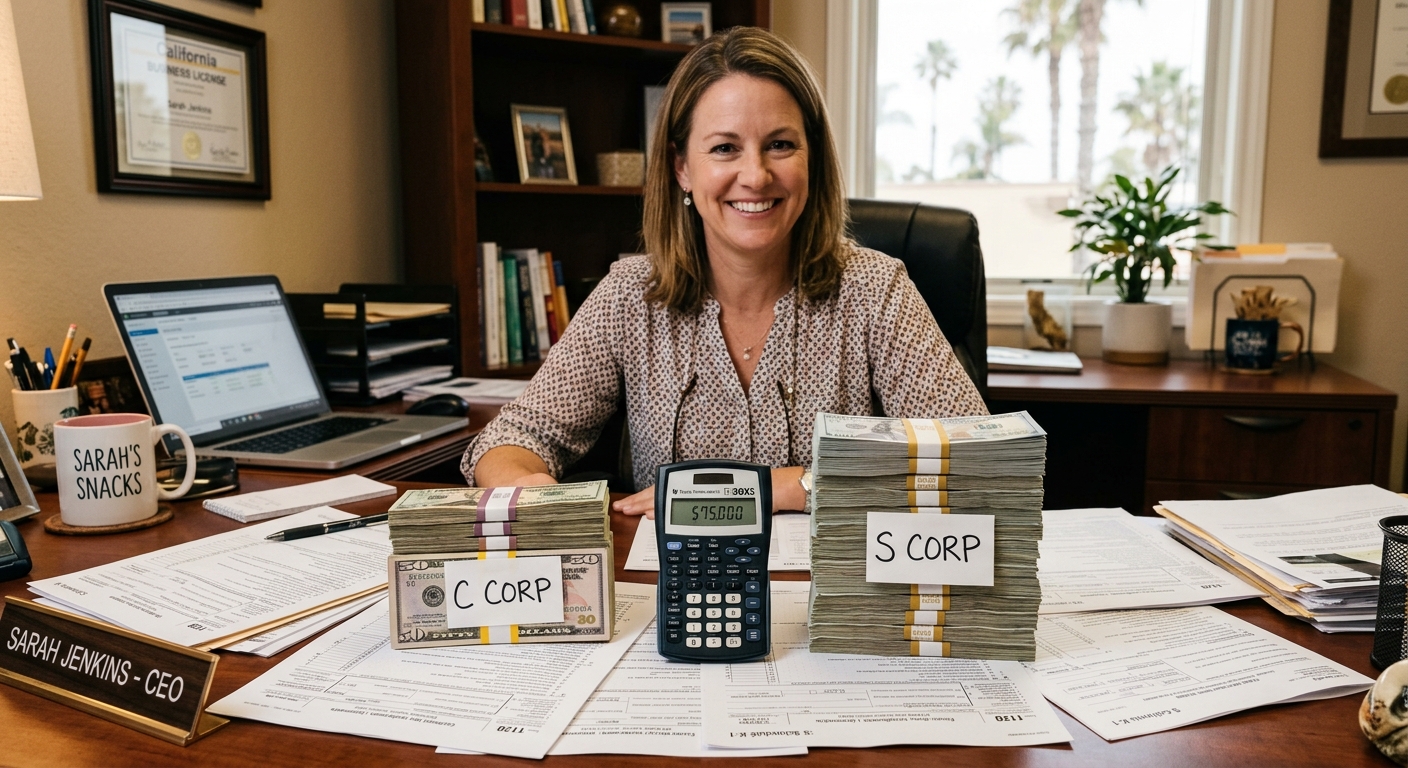
A California business owner earning $75,000 tax on C Corp vs S Corp structures will pay roughly $34,100 through a C Corp after federal entity tax, dividend double taxation, and California’s 8.84% franchise rate. That same $75,000 routed through an S Corp lands closer to $18,900 in total tax. The gap is $15,200 per year, and it compounds every single year you stay in the wrong entity. One IRS form separates those two outcomes.
Why $75,000 Is the Income Level Where Entity Choice Starts Costing Real Money
Below $40,000 in annual business profit, the entity conversation barely matters. The numbers are too small for the compliance cost of payroll, a separate return, and quarterly filings to justify the savings. Above $200,000, most advisors already push the S Corp conversation because the self-employment tax savings are obvious.
But at $75,000, something specific happens. You cross into a federal bracket where the marginal rate on ordinary income hits 22%, California’s rate stacks another 9.3% on top, and self-employment tax adds 15.3% on the first dollar of net earnings. If you are operating as a default LLC or a C Corp, every layer hits simultaneously. And because $75,000 feels like a modest income to many owners, they assume the entity structure does not matter yet.
That assumption costs $15,200 in the first year alone. Over five years, that is $76,000 that leaves your business and never comes back.
The five-layer tax framework is the only way to compare these two entities honestly. A single federal rate comparison is not a comparison at all. For a deep breakdown of every layer, read our complete guide to S Corp tax strategy in California.
The Five Tax Layers That Create the $15,200 Gap at $75,000
Every dollar your business earns in California passes through up to five separate tax events before it reaches your personal bank account. Most owners only see one or two of them. Here is what actually happens at the $75,000 profit level.
Layer 1: Federal Entity Tax (21% vs 0%)
A C Corp pays a flat 21% federal corporate income tax on its profits under IRC Section 11. At $75,000, that is $15,750 gone before you touch a dime. An S Corp pays zero entity-level federal tax. The profit flows through to your personal return on Schedule K-1 and gets taxed at your individual rates. That is a $15,750 head start for the S Corp.
Layer 2: Federal Dividend Double Taxation
After the C Corp pays its $15,750 in federal tax, you have $59,250 left inside the corporation. To get that money into your hands, you take a dividend distribution. Qualified dividends are taxed at 15% for most filers under IRC Section 1(h)(11). That is another $8,888 in federal tax on the same income that already got taxed at the entity level. The S Corp owner faces zero double taxation because distributions from an S Corp are generally not subject to a second layer of federal tax, as long as they do not exceed the shareholder’s stock basis under Form 7203 basis tracking rules.
Layer 3: California Franchise Tax Differential (8.84% vs 1.5%)
California taxes C Corp net income at 8.84% under Revenue and Taxation Code Section 23151. At $75,000, that is $6,630. An S Corp pays just 1.5% under R&TC Section 23802, which comes to $1,125. The California layer alone creates a $5,505 gap. Many business owners never realize how much the state franchise tax differential compounds over time.
Layer 4: QBI Deduction Exclusivity Under IRC Section 199A
The Qualified Business Income deduction, made permanent under the One Big Beautiful Bill Act (OBBBA), allows S Corp owners to deduct up to 20% of their qualified business income from their personal tax return. At $75,000 in S Corp profit with a reasonable salary of $40,000, the QBI-eligible income is $35,000. Twenty percent of that is a $7,000 deduction, which saves roughly $1,540 in federal tax at the 22% bracket. C Corp shareholders get nothing. Dividends do not qualify for the QBI deduction. This layer is permanent now, so this advantage holds every year going forward.
Layer 5: AB 150 PTE Election SALT Cap Bypass
California’s AB 150 pass-through entity tax election allows S Corps to pay state income tax at the entity level at 9.3% and pass a dollar-for-dollar credit to shareholders. This effectively bypasses the $40,000 SALT deduction cap imposed by the OBBBA. At $75,000 in S Corp income, the PTE tax is $6,975, and the credit flows to your personal return, giving you a federal deduction that would otherwise be capped. The federal tax savings from this maneuver is approximately $1,535. C Corps cannot use AB 150 because they already pay entity-level tax with no pass-through credit mechanism.
Side-by-Side Tax Comparison at $75,000
| Tax Layer | C Corp | S Corp |
|---|---|---|
| Federal Entity Tax | $15,750 | $0 |
| Federal Dividend Tax (on after-tax amount) | $8,888 | $0 |
| California Franchise Tax | $6,630 | $1,125 |
| QBI Deduction Savings | $0 | ($1,540) |
| AB 150 PTE SALT Bypass | $0 | ($1,535) |
| Total Tax Burden | $31,268 | $16,050 |
| Annual Gap | $15,218 | |
That $15,218 is not a projection. It is the arithmetic of five tax layers applied to one income level.
Want to see how these numbers shift at your exact income? Plug your business profit into this small business tax calculator to estimate your total tax under each structure.
The Five Costliest Mistakes at $75,000 That Lock Owners Into the Wrong Entity
Mistake 1: Believing $75,000 Is Too Small for an S Corp
This is the most expensive myth in small business taxation. The IRS does not set a minimum income threshold for S Corp elections. The real question is whether the self-employment tax savings exceed the cost of running payroll and filing Form 1120-S. At $75,000, the SE tax savings alone on a $35,000 distribution (after a $40,000 reasonable salary) run approximately $4,945 per year. Payroll services cost $500 to $1,200 annually. The math is not close.
Mistake 2: Trusting the 21% C Corp Rate Without Running the Full Five Layers
The 21% federal rate looks attractive on paper. But it is only the first of five layers. After you add the dividend tax, the California franchise tax at 8.84%, and the loss of both QBI and AB 150, the C Corp effective rate at $75,000 climbs to 41.7%. The S Corp effective rate at the same income level is 21.4%. That 20.3 percentage point gap is the real cost of trusting one number.
Mistake 3: Missing the March 15 Form 2553 Deadline
IRS Form 2553 must be filed by March 15 of the tax year in which you want the S Corp election to take effect, or within 75 days of forming your entity, whichever comes later. Miss that window, and you stay a C Corp (or default LLC) for the entire year. At $75,000, that one missed deadline costs $15,218. Late election relief exists under Revenue Procedure 2013-30, but it requires you to demonstrate reasonable cause and file retroactively. Do not rely on it as a primary strategy.
Mistake 4: Setting an Unreasonable Salary
The IRS scrutinizes S Corp officer compensation under the reasonable salary standard established in Watson v. Commissioner. At $75,000 in total business profit, a salary of $40,000 to $45,000 is defensible for many service-based businesses. Set it too low, and you face reclassification of distributions as wages, plus back payroll taxes, penalties, and interest. Set it too high, and you eliminate the SE tax savings that make the S Corp election worthwhile. The IRS Palantir SNAP AI system now cross-references salary-to-distribution ratios across industries, making low-salary strategies riskier than ever.
Mistake 5: Forgetting California’s Separate Filing Requirements
Filing Form 2553 with the IRS does not notify the California Franchise Tax Board. You must separately file FTB Form 3560 to register your S Corp election with the state. Skip this, and California treats you as a C Corp, charging the full 8.84% franchise tax instead of 1.5%. That is a $5,505 penalty for missing one state form. You also lose eligibility for the AB 150 PTE election until the state registration is corrected.
KDA Case Study: Sacramento Freelance Consultant Saves $15,200 With One Election
David, a Sacramento-based IT consultant, earned $75,000 in net business profit through his single-member LLC. His CPA had told him for three years that his income was “too low” for an S Corp election. He was paying $10,597 in self-employment tax, $6,630 in California franchise tax (treated as a disregarded entity flowing to Schedule C), and roughly $12,500 in federal income tax with no QBI optimization.
KDA evaluated David’s five-layer tax position and identified $15,200 in annual savings. The strategy included filing a late S Corp election under Rev. Proc. 2013-30, setting a reasonable salary at $40,000, activating the AB 150 PTE election for SALT cap bypass, implementing the permanent QBI deduction on $35,000 in pass-through income, and setting up dual federal and California depreciation schedules for his $8,400 in business equipment under R&TC Sections 17250 and 24356 (California does not conform to federal bonus depreciation under IRC Section 168(k)).
David paid $4,800 for the full engagement, including entity formation restructuring, payroll setup, and first-year S Corp return preparation. His first-year savings were $15,200, delivering a 3.2x ROI. Over five years, projected savings total $76,000 assuming flat income, and more if his revenue grows.
Ready to see how we can help you? Explore more success stories on our case studies page to discover proven strategies that have saved our clients thousands in taxes.
Three Narrow Scenarios Where a C Corp Wins at $75,000
The S Corp advantage is clear at $75,000 for most California owners. But three specific situations flip the math.
Scenario 1: Full Earnings Retention Below the Accumulated Earnings Tax Threshold
If you plan to retain every dollar inside the corporation and reinvest it without taking distributions, the C Corp avoids the dividend double-taxation layer entirely. The accumulated earnings tax under IRC Section 531 does not kick in until retained earnings exceed $250,000. At $75,000 per year, you could retain profits for more than three years before approaching that threshold. But this only works if you genuinely do not need the cash personally. Most owners at $75,000 cannot afford to leave all profit inside the entity.
Scenario 2: Venture Capital Funding Requirements
If you are raising institutional capital, most VC firms require a C Corp structure because S Corps cannot issue preferred stock or have more than 100 shareholders under IRC Section 1361(b)(1)(A) and (D). At $75,000 in current revenue, you are likely pre-revenue or early stage, and the flexibility to raise capital may outweigh the annual tax savings. This is a growth-stage decision, not a tax decision.
Scenario 3: QSBS Section 1202 Exclusion
Qualified Small Business Stock under IRC Section 1202 allows C Corp shareholders to exclude up to $10 million (or 10 times their basis) in capital gains when selling stock held for at least five years. California does not conform to QSBS under R&TC Section 18152.5, so the exclusion only applies at the federal level. At $75,000 in annual profit, you would need significant growth projections and a clear exit timeline for the QSBS benefit to outweigh five years of $15,200 annual S Corp savings totaling $76,000.
OBBBA Permanent Changes That Affect the $75,000 Calculation in 2026
The One Big Beautiful Bill Act made several provisions permanent that directly impact the C Corp vs S Corp analysis at every income level, including $75,000.
Permanent QBI Deduction Under IRC Section 199A
Before OBBBA, the QBI deduction was scheduled to expire after 2025. Its permanence means S Corp owners at $75,000 can count on the $1,540 annual savings from this deduction indefinitely. C Corp owners never access this benefit.
100% Bonus Depreciation Restored Under IRC Section 168(k)
OBBBA restored 100% first-year bonus depreciation, which had been phasing down. Both C Corps and S Corps can use this federally, but California does not conform under R&TC Sections 17250 and 24356. This means California S Corp owners must maintain dual depreciation schedules, one for the federal return and one for the state. At $75,000, the equipment purchases are typically modest ($5,000 to $15,000), but the dual-schedule requirement still applies. Failing to track both creates audit exposure.
$40,000 SALT Cap With AB 150 Bypass
OBBBA raised the SALT deduction cap from $10,000 to $40,000. For S Corp owners at $75,000, the AB 150 PTE election still provides value because the entity-level state tax payment generates a federal deduction that is not subject to the SALT cap at all. The $1,535 savings from this layer remains available regardless of the cap increase.
$15 Million Estate Exemption With Stepped-Up Basis
The permanent $15 million per-person estate tax exemption ($30 million for married couples with portability under IRC Section 2010(c)(4)) favors S Corp structures for succession planning. S Corp stock receives a stepped-up basis at death, eliminating capital gains on accumulated appreciation. C Corp stock also receives a stepped-up basis, but the double-taxation structure means heirs inherit a less tax-efficient entity.
Eight Steps to Convert From C Corp to S Corp at $75,000
If you are currently operating as a C Corp at $75,000 in profit and the S Corp structure makes sense for your situation, here is the exact process.
Step 1: Verify Eligibility Under IRC Section 1361(b)
Confirm you have no more than 100 shareholders, all of whom are U.S. citizens or residents. You must have only one class of stock. No corporate or partnership shareholders are permitted.
Step 2: Evaluate Built-In Gains Tax Under IRC Section 1374
If your C Corp holds appreciated assets, converting to an S Corp triggers a five-year recognition period during which any gains on those assets are taxed at the C Corp rate (21% federally). At $75,000, most owners have minimal appreciated assets, but real property, equipment, or intellectual property should be evaluated.
Step 3: Clean Up Accumulated Earnings and Profits Under IRC Section 1368(c)
C Corp retained earnings (called “accumulated earnings and profits” or AE&P) do not disappear when you elect S Corp status. Distributions from an S Corp with AE&P are first allocated against the Accumulated Adjustments Account (AAA), then against AE&P, then against stock basis. Failing to distribute or track AE&P creates dividend tax exposure years after conversion.
Step 4: File IRS Form 2553 by March 15
Submit Form 2553 to the IRS by March 15 of the year you want the election to take effect. Late elections are available under Rev. Proc. 2013-30 if you can demonstrate reasonable cause.
Step 5: File FTB Form 3560 With California
Separately notify the Franchise Tax Board of your S Corp election. This is a California-specific requirement that the IRS filing does not satisfy.
Step 6: Set Up Payroll With a Reasonable Salary
At $75,000, a reasonable salary of $40,000 to $45,000 is defensible for most service-based businesses. Register for payroll tax accounts with the EDD, set up quarterly Form 941 filings, and issue yourself a W-2 at year end. The remaining $30,000 to $35,000 flows as a distribution, free of self-employment tax.
Step 7: Activate the AB 150 PTE Election
File the AB 150 election with the FTB by the original due date of the S Corp return (March 15). Pay the 9.3% PTE tax at the entity level and claim the credit on your personal California return.
Step 8: Establish Dual Depreciation Schedules
Because California does not conform to federal bonus depreciation, you must maintain separate depreciation schedules for federal and state purposes. This applies to all depreciable assets placed in service during or after the conversion year. Use the California-conforming MACRS tables for state and the enhanced IRC Section 168(k) rules for federal.
What If I Am an LLC Taxed as a Sole Proprietorship at $75,000?
If you are a single-member LLC that has not elected S Corp or C Corp status, the IRS treats you as a disregarded entity. Your $75,000 in profit hits Schedule C and gets hit with 15.3% self-employment tax on 92.35% of net earnings under IRC Section 1401. That is $10,597 in SE tax alone, on top of your federal income tax and California state tax.
Electing S Corp status for your LLC does not require forming a new entity. You file Form 2553, set a reasonable salary, run payroll, and the remaining profit flows through as a distribution exempt from SE tax. At $75,000 with a $40,000 salary, you save approximately $4,945 in SE tax, gain access to the QBI deduction, and unlock the AB 150 PTE election. The total savings range from $8,000 to $11,000 depending on your filing status and other income.
Will This Trigger an IRS Audit?
The S Corp election itself does not trigger an audit. But the IRS Palantir SNAP AI system now monitors several patterns that correlate with S Corp compliance issues at every income level.
At $75,000, the most common flags include a salary-to-distribution ratio below 40% (paying yourself less than $30,000 while distributing $45,000 would raise questions), missing quarterly payroll tax deposits on Form 941, inconsistent income reporting between Form 1120-S and Schedule K-1, and gaps in Form 7203 basis documentation. None of these are audit triggers by themselves, but the AI system cross-references multiple data points simultaneously. Staying compliant with reasonable salary benchmarks and filing every form on time is the simplest way to stay off the radar.
Ready to Reduce Your Tax Bill?
KDA Inc. specializes in strategic tax planning for business owners, S Corps, LLCs, and high-net-worth individuals. Book a personalized consultation and walk away with a clear plan.
Frequently Asked Questions
Can I Elect S Corp Status for My LLC Without Forming a Corporation?
Yes. An LLC can elect S Corp tax treatment by filing Form 2553 with the IRS. The LLC remains an LLC under state law but is taxed as an S Corp for federal and state purposes. You do not need to dissolve the LLC or form a new corporation.
What Happens If My Income Drops Below $75,000 After Electing S Corp?
You can revoke the S Corp election at any time by submitting a revocation statement to the IRS with consent from shareholders holding more than 50% of the stock. However, revoking triggers a five-year lockout under IRC Section 1362(g), during which you cannot re-elect S Corp status without a Private Letter Ruling ($15,300 filing fee). If your income drops temporarily, it is usually better to adjust your reasonable salary downward rather than revoke.
Does California Conform to the Federal QBI Deduction?
No. California does not conform to IRC Section 199A. The QBI deduction reduces your federal tax only. Your California taxable income remains the full S Corp pass-through amount without the 20% QBI reduction. This is why the AB 150 PTE election matters for California S Corp owners, as it provides a separate mechanism for state-level tax savings.
How Long Does the S Corp Election Process Take?
From filing Form 2553 to receiving IRS confirmation typically takes four to eight weeks. Setting up payroll accounts with the California EDD takes two to three weeks. The AB 150 PTE election is made on the S Corp return itself. Most owners can have the full structure operational within 60 to 90 days.
Is the $800 California Minimum Franchise Tax Required for S Corps?
Yes. Every S Corp registered in California owes an $800 minimum franchise tax under R&TC Section 17941, regardless of income. This applies even if the S Corp has zero revenue. The 1.5% net income tax under R&TC Section 23802 applies only when it exceeds $800. At $75,000 in profit, your 1.5% tax is $1,125, which exceeds the minimum, so you pay $1,125.
What If I Already Filed My C Corp Return for This Year?
If you have already filed your C Corp return (Form 1120) for the current tax year, you cannot retroactively elect S Corp status for that year without relief under Rev. Proc. 2013-30. You would need to file the S Corp election for the following tax year by March 15. In the meantime, optimize your C Corp structure by maximizing deductible expenses, contributing to retirement plans, and using the $2.5 million Section 179 expensing limit under OBBBA.
This information is current as of April 30, 2026. Tax laws change frequently. Verify updates with the IRS or FTB if reading this later.
“The IRS does not charge you extra for choosing the right entity. It just charges you for choosing the wrong one.”
Book Your $75,000 Entity Analysis Session
If your business is earning around $75,000 and you are still operating as a C Corp, a default LLC, or a sole proprietorship, you are likely overpaying by $8,000 to $15,200 every single year. That money does not come back. Our team will run your exact five-layer comparison, identify the right salary, and build the S Corp structure that keeps the most cash in your pocket. Click here to book your entity analysis session now.



