
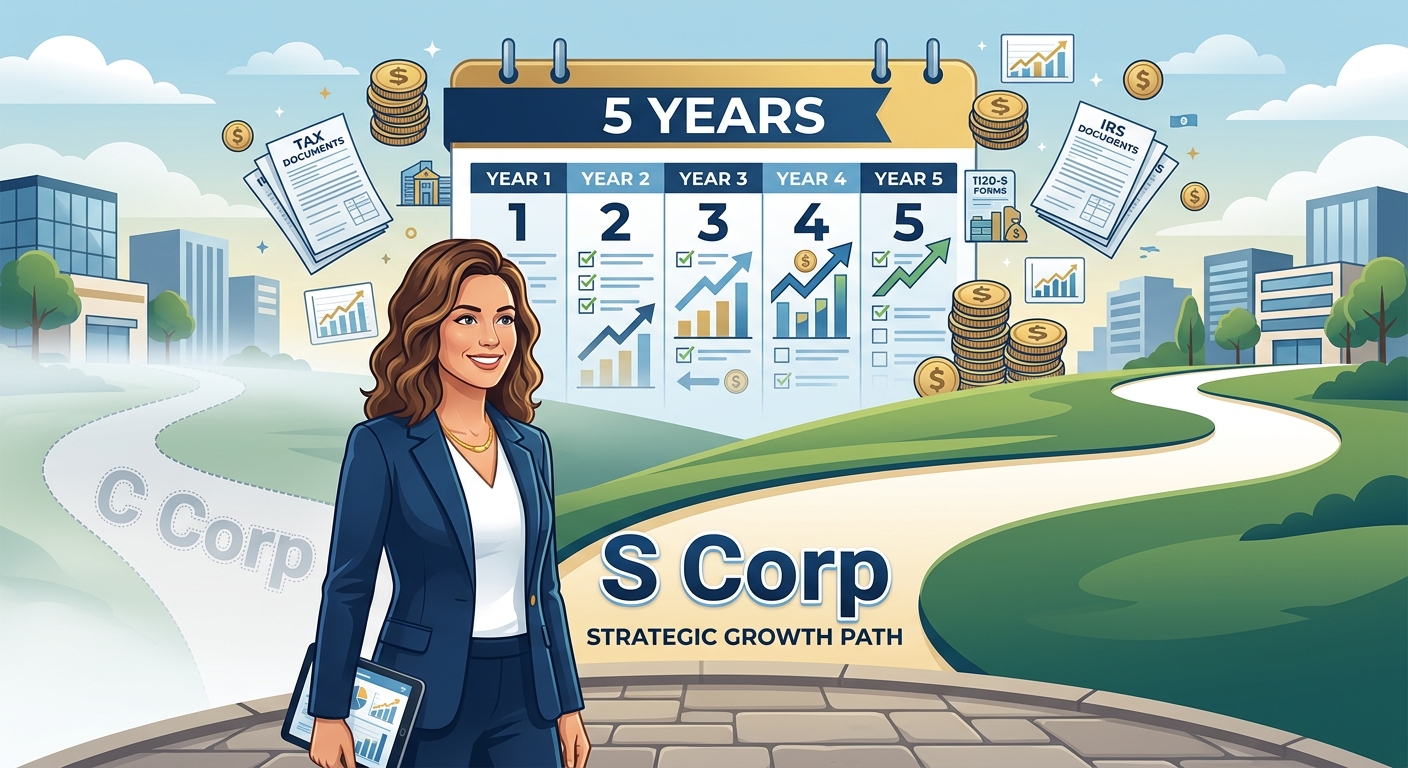
The 5-Year Clock Starts Ticking the Moment You Convert
Every year, thousands of California C Corp owners file Form 2553 to elect S Corp status, expecting immediate tax relief. Most of them have no idea that a 5 year when changing from C Corp to S Corp countdown just started, and the IRS is watching every asset on their books. That countdown is the built-in gains (BIG) tax recognition period under IRC Section 1374, and getting it wrong can trigger a surprise federal tax bill of $30,000, $60,000, or more on gains your company earned before the conversion ever happened.
The BIG tax is not optional. It is not a penalty. It is a mandatory federal tax applied at the highest corporate rate (currently 21%) on any recognized built-in gain during the five-year window after your S Corp election takes effect. If your C Corp held appreciated assets, unrealized receivables, or inventory with embedded profit at the time of conversion, those gains do not get a fresh start just because your entity status changed.
Quick Answer
When you change from a C Corp to an S Corp, the IRS imposes a 5-year built-in gains tax recognition period under IRC Section 1374. Any asset your company owned on the conversion date that is sold at a gain during those five years gets hit with a 21% federal BIG tax on top of the regular shareholder-level tax. After the 5-year window closes, the BIG tax disappears entirely. The key to surviving this period is knowing which assets carry built-in gains, timing dispositions strategically, and offsetting gains with built-in losses or net operating loss carryforwards from C Corp years.
What the 5-Year Built-In Gains Tax Actually Means for Your Business
The BIG tax exists because Congress did not want C Corp owners to dodge double taxation by converting to S Corp status right before selling appreciated assets. Without this rule, a C Corp owner sitting on a building worth $2 million (with a $500,000 basis) could elect S Corp status on January 1 and sell the building on January 2, paying only shareholder-level tax instead of the combined corporate and individual tax that a C Corp sale would have triggered.
IRC Section 1374 closes that loophole by creating a recognition period. During the 5 year when changing from C Corp to S Corp recognition window, any gain on assets that existed at the time of conversion is subject to a flat 21% entity-level tax. That 21% is in addition to the income tax each shareholder pays on their share of the gain flowing through on Schedule K-1.
How the BIG Tax Math Works in Practice
Take a California business owner who converted a C Corp to an S Corp on January 1, 2024. The C Corp owned commercial equipment with a fair market value (FMV) of $400,000 and an adjusted basis of $150,000 at conversion. The net built-in gain on that equipment is $250,000.
If the owner sells that equipment in Year 3 (2026) for $420,000:
- Recognized built-in gain: $250,000 (the gain that existed at conversion)
- Post-conversion appreciation: $20,000 ($420,000 sale price minus $400,000 FMV at conversion)
- BIG tax on $250,000 at 21%: $52,500
- Shareholder-level federal tax on $270,000 total gain (assuming 24% bracket): $64,800
- California state tax on the gain: approximately $33,210 (12.3% top rate)
- Total combined tax: approximately $150,510
If that same owner waited until Year 6 (2029, after the 5-year window closed), the $52,500 BIG tax vanishes entirely. The total tax drops to approximately $98,010. That is a $52,500 difference for waiting one year.
Many business owners converting from C Corp to S Corp underestimate how expensive an early asset sale can be during the recognition period. The BIG tax effectively recreates the double taxation that the S Corp election was supposed to eliminate.
Which Assets Carry Built-In Gains?
Not every asset on your balance sheet creates BIG tax exposure. Only assets with a fair market value exceeding their adjusted tax basis on the conversion date are subject to this rule. Common BIG tax triggers include:
- Real property: Buildings, land, and improvements that have appreciated since purchase
- Equipment and vehicles: Particularly items that have been depreciated below their actual market value
- Accounts receivable: If your C Corp used the cash method of accounting, uncollected receivables have a zero basis and create dollar-for-dollar built-in gains
- Inventory: LIFO inventory layers often carry significant embedded gains
- Intangible assets: Goodwill, customer lists, and patents with appreciated values
- Investments: Stocks, bonds, or partnership interests held by the corporation
On the other side, assets with a fair market value below their adjusted basis at conversion create built-in losses. These built-in losses can offset built-in gains recognized during the same tax year within the 5-year window, reducing or eliminating the BIG tax. This is why a thorough appraisal of every asset on the conversion date is not optional. It is the foundation of your entire BIG tax defense strategy.
Five Strategies to Minimize or Eliminate the BIG Tax During the 5-Year Window
Surviving the 5-year recognition period does not require you to freeze your business operations. It requires strategic timing, smart offsets, and documentation that can withstand an audit. Here are five proven approaches that reduce or eliminate BIG tax exposure.
Strategy 1: Net Built-In Gain Limitation and Loss Offsets
The BIG tax is not calculated on individual assets in isolation. IRC Section 1374(d)(2) allows the net recognized built-in gain for any tax year to be reduced by built-in losses recognized in the same year. If your C Corp held assets that had declined in value at conversion, selling those loss assets in the same year as gain assets can offset the BIG tax dollar for dollar.
For example, if you recognize $200,000 in built-in gains from selling appreciated equipment but also recognize $120,000 in built-in losses from disposing of depreciated vehicles, your net recognized built-in gain drops to $80,000. The BIG tax falls from $42,000 to $16,800.
Pro Tip: The IRS requires that both the gains and losses be recognized in the same tax year. You cannot carry built-in losses forward to offset gains in a future year within the recognition period. Timing is everything.
Strategy 2: C Corp Net Operating Loss Carryforwards
If your C Corp had accumulated net operating losses (NOLs) before conversion, those losses can reduce the BIG tax base under IRC Section 1374(b)(2). This is one of the few situations where frozen C Corp NOLs retain real value after an S Corp election.
Suppose your C Corp carried $150,000 in NOLs at conversion. In Year 2 of the recognition period, you recognize $200,000 in built-in gains. The NOL offset reduces the taxable built-in gain to $50,000, and the BIG tax drops from $42,000 to $10,500. That is a $31,500 savings from losses you might have assumed were worthless. For a deeper analysis of how NOLs interact with S Corp conversions, see our comprehensive S Corp tax strategy guide.
Strategy 3: Deferring Asset Sales Beyond the 5-Year Window
The simplest and most effective BIG tax strategy is patience. Once the 5-year recognition period expires, every built-in gain becomes permanently exempt from the entity-level BIG tax. If you can delay the sale of appreciated assets until after the window closes, you eliminate the 21% corporate-level tax entirely.
This strategy works best for assets you were not planning to sell immediately anyway, such as real estate, long-term equipment, or intellectual property. It does not work for assets you must sell due to obsolescence, contract requirements, or cash flow needs.
If you want to see how different sale timings affect your total tax bill, run the numbers through this small business tax calculator to estimate your federal liability under different scenarios.
Strategy 4: Installment Sales Under IRC Section 453
If you must sell an appreciated asset during the recognition period, structuring the sale as an installment sale can spread the gain recognition across multiple tax years. While the BIG tax still applies to the built-in gain portion, spreading the recognition can help you stay under annual BIG tax limitations and coordinate with other offset strategies.
Be careful with this approach. The IRS treats the entire built-in gain as recognized in the year of sale for BIG tax purposes under certain circumstances. Work with a tax professional to ensure your installment sale structure actually defers BIG tax rather than just deferring shareholder-level tax. Our entity formation and restructuring services include BIG tax planning as a core component of every C-to-S conversion.
Strategy 5: Section 1374(d)(7) Taxable Income Limitation
The BIG tax for any year cannot exceed the amount that would be the corporation’s taxable income if it were still a C Corp. This means that if your S Corp has a net loss for the year (before considering BIG tax items), the BIG tax can be reduced or eliminated for that year.
This creates a planning opportunity. By accelerating deductible expenses into years where you expect to recognize built-in gains, you can reduce the taxable income limitation and shrink the BIG tax. Bonus depreciation under OBBBA (now permanent at 100%), retirement plan contributions, and prepaid expenses can all serve this purpose.
California-Specific Traps That Make the 5-Year Window Even More Expensive
California does not simply follow the federal BIG tax rules. The state adds its own layer of complexity and cost that catches unprepared business owners off guard.
Trap 1: California’s 1.5% Net Income Tax Applies During the Recognition Period
California imposes a 1.5% tax on the net income of every S Corp (Revenue and Taxation Code Section 23802). During the BIG tax recognition period, gains from selling built-in assets flow through to shareholder income and are also subject to this 1.5% entity-level state tax. Combined with the 21% federal BIG tax, California S Corps face a total entity-level tax rate of 22.5% on built-in gains during the 5-year window, before any shareholder-level tax is calculated.
Trap 2: Bonus Depreciation Nonconformity Creates Basis Mismatches
California does not conform to federal bonus depreciation under R&TC Sections 17250 and 24356. If your C Corp claimed 100% bonus depreciation on equipment before conversion, the federal adjusted basis of that equipment may be zero while the California basis could still be substantial. This creates different built-in gain calculations for federal and state purposes, requiring dual depreciation schedules and separate BIG tax tracking for California.
Trap 3: The $800 Annual Franchise Tax Does Not Offset BIG Tax
California’s minimum $800 franchise tax is a flat fee, not a credit against your BIG tax exposure. You pay the franchise tax regardless of whether you owe BIG tax, shareholder-level tax, or no tax at all. Many owners incorrectly assume the franchise tax offsets other California tax obligations. It does not.
Trap 4: AB 150 PTE Election Timing and BIG Tax Interaction
California’s AB 150 Pass-Through Entity (PTE) elective tax allows S Corps to pay a 9.3% entity-level tax to bypass the $40,000 SALT deduction cap under OBBBA. However, the PTE election interacts with BIG tax timing in ways most advisors overlook. If you are recognizing significant built-in gains during a particular year, the PTE election may create a situation where you are paying three layers of entity-level tax: the federal BIG tax, the California 1.5% net income tax, and the 9.3% PTE tax. Coordinate these elections carefully.
Trap 5: California Section 179 Cap Creates Additional Timing Pressure
California limits Section 179 to $25,000 (compared to the federal $2,500,000 under OBBBA). This means California business owners have fewer tools to offset income during years when BIG tax gains are recognized, making it harder to use Strategy 5 (the taxable income limitation) at the state level.
KDA Case Study: Fresno Manufacturing Owner Saves $78,400 by Timing the 5-Year Window
David, a Fresno-based manufacturing company owner, converted his C Corp to an S Corp in January 2022. His company held three major assets with built-in gains at conversion: a commercial building (FMV $1.2 million, basis $680,000), CNC equipment (FMV $340,000, basis $95,000), and accounts receivable (FMV $186,000, basis $0 under cash method accounting).
Total net built-in gain at conversion: $951,000. Potential BIG tax exposure at 21%: $199,710.
David came to KDA in mid-2024, Year 3 of his recognition period. He was planning to sell the CNC equipment and collect the remaining receivables that year, which would have triggered approximately $91,770 in BIG tax alone. Here is what we did instead:
- Accelerated collection of receivables: We restructured collection timelines so $112,000 in receivables were collected in Year 3 alongside the recognition of $85,000 in built-in losses from obsolete inventory David had not yet disposed of. Net BIG gain for Year 3: $27,000. BIG tax: $5,670 instead of $23,520.
- Deferred CNC equipment sale to Year 6: By leasing replacement equipment instead of buying, David kept the original CNC machines operational through Year 5. He sold them in January 2028 (Year 6), completely outside the recognition period. BIG tax saved: $51,450.
- Applied C Corp NOL carryforward: David had $43,000 in frozen NOLs. We applied these against the remaining built-in gains recognized in Year 4, saving an additional $9,030 in BIG tax.
- Filed AB 150 PTE election strategically: We elected PTE treatment only in years where BIG tax was minimal, avoiding the triple-tax scenario in high-gain years.
Total BIG tax paid: $14,280. Total BIG tax avoided: $78,400. KDA fee: $8,500. First-year ROI: 9.2x. Five-year projected savings with continued planning: $185,430.
Ready to see how we can help you? Explore more success stories on our case studies page to discover proven strategies that have saved our clients thousands in taxes.
The Five Costliest Mistakes During the 5-Year Recognition Period
After reviewing hundreds of C-to-S conversions, these are the mistakes that cost California business owners the most money during the 5 year when changing from C Corp to S Corp recognition window.
Mistake 1: No Appraisal on the Conversion Date
Without a professional appraisal documenting the fair market value of every asset on the day your S Corp election takes effect, you have no defensible basis for calculating built-in gains. The IRS can (and does) challenge FMV claims that are not supported by qualified appraisals. A $3,000 to $8,000 appraisal can save you $50,000 or more in disputed BIG tax calculations. See IRS Publication 544 for guidance on determining fair market values for asset sales and dispositions.
Mistake 2: Selling Appreciated Assets in Year 1
Some owners convert and immediately sell assets, assuming the S Corp election eliminates all double taxation. It does not, at least not for five years. Selling appreciated assets in Year 1 triggers the maximum BIG tax with the fewest offset opportunities. Unless you have substantial NOLs or built-in losses, Year 1 sales are almost always the most expensive from a BIG tax perspective.
Mistake 3: Ignoring Cash-Method Receivables
If your C Corp used the cash method of accounting, every dollar of outstanding accounts receivable at conversion has a zero tax basis. When those receivables are collected during the recognition period, the entire amount is a built-in gain subject to the 21% BIG tax. A C Corp with $300,000 in receivables at conversion faces $63,000 in BIG tax on money it has not even received yet. The solution is to accelerate collections before the conversion date or pair collections with built-in loss recognition.
Mistake 4: Forgetting Dual State/Federal Tracking
California’s nonconformity with federal bonus depreciation means your built-in gain calculations may differ between federal and state returns. Owners who track only the federal numbers frequently underreport or overreport California BIG tax exposure, leading to penalties, interest, or missed offset opportunities.
Mistake 5: Missing the NOL Offset Window
C Corp NOLs can offset BIG tax, but only during the recognition period. If you do not strategically recognize built-in gains during years when NOLs are available, those losses expire worthless from a BIG tax perspective. You cannot use them after the 5-year window closes because the BIG tax no longer applies.
The OBBBA Changes That Affect Your 5-Year Window in 2026
The One Big Beautiful Bill Act (OBBBA) made several provisions permanent that directly impact BIG tax planning during the 5-year recognition period:
- 100% bonus depreciation (permanent): This is now a permanent tool for reducing taxable income during high-BIG-tax years. By placing new assets in service and claiming full bonus depreciation, you can lower your taxable income limitation under Section 1374(d)(7), reducing the BIG tax dollar for dollar.
- $2,500,000 Section 179 limit (permanent): The expanded Section 179 provides another lever for compressing taxable income in BIG tax years. Note that California still caps Section 179 at $25,000.
- Permanent QBI deduction: The 20% Qualified Business Income deduction under Section 199A remains available for S Corp shareholders, providing ongoing tax savings that partially offset any BIG tax paid during the recognition period.
- $40,000 SALT cap: The new permanent SALT deduction cap (up from $10,000 under TCJA) makes the AB 150 PTE election slightly less critical but still valuable for California S Corp owners paying high state taxes during the BIG tax window.
Step-by-Step: How to Navigate the 5-Year Window After Converting
If you have already converted or are planning to convert from C Corp to S Corp, follow this 8-step process to minimize BIG tax exposure during the recognition period.
- Get a qualified appraisal of all assets on the conversion date. Document fair market values for real property, equipment, inventory, receivables, intangibles, and investments. This is your BIG tax baseline.
- Calculate net unrealized built-in gain (NUBIG). Subtract total adjusted basis from total FMV across all assets. This is your maximum BIG tax exposure for the entire 5-year period.
- Identify built-in loss assets. Any asset with FMV below basis at conversion creates an offset opportunity. List these separately and plan their disposition timing.
- Inventory C Corp NOL carryforwards. Confirm the exact amount and confirm they meet IRS requirements for BIG tax offset eligibility.
- Create a 5-year asset disposition calendar. Map out which assets you plan to sell, replace, or dispose of in each year. Time built-in gain recognition to coincide with built-in loss recognition or high-deduction years.
- Coordinate California depreciation schedules. Maintain dual federal/state depreciation tracking for every asset to ensure accurate BIG tax calculations at both levels.
- File AB 150 PTE election strategically. Elect PTE treatment in years with minimal BIG tax exposure. Avoid PTE in years with high built-in gain recognition to prevent triple taxation.
- Review and adjust annually. The 5-year window is dynamic. Business conditions, asset values, and tax law changes (like OBBBA) require annual reassessment of your BIG tax strategy.
What Happens After the 5-Year Window Closes?
Once the recognition period expires, the BIG tax disappears permanently. All assets, regardless of when your company acquired them or how much built-in gain they carried at conversion, are treated as S Corp assets without any entity-level tax on sale. This is the payoff for disciplined planning during the 5-year window.
However, two residual issues can linger after the window closes:
- Accumulated Earnings and Profits (E&P): If your C Corp had accumulated E&P at conversion, distributions from the S Corp are still treated as taxable dividends to the extent of accumulated E&P under the ordering rules of IRC Section 1368(c). This trap continues indefinitely until the E&P is fully distributed or eliminated.
- AAA tracking: Your Accumulated Adjustments Account (AAA) must be tracked separately from E&P. Distributions first come from AAA (tax-free to the extent of basis), then from E&P (taxable as dividends), then from remaining basis. Getting this ordering wrong can turn tax-free distributions into taxable dividends.
Should You Delay Your C Corp to S Corp Conversion to Avoid the 5-Year Window?
Some advisors suggest delaying conversion until you have sold appreciated assets while still a C Corp. This is sometimes the right call, but not always. Consider these factors:
- If your appreciated assets are not being sold anytime soon: Convert now. The sooner you start the 5-year clock, the sooner it expires. Meanwhile, you save on self-employment tax and eliminate ongoing double taxation on operating income.
- If you plan to sell major assets within 2 years: Delay the conversion, sell the assets as a C Corp, and then convert. You will pay C Corp tax on the sale, but you avoid the BIG tax plus shareholder-level tax combination that is often more expensive.
- If you have significant NOLs: Convert now. Your NOLs can offset BIG tax during the recognition period, making the 5-year window significantly less expensive.
- If your business has mostly depreciating assets: Convert now. Equipment, vehicles, and technology lose value over time. The longer you wait, the less built-in gain exists, but you are also losing years of S Corp tax savings on operating income.
Ready to Reduce Your Tax Bill?
KDA Inc. specializes in strategic tax planning for business owners, S Corps, LLCs, and high-net-worth individuals. Book a personalized consultation and walk away with a clear plan.
Frequently Asked Questions About the 5-Year BIG Tax Window
Does the 5-year BIG tax period apply to every C Corp that converts to S Corp?
Yes. Every C Corp that elects S Corp status is subject to the 5-year recognition period under IRC Section 1374. However, the BIG tax only applies if the corporation owned assets with built-in gains (FMV exceeding basis) on the conversion date. If all assets had a basis equal to or greater than FMV at conversion, there is no BIG tax exposure.
Can I shorten the 5-year recognition period?
No. Congress permanently set the recognition period at five years. Previously, the period was temporarily reduced to seven years, then five years, and finally made permanent at five years under the Protecting Americans from Tax Hikes (PATH) Act of 2015. There is no mechanism to shorten it further.
What if my S Corp election is revoked and I re-elect later?
If you revoke your S Corp election and later re-elect, a new 5-year BIG tax recognition period begins on the new effective date. Under IRC Section 1362(g), you generally cannot re-elect S Corp status within five years of a revocation without IRS consent. This means you could face overlapping recognition periods and additional tax complexity.
Does the BIG tax apply to assets purchased after the conversion?
No. The BIG tax applies only to assets the corporation owned on the conversion date (or assets received in certain tax-free exchanges that substituted for conversion-date assets). Assets purchased after the S Corp election takes effect are not subject to BIG tax.
How does the BIG tax interact with the QBI deduction?
The BIG tax is an entity-level tax that reduces the net income flowing through to shareholders. The QBI deduction is calculated on the shareholder’s share of income after the BIG tax has been paid. This means the BIG tax reduces the QBI deduction amount, creating a secondary cost beyond the direct tax payment.
Will an IRS audit specifically examine BIG tax calculations?
Yes. The IRS includes BIG tax verification as part of its S Corp audit procedures, particularly for corporations that converted from C Corp status within the last five years. The IRS examines the conversion-date appraisal, asset disposition records, and gain recognition calculations. Incomplete documentation is the number one reason BIG tax assessments increase during audits.
This information is current as of April 7, 2026. Tax laws change frequently. Verify updates with the IRS or FTB if reading this later.
Book Your BIG Tax Strategy Session
If you have converted from a C Corp to an S Corp or are planning to, the 5-year built-in gains tax window is ticking. Every asset sale, every receivable collected, and every disposition during this period carries potential BIG tax consequences that most business owners do not discover until their tax return is already filed. Do not leave $30,000 to $200,000 on the table because you did not plan for the recognition period. Book a personalized consultation with our team and get a custom BIG tax minimization roadmap built around your specific assets, timeline, and California tax exposure. Click here to book your consultation now.
“The IRS does not reward patience accidentally. The 5-year BIG tax window is designed to punish impulsive sellers and reward business owners who plan every asset move in advance.”


