
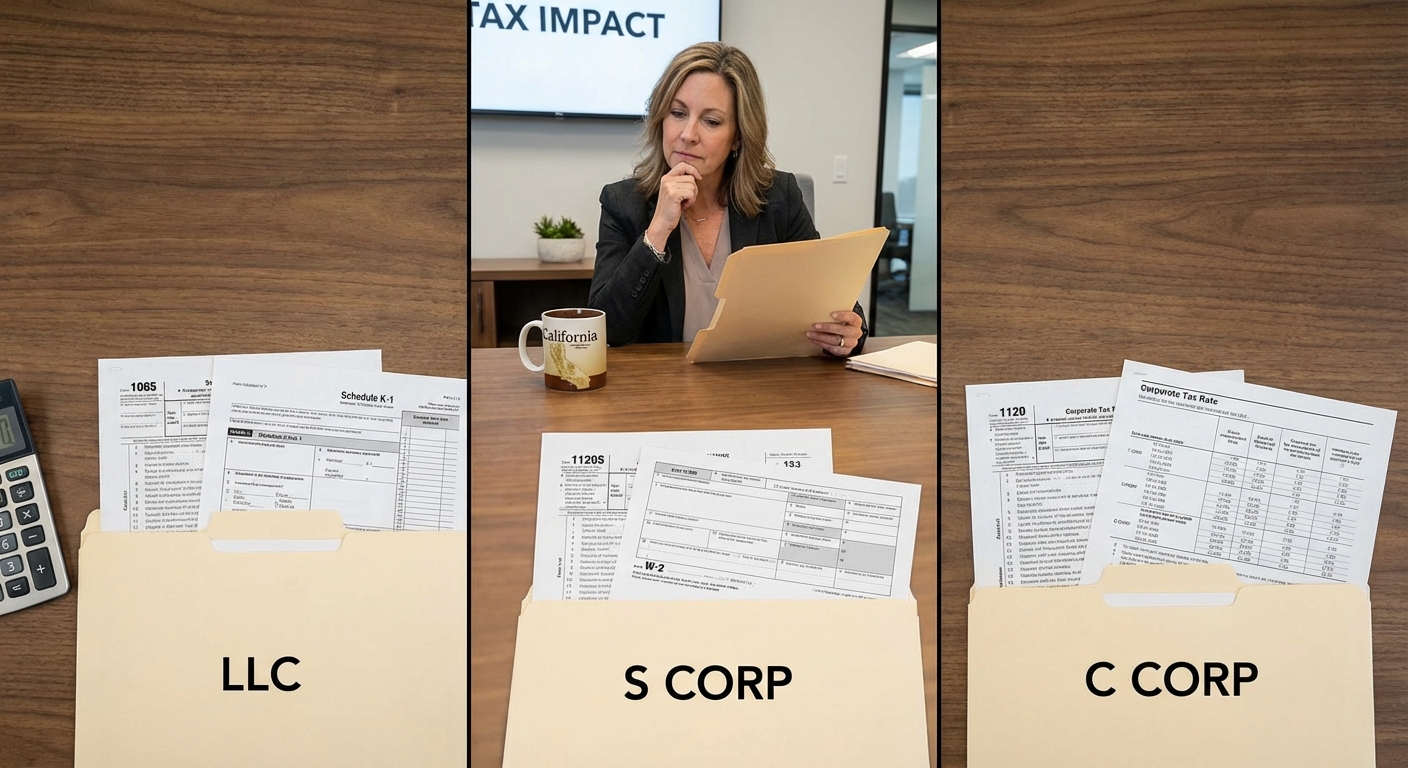
2026’s Tax Showdown: Why LLC vs S Corp vs C Corp Tax Comparisons Are Costing California Owners $20K+
It’s estimated that nearly 70% of California business owners make the wrong entity tax move—so their profits bleed away year after year. The worst part? The answer isn’t just “talk to your CPA”—it’s about understanding what really drives a $20K swing in take-home income, and why new IRS and California rules for 2026 mean yesterday’s advice could cost you thousands.
Quick Answer: LLC vs S Corp vs C Corp in Plain English
LLC vs S Corp vs C Corp tax comparison: LLCs are flexible but expose profits to self-employment tax. S Corps combine pass-through taxation and payroll, letting owners split income for tax savings—but strict rules apply. C Corps are taxed twice but allow reinvestment and fringe benefits. In 2026, compliance mistakes can cost $8,000–$24,000 per year on $150K profit, depending on your setup, documentation, and IRS audits. There’s no “best”—only what fits your profit, risk, and growth plan. This is current as of 2/18/2026—tax laws change fast, especially in California.
How the 2026 Tax Landscape Adds (or Steals) Five Figures Per Year
The game has changed for small business tax strategy in 2026. California’s Franchise Tax Board (FTB) has synced some rules with the IRS—but major state and federal mismatches remain. Here’s what’s new and why it matters for LLCs, S Corps, and C Corps:
- IRS “Payroll Audit” Push: The IRS doubled S Corp payroll audits in California in 2025. Fail to set “reasonable salary,” and you risk tens of thousands in back taxes and penalties. (See S Corp IRS rules.)
- California $800 Minimum Franchise Tax: Hits all entities—whether or not you make a profit. It’s unavoidable for LLCs and corporations, unlike most other states. (More on the CA FTB minimum.)
- New Deductions and Credits: The 2026 “One Big Beautiful Bill Act” lets filers deduct more car loan interest, claim “No Tax on Tips” up to $25K, and deduct up to $12,500 in overtime for single owners. If you’re not adapting, you’re leaving new money on the table (source).
- State vs. Federal Double-Dip Penalties: Get your tax status wrong and you’ll pay both IRS and FTB fines—California fiercely chases non-compliant LLCs and late S Corp elections.
Most owners are caught off guard when their “safe” choice backfires. If you’re a high-income W-2 employee turned side hustler, real estate investor, or startup founder, your risk—and saving potential—skyrockets with the entity you pick.
Case Study: Bay Area Tech Consultant’s $34,800 S Corp vs LLC Turnaround
Meet “Eric,” a W-2 consultant who started a tech advisory LLC and cleared $210,000 in profit his first year. His CPA said staying an LLC was easier, but it cost him $27,750 in extra self-employment tax (15.3% on net earnings) and triggered an $800 FTB bill he wasn’t expecting. After working with KDA, we:
- Restructured him as an S Corp mid-year (Form 2553 retroactive election)
- Set “reasonable salary” at $95,000—documented for IRS compliance
- Ran the rest as profit distributions (no self-employment tax on these)
- Implemented accountable plan reimbursements for home office, phone, and travel
- Saved $18,150 in self-employment tax the first full year, plus $16,650 in new state and federal write-offs
Eric paid $5,000 in consulting fees for formation, payroll, and ongoing strategy—his ROI was 6.9x the first year alone.
Ready to see how we can help you? Explore more success stories on our case studies page to discover proven strategies that have saved our clients thousands in taxes.
LLC vs S Corp vs C Corp Tax Comparison: Real Numbers for 2026
Let’s look at what LLC vs S Corp vs C Corp tax comparison looks like for a California business with $150,000 in net profit:
| Structure | Federal Tax | CA Franchise Tax | Payroll Required? | Self-Employment Tax? | Take-Home (Approx.) |
|---|---|---|---|---|---|
| LLC (Default) | $30,000 | $800 | No | Yes (Full) | $101,200 |
| S Corp | $20,150 | $800 | Yes | Only on Salary | $116,200 |
| C Corp | $28,500* | $800 | Optional | No** | $99,750 |
*Assumes profit paid as salary and dividends; double tax applies.
**C Corp owners pay Social Security & Medicare on salary, but C Corp retains flexibility for business reinvestment.
Even with the same profits, your after-tax income can swing by over $16,000—just by picking the right structure. If you own rental property, do consulting as a 1099, or reinvest profits, your scenario will diverge even more.
Why Most Owners Blow Their Tax Savings: Common Traps of 2026
Fact: Audit rates for S Corps went up 2x in California last year. LLCs switching mid-year (or filing late S Corp elections) get flagged. Here’s where even smart, six-figure owners get tripped up:
- Poor Documentation: No salary memo, missing payroll reports, and late Form 2553 = audit target
- Double-Tax Confusion: C Corps taxed on profit AND again on dividends. Some accountants gloss over the dividend tax
- Missed Write-Offs: LLCs skip retirement plans; S Corp owners don’t maximize accountable plan reimbursements
- Owner Loans/Draws: Bookkeeping misses can turn legitimate withdrawals into IRS red flags
- California $800 Rule: Rookie mistake: dissolving an entity late or failing to file CA Form 568 racks up five-figure penalties fast
Red Flag Alert: The IRS is matching payroll tax data with S Corp and C Corp returns in 2026—a new initiative that’s catching under-reported wages and unfiled payroll forms. If you’re unsure if your entity is compliant, get a compliance check now.
How to Choose: The 5-Minute Owner Decision Checklist
- LLC (Default): Best for very early-stage businesses, real estate investors, single-member LLCs with profit under $40K, or those who want simplicity and flexibility
- S Corp: Best for owners with $60,000+ in net profit, who can justify a “reasonable salary” and don’t have foreign owners or unusual corporate structures
- C Corp: Best for tech startups planning venture capital raises, businesses reinvesting all profits, or those needing robust health/fringe benefits
Still confused? For a deep dive, see our comprehensive S Corp tax guide.
Pro Tip: If you’re a W-2 employee turned consultant, run your numbers through this small business tax calculator to see your real after-tax outcome before making a move.
KDA Case Study: S Corp Rescue for a Real Estate Broker
“Monica” was a high-earning real estate broker in Los Angeles, reporting $310,000 in annual commissions as a sole-member LLC. She was paying over $47,000 in self-employment tax alone, on top of federal and California income tax. After a comprehensive review, KDA:
- Filed a late S Corp election (using IRS relief procedures) for the current tax year
- Set “reasonable salary” at $135,000 with the rest as distributions
- Established a Solo 401(k), letting Monica defer $67,500 in pre-tax contributions (employee + employer)
- Documented accountable plan reimbursements for $9,300 in legitimate business expenses
- Brought ongoing bookkeeping in-house to lock in compliance and flag audit risks early
- Result: Monica paid $7,500 in consulting and payroll fees and realized $33,600 savings the first year—plus a 4.5x ROI on advisory costs
Ready to see how we can help you? Explore more success stories on our case studies page to discover proven strategies that have saved our clients thousands in taxes.

Key Differences Demystified: What the IRS and FTB Don’t Spell Out
- LLC (Default): Pass-through taxation, but all income subject to self-employment tax. Minimal annual paperwork but high ongoing tax drag once profit rises
- S Corp: Avoids self-employment tax on the distribution portion, but requires payroll, annual corporate formalities, and tight compliance with “reasonable compensation” rules (see IRS S Corp rules)
- C Corp: Profits taxed at 21%, then at shareholder rate if distributed as dividends. Unlimited shareholders, easy capital raise, and most flexible fringe benefits, but risk of “double tax” and ongoing compliance costs
Common Mistake That Triggers an Audit: S Corp or C Corp owners who treat all profit as distributions (no payroll) are prime targets for IRS audits in 2026. The IRS cross-references 941 payroll filings with S Corp 1120S and C Corp 1120.
What If I Want to Switch Entity Types?
For LLCs electing S Corp status (Form 2553) in 2026, timing is critical—file by March 15 for full-year effect, or you’ll be stuck waiting or retroactively navigating IRS relief. For C Corps, consider a tax-free reorganization or QSUB, but beware of legal and tax traps. Pro Tip: Document every change with minutes, updated operating agreements, and IRS/FTB acknowledgments. Talk to a specialist before making any move.
FAQ: Following Up on LLC, S Corp, and C Corp Tax Choices
Will an S Corp save me money if my profit is under $40,000?
No—payroll costs and compliance outweigh the small tax savings below this profit level. Stick with an LLC unless your income rises.
Can a California LLC elect S Corp status?
Yes. Use IRS Form 2553, but maintain state compliance (file CA Form 100S and pay the $800 min. tax).
How do distributions work for S Corp and C Corp?
S Corp: Profits can be split into salary (payroll) and distributions, the latter not subject to self-employment tax. C Corp: After-tax profits paid as dividends, which are taxed again to owners.
What’s the penalty for late S Corp election in California?
You’ll face double taxes on profit and may have to jump through IRS “relief for late election” hoops. Fix it early.
What documents must be kept for LLCs, S Corps, and C Corps?
LLC: Operating agreement, minutes, annual statements. S Corp: Payroll records, annual meeting minutes, corporate resolutions. C Corp: Same, plus shareholder ledgers and dividend history.
The IRS Isn’t Hiding These Savings—They’re Just Not Teaching Them
Your CPA or online toolkit probably isn’t explaining the five-figure impact of your entity choice. In 2026, FTB and IRS data cross-checks have made “easy” setups dangerous—especially for high-income or California-based owners. If you’re committed to keeping more of your profit this year, don’t stay in the dark. The IRS isn’t hiding these write-offs—you just weren’t taught how to find them.
Book Your Tax Entity Strategy Assessment
If you’re unsure whether your LLC, S Corp, or C Corp status is costing you thousands each year, get a forensic deep dive and fix it for 2026. Book a personalized strategy session with a KDA senior strategist and finally take control of your tax outcome. Click here to secure your consultation now.


