
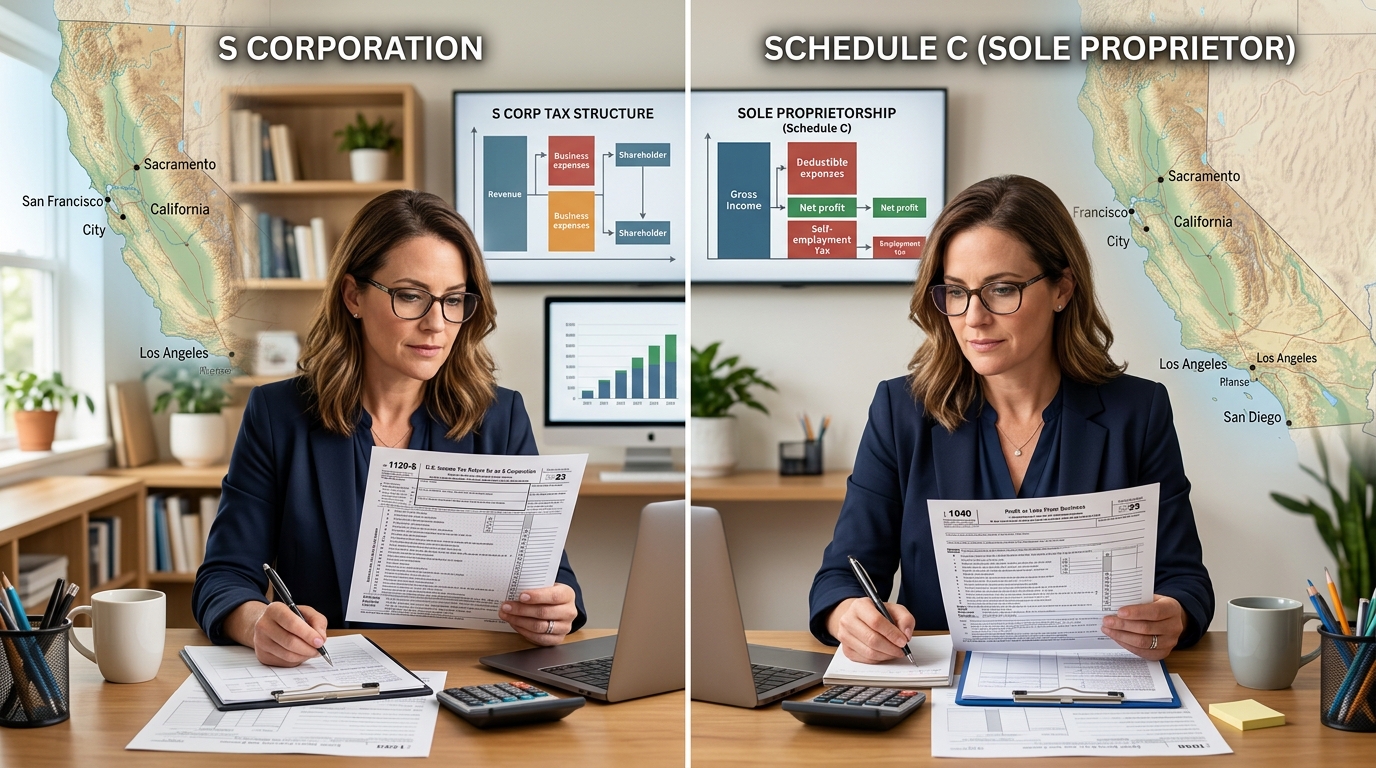
Many self employed taxpayers quietly suspect they are leaving thousands of dollars on the table because they are not using the right business structure. If you are profitable and still reporting everything on Schedule C, the difference between that and an S corporation can easily be five figures a year. The catch is that the rules are technical, California adds its own twists, and the wrong move can actually increase your taxes instead of cutting them.
Fast tax fact: the average six figure sole proprietor pays self employment tax on every dollar of net profit, while a properly structured S corporation often pays that tax only on the salary portion. That single design choice is where most of the savings live.
Quick answer
The short version of the **2016 s corp vs schedule c** debate is this. Schedule C is simpler and flexible but subjects all net profit to self employment tax. An S corporation adds payroll, filings, and California franchise fees but can dramatically reduce that self employment tax if you pay yourself a reasonable salary and take the rest as distributions. For many profitable service businesses between about 80,000 and 500,000 of net income, the S corporation will win by several thousand dollars a year when designed correctly.
Understanding 2016 s corp vs schedule c in plain English
To compare these structures, you need to understand what each one actually is on your tax return. A Schedule C is just the form an individual uses to report sole proprietor or single member LLC business income on their personal Form 1040. All your business income and expenses flow through there, and the bottom line is your net profit.
That net profit is subject to two layers of federal tax. First, it increases your regular income tax. Second, it is hit with self employment tax, which is basically Social Security and Medicare for self employed people, calculated on Schedule SE. For 2025 and 2026, that combined self employment tax rate is 15.3 percent on the Social Security wage base and 2.9 percent above that, plus the 0.9 percent additional Medicare tax for higher earners. See IRS Publication 334 for the small business overview.
An S corporation is not a different kind of business activity. It is a tax election a corporation or LLC can make with the IRS using Form 2553. When you elect S corporation treatment, the business files its own return on Form 1120 S. The company still passes its profit through to you, but the IRS expects you, as a shareholder employee, to take part of that profit as W 2 wages and the rest as distributions.
The key distinction for this comparison is that only the W 2 wages are subject to Social Security and Medicare payroll taxes. The distributions are generally not subject to self employment tax, which is where the savings come in. The IRS explains this distinction and the need for reasonable compensation in IRS Publication 15.
Where the tax savings really show up
Consider Maria, a California marketing consultant netting 180,000 after expenses. As a Schedule C filer, the entire 180,000 is subject to self employment tax. Roughly 25,000 of that bill is just Social Security and Medicare on Schedule SE, before we even talk about federal and state income tax.
If Maria instead operates through an S corporation and pays herself a 90,000 W 2 salary that fits her role and industry standards, only that 90,000 is subject to payroll tax. The remaining 90,000 is treated as a distribution. The payroll tax on 90,000 is roughly 13,770. Compare that to about 25,000 on the full 180,000 as a sole proprietor, and you see roughly 11,000 in annual payroll tax savings.
At that level of income, after California 1.5 percent S corporation franchise tax and a few thousand a year in payroll, bookkeeping, and compliance costs, Maria can still be 6,000 to 8,000 ahead each year. This is why many self employed professionals start looking hard at the S corporation model when they cross about 80,000 of consistent net profit.
To manage the additional moving parts, many owners lean on professional support. Strategic, year round work with a firm that offers strong tax planning services usually uncovers additional savings beyond the basic S corporation design.
KDA Case Study: Consultant shifts from Schedule C to S corporation
Jordan is a 1099 software consultant in Los Angeles. For years he filed a Schedule C and netted between 140,000 and 190,000 with no employees and very low overhead. Jordan came to KDA frustrated that he was paying more than 40 percent of his income in combined federal and California tax.
We analyzed his numbers and showed him what a 2016 s corp vs schedule c comparison would have looked like at his income levels. Under the S corporation model, we targeted a 95,000 reasonable salary based on his experience and typical market pay for senior developers, with the remaining profit taken as distributions.
In the first full year after restructuring, Jordan netted 170,000 before owner compensation. On Schedule C, that entire 170,000 would have been subject to self employment tax. In the S corporation, only his 95,000 salary was subject to payroll tax. After accounting for California franchise tax, payroll processing fees, and professional support, Jordan saved just over 9,400 in federal payroll taxes and another 1,200 in related income tax effects. His total out of pocket for entity setup, ongoing compliance, and advisory was about 3,600, so his first year return on investment was roughly 3.0 times what he paid us.
Ready to see how we can help you? Explore more success stories on our case studies page to discover proven strategies that have saved our clients thousands in taxes.
How California changes the comparison
California adds extra layers to the 2016 s corp vs schedule c analysis that you cannot ignore. Sole proprietors pay the regular California personal income tax on their net income, but there is no separate entity level tax. For S corporations, California imposes a 1.5 percent franchise tax on net income with a minimum payment each year, even if you break even or have a loss.
On the surface, that 1.5 percent looks like a drawback compared to Schedule C. In practice, if your federal payroll tax savings are large enough, the California franchise tax is just part of the cost of unlocking those savings. Using Jordan again, his S corporation paid roughly 2,550 in California franchise tax on 170,000 of net income, but he still came out thousands ahead because of the reduced payroll tax on distributions.
If you own California rentals inside your structure or run multiple activities, the calculus changes again. That is why higher earning taxpayers often benefit from a customized design, sometimes combining an S corporation with a separate LLC for real estate or intellectual property. That level of design is where a firm focused on premium advisory services rather than only tax preparation can justify its fees.
For federal rules on pass through treatment and state level nuances, see IRS Publication 541 and the California Franchise Tax Board guidance for S corporations.
Common mistakes that make S corporations backfire
Despite the clear upside in many situations, plenty of taxpayers manage to turn an S corporation into a problem. The most common error is paying themselves an unreasonably low salary to chase maximum short term payroll tax savings. That is exactly the kind of pattern that attracts IRS scrutiny.
Reasonable compensation is not a fixed number in the tax code. The IRS expects your salary to reflect what you would pay someone else to do your job, based on role, industry, geographic area, experience, and actual time spent in the business. Underpaying that salary while pulling large distributions is what turns a smart strategy into an audit risk. For background on payroll tax obligations, see IRS Publication 15 A.
Another frequent mistake is electing S corporation status too early. If your business is still volatile, losing money, or netting under about 50,000, the added cost of payroll, compliance, and California franchise tax will often wipe out any savings. In those years a lean Schedule C structure may be better.
Red flag alert: if your advisor is promising large S corporation savings at 30,000 or 40,000 of profit without walking you through payroll cost, bookkeeping, and state taxes, you are not getting strategic guidance. You are being sold a product.
Will this structure trigger an audit
Used correctly, an S corporation alone does not automatically increase audit risk. The IRS is far more concerned with patterns that suggest abuse, such as large distributions paired with tiny salaries, or suddenly shifting from no payroll to very low payroll while profit jumps.
On the Schedule C side, the bigger exposure is that high profit sole proprietors are easy to profile. A consultant netting 200,000 on Schedule C is an obvious candidate for unreported income or aggressive deductions. That does not mean you should fear this structure. It means your records, receipts, and mileage logs need to be airtight and your deductions grounded in IRS Publication 535 for business expenses.
For both structures, the most important audit defense is consistency. Pay a salary that increases in line with your profit and industry norms. Document how you arrived at that salary, keep minutes of owner decisions, and avoid sudden, unexplained spikes in distributions that are out of line with historical patterns.
How 2016 s corp vs schedule c plays out at different income levels
The break even point for most taxpayers sits in a range, not at a single number. At lower incomes, the simplicity of Schedule C usually wins. As profit scales, the S corporation starts to pull ahead.
Around 60,000 of net profit
At this level, the self employment tax on Schedule C is roughly 9,000. An S corporation might allow you to take a 40,000 salary and 20,000 as distributions. Payroll tax on 40,000 is about 6,120. You save around 2,880 before counting California franchise tax, payroll service fees, and higher accounting costs. After those costs, the benefit may only be a few hundred dollars. For many people, that is not worth the added complexity.
Around 120,000 of net profit
Now the numbers get more interesting. Say you take a 70,000 salary and 50,000 as distributions. Payroll tax on 70,000 runs about 10,710. Schedule C self employment tax on 120,000 is closer to 18,000. Saving more than 7,000 a year leaves plenty of room for California franchise tax and professional fees while still producing a meaningful net benefit.
Above 250,000 of net profit
At higher incomes, S corporation savings can be dramatic, but the design issues magnify. Reasonable compensation expectations rise, the additional 0.9 percent Medicare surtax kicks in for high earners, and California rates climb. This is where a tailored design for business owners with complex situations pays off.
If you want to run quick numbers on different profit and salary combinations, plug your assumptions into a small business tax calculator to see approximate federal tax impact before you meet with a strategist.
What about the qualified business income deduction
The qualified business income deduction, sometimes called the 20 percent pass through deduction, can benefit both Schedule C filers and S corporation shareholders. It allows certain taxpayers to deduct up to 20 percent of their qualified business income on their individual return, subject to multiple limitations and thresholds. See IRS Publication 535 for the mechanics.
A subtle point in the 2016 s corp vs schedule c comparison is that reasonable W 2 wages you pay yourself reduce the portion of income classified as qualified business income. That can shrink the base used for your 20 percent deduction. At higher incomes for certain service businesses, however, having enough wages can actually preserve the deduction under the wage and property tests. This is exactly why a side by side model, rather than rules of thumb, is essential once your income crosses key thresholds.
In California, the state does not conform to the federal qualified business income deduction, so that particular benefit plays out only on your federal return. Any analysis focusing purely on federal savings without modeling California is incomplete for residents.
Choosing between staying on Schedule C or electing S corporation
By now, you can see that 2016 s corp vs schedule c is not just a paperwork question. It is a design choice that shapes how much of your profit is exposed to payroll taxes, how complex your life gets, and how future tax planning moves will work.
For a lean consultant netting 45,000 while still building their brand, Schedule C is often the right move. For the same consultant two years later, netting 150,000 with stable clients and predictable work, an S corporation may be the smarter route if the math supports it and you are willing to embrace payroll and better bookkeeping.
The simplest way to make a good decision is to have a professional model both paths for the same year with realistic assumptions. That model should factor in federal and California income taxes, self employment or payroll taxes, California franchise tax, payroll provider fees, accounting, and advisory costs. Only then can you see the true net benefit.
Bottom line and next steps
If your business profit is climbing and you are still on Schedule C, it is worth running a serious 2016 s corp vs schedule c comparison. The potential to redirect 5,000 to 15,000 a year from self employment tax into your own pocket is real for many high earning sole proprietors, especially in service businesses without heavy equipment or inventory.
This information is current as of 6/27/2026. Tax laws change frequently. Verify updates with the IRS or California Franchise Tax Board if you are reading this later.
Ready to Reduce Your Tax Bill?
KDA Inc. specializes in strategic tax planning for business owners, S Corps, LLCs, and high-net-worth individuals. Book a personalized consultation and walk away with a clear plan.
Book your tax strategy session
If you are not sure whether your current setup should stay on Schedule C or move to an S corporation, you should not guess. We will map out both options with real numbers, show you exactly how much tax you could save, and design a compliant salary and distribution plan that fits your business. Click here to book your consultation now.



