
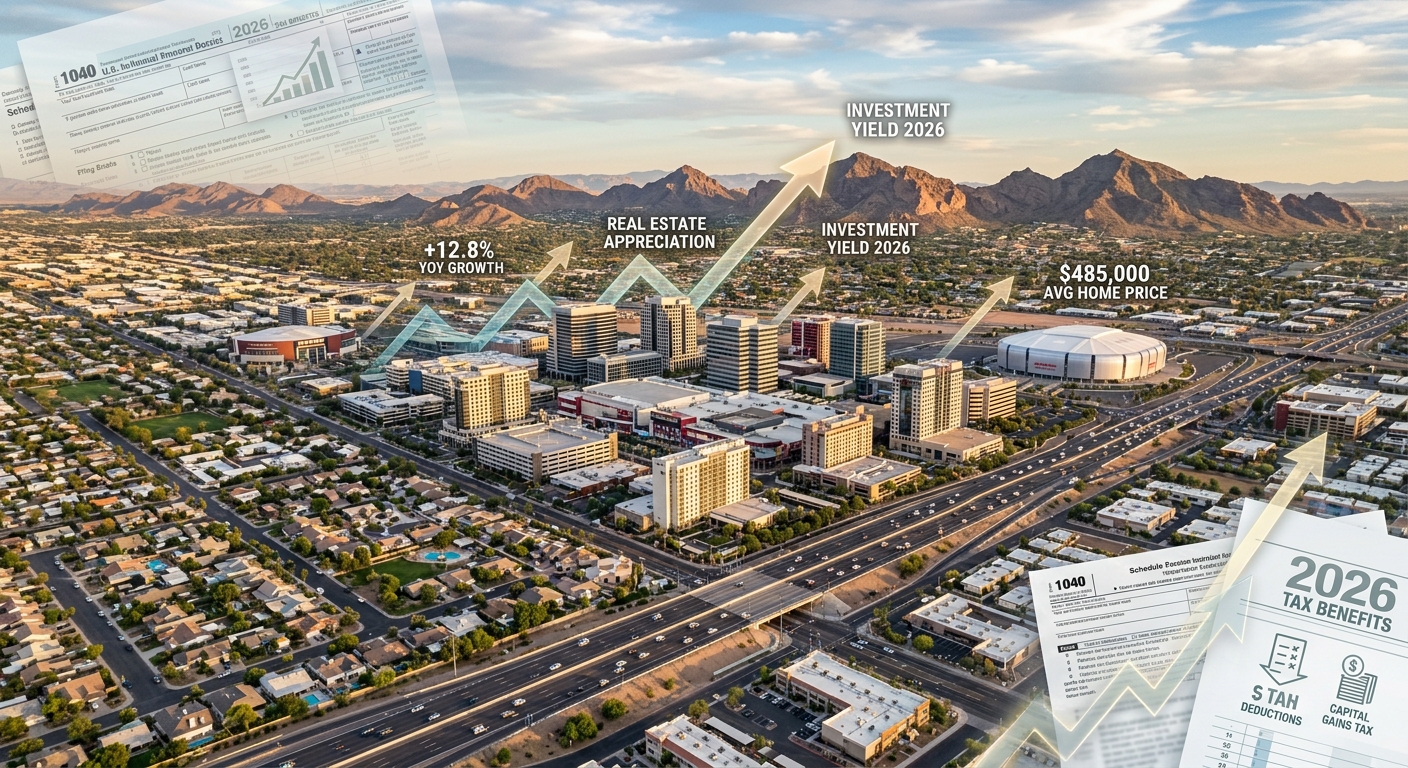
Why Glendale, AZ Real Estate Investors Are Using the 1031 Exchange to Build Wealth in 2026
Real estate investors in Glendale, Arizona are sitting on a massive opportunity most of them don’t fully understand. The 1031 exchange Glendale AZ strategy lets property owners sell an investment asset, reinvest the proceeds into a replacement property, and defer every dollar of capital gains tax they would have owed. Not reduce it. Not split it up over several years. Defer the entire amount, potentially for decades or even permanently.
That is not hyperbole. It is the single most powerful legal tax deferral tool available to real estate investors in the United States, and it is especially relevant in a high-growth metro like Greater Phoenix right now. Yet a surprising number of Glendale property owners either overlook it entirely, or they attempt it and make avoidable mistakes that blow up the exchange and trigger a six-figure tax bill.
This guide breaks down exactly how a 1031 exchange works for Glendale, AZ investors in 2026, what the IRS requires, the strict timelines you cannot miss, and the real-world dollar amounts at stake. Whether you own a rental duplex near Westgate, a strip mall along Bell Road, or a handful of single-family rentals across Maricopa County, these rules apply to you.
Quick Answer
A 1031 exchange allows Glendale, AZ real estate investors to sell an investment property and defer 100% of the capital gains tax by reinvesting into a like-kind replacement property within strict IRS timelines. You have 45 days to identify replacement properties and 180 days to close. Fail either deadline, and you owe the full tax bill. Done correctly, an investor selling a $500,000 property with $150,000 in gains could defer $35,000 or more in combined federal and Arizona state taxes.
What Is a 1031 Exchange and Why Does It Matter for Glendale Investors?
Section 1031 of the Internal Revenue Code allows a taxpayer to postpone paying capital gains tax on the sale of investment or business-use property, as long as the proceeds are reinvested into a “like-kind” replacement property. The IRS defines “like-kind” broadly for real estate. A Glendale rental home can be exchanged for raw land in Scottsdale, a commercial warehouse in Tempe, or an apartment complex in Tucson. The property types do not need to match. What matters is that both properties are held for investment or business use, not personal use (see IRS Publication 544 for detailed rules on sales and exchanges).
For Glendale, AZ specifically, this matters because property values across the West Valley have climbed significantly since 2020. Investors who purchased rental properties five or six years ago are now sitting on substantial unrealized gains. Without a 1031 exchange, selling a property with $200,000 in appreciation could result in a combined federal and Arizona tax bill of $40,000 to $55,000, depending on income level and how long the property was held.
A properly executed 1031 exchange Glendale AZ strategy eliminates that tax hit entirely at the time of sale. The deferred gain rolls into the replacement property’s cost basis, and the investor keeps the full proceeds working in the next deal.
Who Qualifies for a 1031 Exchange?
Qualification is straightforward but strict:
- Property must be held for investment or business use. Your primary home does not qualify. A vacation home you use personally does not qualify unless it meets specific rental activity thresholds.
- Both the relinquished property and the replacement property must be real estate. After the Tax Cuts and Jobs Act of 2017, personal property exchanges (equipment, vehicles, art) no longer qualify.
- You must use a qualified intermediary (QI). You cannot touch the sale proceeds at any point. The QI holds the funds in escrow until the replacement property closes.
- You must meet both IRS deadlines. 45 days to identify, 180 days to close. No extensions, no exceptions.
The Step-by-Step 1031 Exchange Process for Glendale, AZ Properties
If you have never done a 1031 exchange before, the process can feel intimidating. It is actually very logical once you understand the sequence. Here is exactly how it works, broken down for Glendale property owners:
- Decide to sell your investment property. Before listing, contact a qualified intermediary and your tax advisor. You must have the QI agreement in place before closing on the sale. Waiting until after you sell is too late.
- Engage a Qualified Intermediary (QI). The QI is a neutral third party who holds your sale proceeds. They are not your real estate agent, your attorney, or your CPA. They must be independent. Typical QI fees in Arizona range from $750 to $1,200 per exchange.
- Close the sale of your relinquished property. At closing, the sale proceeds go directly to the QI. You never receive the money. If the funds touch your bank account, even briefly, the exchange is disqualified.
- Identify replacement properties within 45 calendar days. Starting from the day your relinquished property closes, you have exactly 45 days to provide a written list of potential replacement properties to your QI. You may identify up to three properties regardless of value (the “three-property rule”), or more than three if their total value does not exceed 200% of the sold property’s value (the “200% rule”).
- Close on the replacement property within 180 calendar days. You must complete the acquisition of at least one identified replacement property within 180 days of the original sale closing. The QI releases the exchange funds to complete the purchase.
Key Takeaway: The 45-day identification window is the most common point of failure for Glendale investors. In a competitive Arizona market, finding and locking down a replacement property in under seven weeks requires advance planning.
KDA Case Study: Glendale Rental Property Owner Defers $47,000 in Taxes
A Glendale-based real estate investor came to KDA owning four single-family rental properties across the West Valley. She had purchased a three-bedroom home near Glendale Community College in 2019 for $215,000. By 2025, the property had appreciated to $410,000. After accounting for $62,000 in accumulated depreciation recapture and $195,000 in capital gains, her estimated combined federal and Arizona tax liability was approximately $47,500.
She wanted to consolidate her portfolio. Rather than selling outright and losing nearly $48,000 to taxes, KDA structured a 1031 exchange. We connected her with a qualified intermediary, coordinated the sale timeline, and helped her identify a small apartment complex in Mesa within the 45-day window. The replacement property generated stronger monthly cash flow and simplified her management workload from four properties to one.
The result: $47,500 in taxes deferred entirely. Her total cost for the exchange coordination, QI fees, and KDA’s advisory services came to roughly $4,200. That is more than an 11x return in the first year alone, not counting the improved cash flow from the replacement asset.
Ready to see how we can help you? Explore more success stories on our case studies page to discover proven strategies that have saved our clients thousands in taxes.
Common 1031 Exchange Mistakes Glendale AZ Investors Make
The IRS does not offer second chances on 1031 exchanges. If you make any of these mistakes, the entire deferral is lost and you owe the full tax bill retroactively. Here are the errors we see most often among Glendale and greater Phoenix investors:
Mistake #1: Missing the 45-Day Identification Deadline
This is the number one killer of 1031 exchanges nationwide. An investor sells a property, collects the proceeds through the QI, and then spends the next few weeks casually browsing listings. By the time they realize they need to formally identify replacement properties, the 45-day window has closed. There is no extension, no waiver, and no appeal. Miss it by even one day, and the exchange is dead.
The fix: Start shopping for replacement properties before you list your relinquished property. Have two or three strong candidates identified informally so that the formal written identification is a formality, not a scramble.
Mistake #2: Taking Constructive Receipt of Funds
Some investors instruct their escrow company to wire the sale proceeds to their personal bank account, planning to “move it later” to the QI. The moment you have access to the funds, the IRS considers you to have received them, and the exchange fails. Even having the contractual right to access the money can trigger disqualification.
Mistake #3: Exchanging Into a Property You Plan to Live In
A 1031 exchange requires that both properties be held for investment or business use. Buying a replacement property with the intention of moving into it immediately disqualifies the exchange. Some investors try to work around this by renting the replacement property for a short period and then converting it to personal use. The IRS scrutinizes these conversions, and the safe harbor generally requires at least two years of rental use before conversion (see Revenue Procedure 2008-16 for the IRS safe harbor guidelines).
Mistake #4: Not Reinvesting the Full Proceeds
To defer 100% of the gain, you must reinvest all of the net sale proceeds into the replacement property. If you sold for $400,000 and the mortgage payoff was $150,000, you have $250,000 in equity that must go into the next deal. If you only reinvest $200,000, the remaining $50,000 is treated as “boot” and is taxable. Many investors do not realize that even keeping a small amount out of the exchange triggers partial taxation.
What Happens If You Miss a Deadline?
If either the 45-day identification deadline or the 180-day closing deadline is missed, the exchange is fully disqualified. The QI releases the funds back to you, and the entire capital gain becomes taxable in the year the original property was sold. For a Glendale investor sitting on $150,000 in gains, that could mean a surprise tax bill north of $35,000, plus potential penalties and interest if the tax is not paid on time.
1031 Exchange Glendale AZ: Federal vs. Arizona State Tax Implications
One of the advantages for Arizona investors is that the state conforms to federal 1031 exchange rules. Unlike some states (California, for example, which tracks deferred gains and taxes them if you later sell a replacement property in another state), Arizona does not impose additional exchange restrictions beyond federal law.
Here is what the tax deferral looks like in dollar terms for a typical Glendale investment property sale:
| Tax Component | Without 1031 Exchange | With 1031 Exchange |
|---|---|---|
| Federal Capital Gains Tax (20%) | $30,000 | $0 (deferred) |
| Net Investment Income Tax (3.8%) | $5,700 | $0 (deferred) |
| Depreciation Recapture (25%) | $15,000 | $0 (deferred) |
| Arizona State Tax (~2.5%) | $3,750 | $0 (deferred) |
| Total Tax Liability | $54,450 | $0 |
Based on a $150,000 capital gain and $60,000 in depreciation recapture for a high-income investor. Actual amounts depend on total taxable income, filing status, and other factors.
Arizona’s flat income tax rate of 2.5% makes the state portion relatively modest compared to states like California (which can add 13.3%). But $3,750 is still $3,750. Combined with federal taxes, the deferral for a mid-range Glendale property sale can easily exceed $50,000.
If you want to estimate your total federal tax exposure on a property sale, run the numbers through this capital gains tax calculator before making any decisions.
Types of 1031 Exchanges Available to Glendale Property Owners
Not every exchange follows the standard “sell then buy” sequence. Depending on your situation, one of these variations may work better:
Simultaneous Exchange
Both properties close on the same day. This is rare in practice because it requires perfect coordination between the buyer of your relinquished property and the seller of your replacement property. When it works, it eliminates timing risk entirely.
Delayed Exchange (Most Common)
This is the standard 1031 exchange structure described above. You sell first, then buy within the 45/180-day windows. Roughly 95% of all 1031 exchanges follow this model.
Reverse Exchange
You buy the replacement property first, then sell the relinquished property. This is useful in a hot market where you find the perfect replacement property before your current property sells. Reverse exchanges are more complex and expensive. The replacement property must be held by an Exchange Accommodation Titleholder (EAT) until the relinquished property is sold. QI fees for reverse exchanges typically run $3,000 to $7,500.
Build-to-Suit Exchange (Improvement Exchange)
You use exchange funds to acquire a replacement property and make improvements to it before the 180-day deadline. This allows you to exchange into a property that meets your exact specifications. The improvements must be completed and the property must be transferred to you within the 180-day window.
Should You Consider a Delaware Statutory Trust (DST)?
Yes, if:
- You want to exit active property management
- You need a replacement property identified quickly within the 45-day window
- You want to diversify into institutional-quality assets
- You are nearing retirement and want passive income
No, if:
- You want hands-on control over property decisions
- You plan to make substantial improvements to the replacement property
- You want leverage flexibility (DSTs have fixed debt structures)
- You need liquidity because DSTs are illiquid investments
DSTs qualify as like-kind replacement properties under IRS guidelines. For Glendale investors who are tired of managing tenants and toilets but do not want to trigger a massive tax event, a DST can be a smart 1031 exchange exit ramp.
The Glendale, AZ Real Estate Market and Why Timing Matters in 2026
Glendale sits in one of the fastest-growing metro areas in the country. The West Valley has attracted major employers, including semiconductor manufacturing operations, logistics centers, and healthcare expansions. That growth has pushed property values higher, which means investors who bought properties even three to five years ago are sitting on significant unrealized gains.
Here is the challenge: if you sell without a 1031 exchange strategy in place, the tax hit can consume 20% to 30% of your total equity. In a market where prices have appreciated 40% or more since 2020, that translates into real money. An investor who purchased a Glendale rental property for $280,000 in 2020 and sells it for $440,000 in 2026 has $160,000 in gains. Without a 1031 exchange, $35,000 to $45,000 of that could go to taxes.
KDA works with investors across real estate tax preparation to structure exchanges before the sale happens, not after. The planning phase is where the savings are locked in.
Ready to Reduce Your Tax Bill?
KDA Inc. specializes in strategic tax planning for business owners, S Corps, LLCs, and high-net-worth individuals. Book a personalized consultation and walk away with a clear plan.
Frequently Asked Questions About 1031 Exchanges in Glendale, AZ
Can I do a 1031 exchange on my primary residence in Glendale?
No. Section 1031 only applies to property held for investment or business use. Your personal home does not qualify. However, if you convert a primary residence to a rental property and hold it for at least two years as a rental, it may then qualify for a 1031 exchange.
Is there a limit on how many 1031 exchanges I can do?
No. There is no statutory limit. Some investors chain exchanges together for decades, deferring gains across multiple properties. This is sometimes called a “1031 exchange chain” and is completely legal as long as each exchange independently meets IRS requirements.
Do I have to exchange into Arizona property?
No. The replacement property can be located in any U.S. state. A Glendale investor can exchange into a property in Texas, Florida, Nevada, or any other state. However, be aware that some states (notably California) have clawback provisions that may trigger state tax if you later sell a replacement property acquired through a 1031 exchange involving a California property.
What happens to the deferred gain when I die?
This is where the 1031 exchange becomes one of the most powerful wealth-building tools in the tax code. When the property owner passes away, the heirs receive a stepped-up basis to the fair market value at the date of death. All of the previously deferred gains are permanently eliminated. An investor who deferred $200,000 in gains over a lifetime of exchanges passes those properties to heirs with zero capital gains tax owed on the deferred amounts.
Can I exchange a property I own in an LLC?
Yes. LLCs are disregarded entities for federal tax purposes (unless they elect otherwise), so a single-member LLC can do a 1031 exchange in the member’s name. For multi-member LLCs, the exchange must be done at the entity level unless the LLC distributes the property to members before the exchange. This is a nuanced area that requires careful planning. Learn more about how we help with entity formation and structuring.
What is “boot” in a 1031 exchange?
Boot is anything received in the exchange that is not like-kind real property. This includes cash you keep from the sale proceeds, a reduction in mortgage liability, or personal property included in the deal. Boot is taxable in the year of the exchange. To defer 100% of the gain, you must reinvest all proceeds and acquire a replacement property with equal or greater total value and equal or greater debt.
How do I find a qualified intermediary in Glendale?
QIs do not need to be local, though working with one familiar with Arizona real estate transactions can smooth the process. Look for QIs who are members of the Federation of Exchange Accommodators (FEA), carry fidelity bonds and errors and omissions insurance, and use segregated escrow accounts. Never use your attorney, CPA, real estate agent, or anyone who has acted as your agent in the past two years. The IRS disqualifies related parties from serving as QIs.
Special Situations and Edge Cases
Partial Exchanges
You do not have to reinvest 100% of the proceeds to benefit from Section 1031. If you sell a $500,000 property and only reinvest $400,000 into a replacement, the $100,000 difference is taxable boot, but the $400,000 reinvested portion still qualifies for deferral. This can be useful if you need some cash for other purposes but still want to defer the majority of the gain.
Related Party Exchanges
You can exchange into a property owned by a related party (family member, controlled entity), but both parties must hold their respective properties for at least two years after the exchange. If either party disposes of the property within two years, the original exchange is retroactively disqualified and the deferred gain becomes immediately taxable. This is codified in Section 1031(f) of the Internal Revenue Code.
Multi-State Considerations
Glendale investors who exchange into properties in other states should be aware that some states do not conform to federal 1031 exchange rules, or they impose additional reporting requirements. Arizona conforms fully to federal law, making it one of the more investor-friendly states for exchanges.
The Real Cost of Skipping a 1031 Exchange
Let’s put this in perspective with a direct comparison. Assume a Glendale investor owns a rental property with $200,000 in capital gains and $70,000 in depreciation recapture:
| Scenario | Sell Without 1031 | Sell With 1031 Exchange |
|---|---|---|
| Capital gains tax (federal) | $40,000 | $0 |
| NIIT (3.8%) | $7,600 | $0 |
| Depreciation recapture (25%) | $17,500 | $0 |
| Arizona state tax (2.5%) | $5,000 | $0 |
| QI and advisory fees | $0 | $4,500 |
| Net tax cost / savings | $70,100 paid | $4,500 paid (saving $65,600) |
That $65,600 stays invested and compounding in the replacement property. Over ten years at even a modest 5% annual appreciation, that retained capital grows to over $106,000 in additional equity. The cost of skipping a 1031 exchange is not just the taxes you pay today. It is the growth you lose tomorrow.
When a 1031 Exchange Does Not Make Sense
Despite its power, a 1031 exchange is not always the right move. Here are situations where selling outright may be the better option:
- You need the cash. If you need the equity for personal expenses, debt payoff, or non-real estate investments, tying up proceeds in a replacement property does not help.
- Your gain is small. If the property has minimal appreciation, the tax savings from an exchange may not justify the QI fees and additional complexity. On a $20,000 gain, the total tax might only be $5,000. Spending $1,200 on a QI and dealing with tight deadlines may not be worth it.
- You are in a low-income year. If your taxable income is unusually low (perhaps due to business losses or retirement), your capital gains rate might be 0% or 15%. In that case, paying the lower tax now and resetting your basis could be strategically superior to deferring.
- You want to exit real estate entirely. A 1031 exchange requires reinvestment into real estate. If you want to diversify into stocks, bonds, or other asset classes, you cannot use Section 1031.
This information is current as of 6/8/2026. Tax laws change frequently. Verify updates with the IRS or your tax advisor if reading this later.
Book Your 1031 Exchange Strategy Session
If you own investment real estate in Glendale, AZ and you are even thinking about selling, do not make a move without a tax strategy in place. A properly structured 1031 exchange could save you $30,000, $50,000, or more in taxes, and the planning has to happen before the sale closes. Our team specializes in helping Arizona real estate investors structure exchanges, coordinate with qualified intermediaries, and ensure every IRS requirement is met. Click here to book your 1031 exchange consultation now.



