
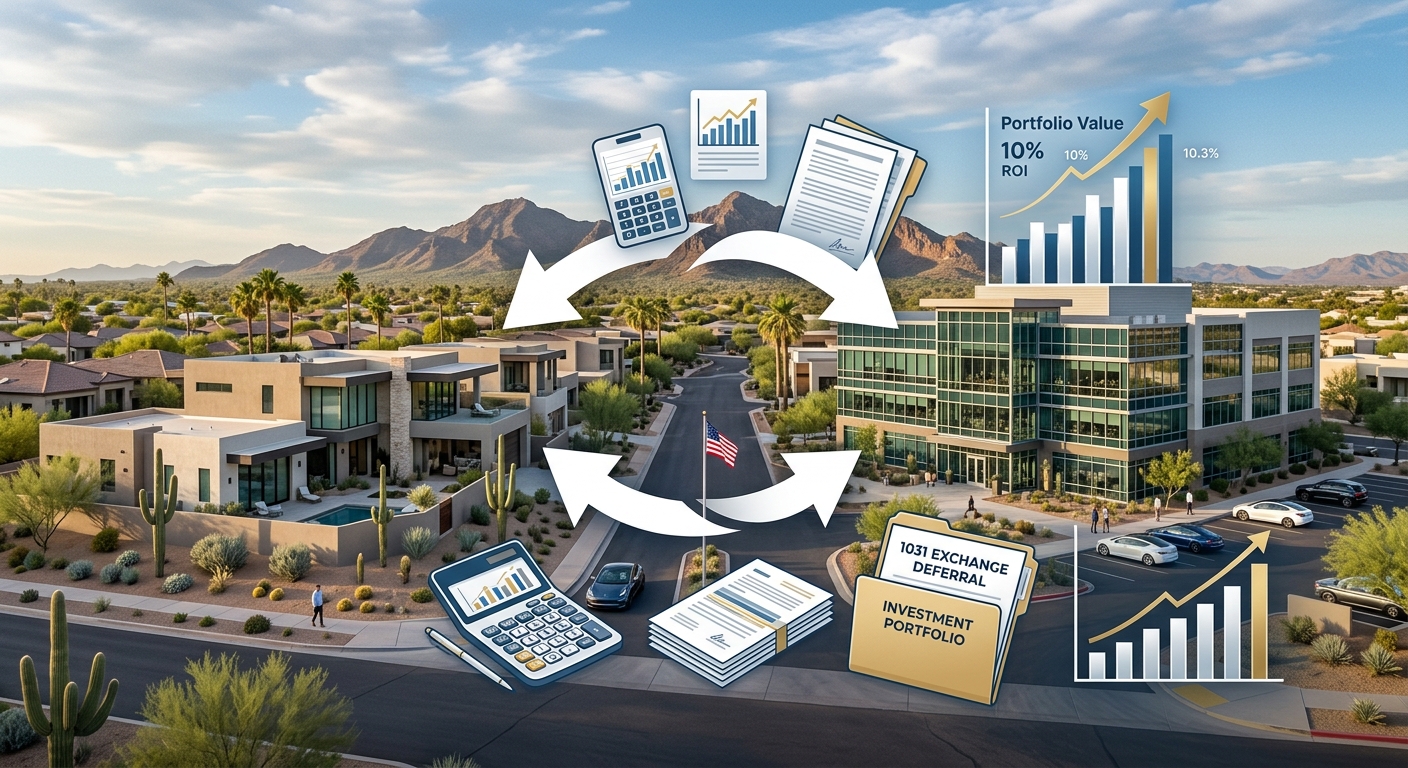
If you own investment property in Pinal County and you are staring down a big capital gains bill, a 1031 exchange Eloy AZ strategy might be the single most powerful tool you are not using yet. The town of Eloy sits in one of Arizona’s fastest-shifting industrial and logistics corridors, and investors who bought land, warehouses, or rentals here five or ten years ago are sitting on real appreciation. The problem is simple: sell without a plan, and the IRS takes a slice of every dollar of gain. Sell with a plan, and you can roll that entire gain into your next property and keep your money working.
This guide breaks down exactly how a like-kind exchange works in 2026, the deadlines you cannot miss, the specific rules Arizona and California investors get wrong, and a real client scenario showing the math. This information is current as of 7/27/2026. Tax laws change frequently. Verify updates with the IRS or Arizona Department of Revenue if you are reading this later.
Quick Answer: What Is a 1031 Exchange?
A 1031 exchange (named after Section 1031 of the Internal Revenue Code) lets you sell one investment or business property and buy another “like-kind” property while deferring the capital gains tax you would normally owe. In plain English: instead of paying tax now, you reinvest the full proceeds and push the tax bill into the future, potentially forever if you keep exchanging. For an Eloy investor selling a $600,000 rental with $250,000 of gain, that can mean deferring $50,000 or more in combined federal and state tax.
How a 1031 Exchange Eloy AZ Deal Actually Works
The core idea is trading up without cashing out. You are not personally “swapping” properties with another owner in most cases. Instead, you sell your relinquished property, a qualified intermediary holds the proceeds, and you use that money to purchase a replacement property. You never touch the cash, which is exactly why the deferral holds.
To qualify, both properties must be held for investment or productive use in a trade or business. Your personal residence does not count. Raw desert land held for appreciation, a leased warehouse near the Union Pacific corridor, a fourplex, or a self-storage facility in Eloy all qualify. For the full statutory language, see IRS Form 8824 instructions, which is the form you file to report the exchange.
The Two Deadlines You Cannot Miss
The entire strategy lives and dies on two hard clocks that start the day you close on your sale:
- The 45-day identification window – You have exactly 45 calendar days to identify your replacement property in writing to your qualified intermediary. Weekends and holidays count. There are no extensions except in federally declared disasters.
- The 180-day closing window – You must close on the replacement property within 180 calendar days of your sale, or by your tax return due date (including extensions), whichever comes first.
Key Takeaway: Miss either deadline by even one day and the entire exchange collapses, making 100% of your gain taxable that year. This is the number one reason DIY exchanges fail.
Identification Rules: The 3-Property, 200%, and 95% Tests
When you identify replacement property, the IRS gives you three ways to stay compliant:
- Three-Property Rule: Identify up to three properties of any value.
- 200% Rule: Identify any number of properties as long as their combined value does not exceed 200% of what you sold.
- 95% Rule: Identify unlimited properties of any value, but you must actually close on 95% of the total identified value.
For most Eloy investors, the three-property rule is the cleanest path. It gives you backups without overcomplicating the paperwork.
Why Eloy, AZ Real Estate Investors Are Uniquely Positioned in 2026
Eloy is not a sleepy retirement town anymore. The stretch of Pinal County along Interstate 10 has become a magnet for logistics, distribution, and industrial development, driven by proximity to both Phoenix and Tucson. That means land basis from a decade ago looks tiny next to today’s values, and appreciation like that is exactly what a like-kind exchange is built to protect.
Arizona also has no separate state-level capital gains carve-out that penalizes exchanges, and it conforms to the federal treatment of Section 1031 for real property. That is a meaningful advantage compared to states with aggressive clawback rules. Our real estate tax team helps investors in Pinal County structure these deals so the appreciation on their Eloy holdings stays invested instead of getting siphoned off at closing. If you want to understand the broader planning picture around depreciation and passive income, our resources for real estate investors break down the full strategy stack.
One important note for 2026: the Tax Cuts and Jobs Act narrowed Section 1031 so it now applies only to real property. You can no longer exchange equipment, vehicles, or other personal property tax-free. So if your Eloy holding is a mixed-use asset with valuable machinery, only the real estate portion qualifies. That distinction trips up a lot of owner-operators.
KDA Case Study: Eloy Land Investor Defers a $58,000 Tax Bill
A client we will call Marcus bought 12 acres of undeveloped land just off the I-10 corridor near Eloy back in 2016 for $180,000. By early 2026, a logistics developer offered him $640,000. Marcus was thrilled about the price but stunned when he ran the numbers on what he would owe. His gain was roughly $460,000 after selling costs, and between the 20% federal long-term capital gains rate, the 3.8% net investment income tax, and Arizona state tax, he was looking at north of $58,000 due at tax time, plus depreciation recapture concerns on improvements he had made.
Marcus came to us with 30 days already gone. We moved fast. We set him up with a qualified intermediary before his sale closed so the proceeds never touched his hands. Within the 45-day window, we helped him identify two replacement properties: a stabilized industrial warehouse in Casa Grande and a smaller flex-space building as a backup. He closed on the warehouse at day 141, well inside the 180-day limit.
The result: Marcus deferred the entire $58,000 tax bill and rolled 100% of his $640,000 into an income-producing property that now generates monthly rent and fresh depreciation deductions. He paid us about $4,200 for the planning, intermediary coordination, and filing support. That is a first-year return of roughly 13.8x on fees, and the deferred tax keeps compounding as long as he holds or continues exchanging.
Ready to see how we can help you? Explore more success stories on our case studies page to discover proven strategies that have saved our clients thousands in taxes.
Do You Qualify for a 1031 Exchange? A Simple Decision Framework
Yes, a like-kind exchange makes sense if:
- You hold the property for investment or business use, not as a primary home
- Your gain is large enough that the tax exceeds the cost of the exchange (usually $30,000+ in gain)
- You intend to reinvest the full proceeds into replacement real estate
- You can commit to the 45-day and 180-day deadlines
No, it probably does not fit if:
- You need to cash out and spend the proceeds
- Your gain is small and the fees eat most of the benefit
- The property is your personal residence (look at the Section 121 exclusion instead)
- You are selling at a loss, in which case there is nothing to defer
Common 1031 Exchange Mistakes Eloy Investors Make
Even sophisticated investors torpedo their own exchanges. Here are the errors we see most often in Pinal County deals:
1. Touching the Money
The instant you receive the sale proceeds, the deferral is dead. You must use a qualified intermediary, and they must control the funds from sale to purchase. Wiring the money to your own bank account, even for a day, is fatal.
2. Buying “Down” and Creating Boot
If your replacement property costs less than what you sold, or you pull cash out, the difference is called “boot” and it is taxable. To fully defer, your replacement must be equal or greater in value and you must reinvest all the equity. An Eloy investor selling a $640,000 property should buy at $640,000 or more.
3. Blowing the 45-Day Identification
Investors get emotionally attached to one property and skip identifying backups. Then the deal falls through at day 44 and there is no time left. Always identify a backup under the three-property rule.
4. Forgetting Depreciation Recapture
A 1031 exchange defers depreciation recapture too, but only if structured correctly. Owners who took years of depreciation on a rental need the exchange to be airtight, or that recapture (taxed up to 25%) comes roaring back.
Pro Tip: Cost segregation studies pair beautifully with exchange strategy. If you want to accelerate depreciation on your replacement property, our team can walk you through cost segregation to front-load deductions on the new asset.
Special Situations and Edge Cases Most Guides Skip
This is where competitor articles go quiet, and where real money is won or lost.
Reverse Exchanges
What if you find the perfect Eloy warehouse before you sell your current property? A reverse exchange lets you acquire the replacement first through an exchange accommodation titleholder, then sell your old property within 180 days. It is more expensive and complex, but in a hot market it can be the only way to lock in a deal.
Improvement (Build-to-Suit) Exchanges
You can use exchange funds to build or improve a replacement property, as long as the improvements are completed and the property is received within the 180-day window. This is powerful for investors buying raw Eloy land and constructing a facility.
Related-Party Transactions
Exchanging with a family member or entity you control triggers a two-year holding requirement. Sell the property inside two years and the deferral unwinds. The IRS watches these closely.
Opportunity Zones Are Winding Down
Here is a timely 2026 note. Investors who deferred capital gains through Qualified Opportunity Funds are hitting a wall: the deferral period ends December 31, 2026, making those deferred gains taxable as of that date. The next round of Opportunity Zones takes effect in 2027 with changed benefits. If you were weighing an Opportunity Zone versus a 1031 exchange, the calculus just shifted heavily toward the exchange for anyone selling right now. A like-kind exchange has no forced recognition date the way the current Opportunity Zone program does.
California Investors Buying in Eloy: What You Need to Know
Many of our Eloy clients are actually California residents diversifying into cheaper, higher-yield Arizona real estate. If that is you, pay attention to the California “clawback” rule under FTB Form 3840. When a California resident does a 1031 exchange out of California property into out-of-state property like Eloy, California tracks the deferred gain and requires you to file Form 3840 annually. When you eventually sell the Arizona property in a taxable transaction, California wants its share of the original deferred gain.
This does not stop the exchange or make it a bad idea. It just means you must keep filing that annual information return with the Franchise Tax Board, or you risk California estimating the tax and coming after you. Our team coordinates both the federal exchange and the California compliance so nothing slips. To see how we handle multi-state complexity, review our approach to tax planning.
1031 Exchange vs. Selling Outright: The Numbers
Here is a side-by-side comparison for a hypothetical Eloy investor with a $500,000 gain:
| Factor | Sell Outright | 1031 Exchange |
|---|---|---|
| Capital gain | $500,000 | $500,000 |
| Federal tax (20%) | $100,000 | $0 (deferred) |
| Net investment income tax (3.8%) | $19,000 | $0 (deferred) |
| Arizona state tax (approx 2.5%) | $12,500 | $0 (deferred) |
| Cash left to reinvest | ~$368,500 | Full $500,000 |
The difference is stark. By exchanging, this investor keeps roughly $131,500 more working capital in play. If you want to run your own capital gains math before deciding, plug your numbers into a capital gains tax calculator to estimate the tax on your sale.
Step-by-Step: How to Execute a 1031 Exchange in Eloy
- Engage a qualified intermediary before you list or close – This is non-negotiable. They must be in place before the sale.
- Sell your relinquished Eloy property – Proceeds go directly to the intermediary, never to you.
- Identify replacement property within 45 days – In writing, using the three-property rule for safety.
- Negotiate and enter contracts – Line up your replacement purchase during the identification window.
- Close within 180 days – The intermediary transfers funds to complete your purchase.
- Report on Form 8824 – File with your federal return, plus Form 3840 if you are a California resident.
Ready to Reduce Your Tax Bill?
KDA Inc. specializes in strategic tax planning for business owners, S Corps, LLCs, and high-net-worth individuals. Book a personalized consultation and walk away with a clear plan.
Frequently Asked Questions
Can I do a 1031 exchange on vacant land in Eloy?
Yes. Vacant land held for investment qualifies as like-kind to virtually any other real property held for investment, including a rental home, warehouse, or apartment building. This is one of the most common Eloy exchange scenarios given the area’s land appreciation.
How much does a 1031 exchange cost?
Qualified intermediary fees typically run $800 to $1,500 for a standard forward exchange, plus your advisor’s planning and filing fees. Reverse and improvement exchanges cost more. Compared to a five- or six-figure tax bill, the cost is almost always worth it.
What happens if my replacement property falls through after day 45?
If you identified backups under the three-property rule, you can pivot to one of them. If you did not, and your only identified property collapses, the exchange fails and the gain becomes taxable. This is why backup identification is essential.
Can I exchange an Eloy property for one in another state?
Absolutely. All real property within the United States is considered like-kind to other U.S. real property. You can exchange your Eloy warehouse for a rental in Texas, Nevada, or anywhere else domestically.
Do I owe tax when I eventually sell the replacement property?
If you sell in a taxable transaction, the deferred gain plus any new gain becomes taxable. But you can keep exchanging indefinitely. Many investors exchange until death, at which point heirs may receive a stepped-up basis, potentially wiping out the deferred gain entirely.
Can I move into my replacement property later?
Possibly, but there are strict holding and use rules. You cannot exchange into a property with the immediate intent to make it your home. The IRS looks at your intent at the time of the exchange. Converting an investment property to a residence years later has its own separate rules under Section 121.
Ready to work with a tax professional who understands Eloy and Pinal County real estate investors? Whether you are selling land off the I-10 corridor or building out an industrial portfolio, the right exchange structure can keep tens of thousands of dollars invested instead of paid to the IRS.
Book Your 1031 Exchange Strategy Session
If you are about to sell an appreciated Eloy property and the capital gains number is keeping you up at night, do not close before you have a plan. The 45-day clock is unforgiving, and one wrong move can cost you five figures. Let our strategy team map out a clean, compliant exchange that keeps your gain working for you. Click here to book your consultation now and protect your next deal.



