
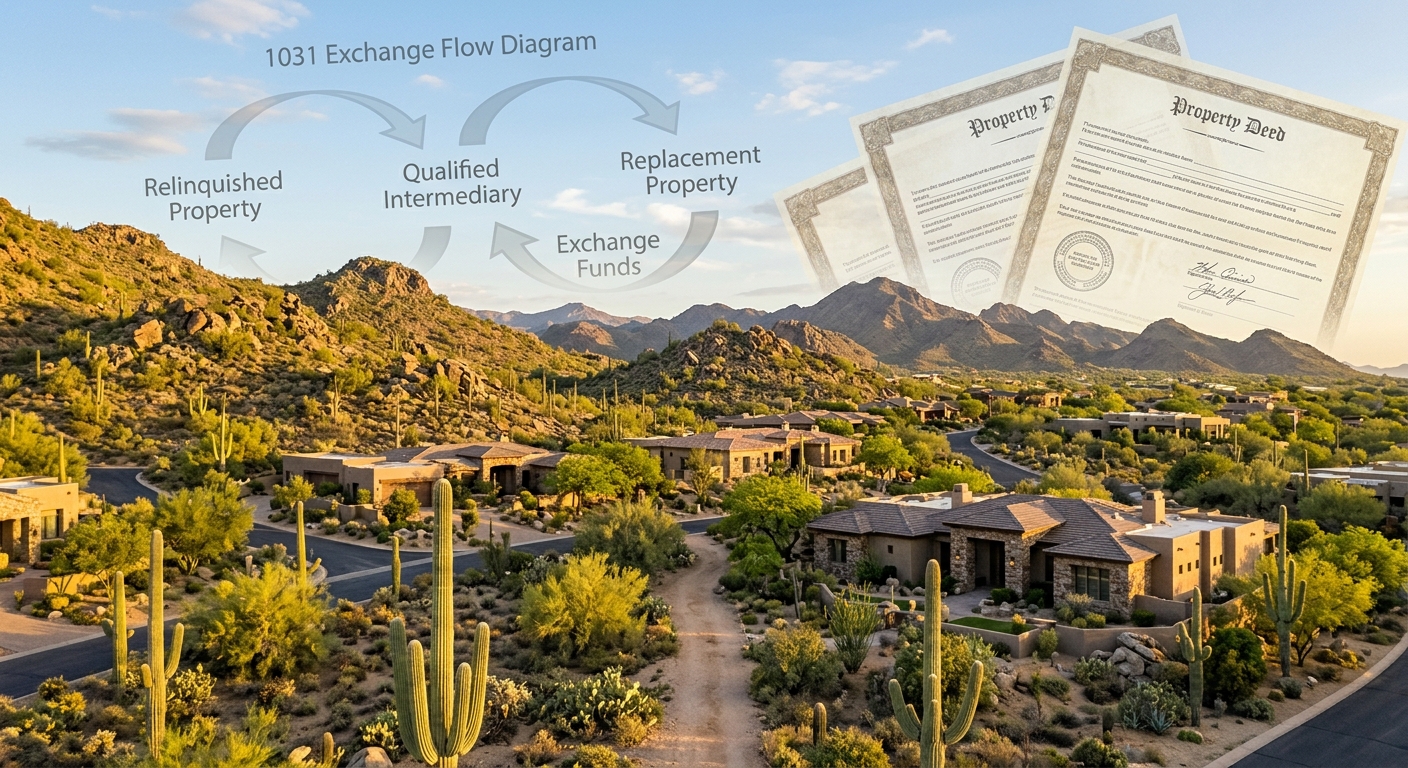
Why Cave Creek, AZ Real Estate Investors Are Using 1031 Exchanges to Build Wealth in 2026
Cave Creek, Arizona, sits at a unique crossroads. It’s a town where luxury desert estates, horse properties, and boutique commercial buildings attract investors from across the country. And right now, in 2026, the investors who are winning here aren’t the ones buying and selling for quick flips. They’re the ones using 1031 exchange Cave Creek AZ strategies to defer massive capital gains tax bills and reinvest every dollar back into bigger, better properties.
If you own investment real estate in Cave Creek or you’re looking to sell a property in the greater Maricopa County area, the 1031 exchange is one of the most powerful wealth-building tools the IRS allows. But most investors either don’t understand how it works, or they make avoidable mistakes that blow up the tax deferral entirely. If you’re looking for professional guidance from a team that understands tax strategy in Cave Creek, this guide walks you through everything you need to know.
This information is current as of 6/18/2026. Tax laws change frequently. Verify updates with the IRS or FTB if reading this later.
Quick Answer
A 1031 exchange lets you sell an investment property in Cave Creek, AZ and defer all capital gains taxes by reinvesting the proceeds into another “like-kind” property. You must identify the replacement property within 45 days, close within 180 days, and use a qualified intermediary. Done right, it can defer $30,000 to $200,000 or more in taxes on a single transaction.
What Is a 1031 Exchange and How Does It Work in Cave Creek?
A 1031 exchange, named after Section 1031 of the Internal Revenue Code, allows you to sell one investment property and buy another without paying capital gains tax at the time of the sale. Instead of losing 20% to 30% of your profit to federal and state taxes, you roll everything forward into the next investment.
Here’s a simple example. Say you bought a rental property in Cave Creek, AZ for $350,000 eight years ago. Today it’s worth $625,000. That’s $275,000 in appreciation. Without a 1031 exchange, you’d owe roughly $55,000 to $82,500 in combined federal capital gains and Arizona state income tax on that gain. With a properly executed 1031 exchange, you owe zero at the time of the sale and reinvest the full $625,000 into your next property.
The IRS doesn’t limit this to one exchange per lifetime. You can do it repeatedly, compounding your wealth each time. Some investors chain 1031 exchanges over decades, deferring hundreds of thousands in taxes along the way.
Key Requirements for a Valid 1031 Exchange
- Like-kind property: Both the property you sell and the one you buy must be held for investment or business use. Personal residences don’t qualify.
- 45-day identification window: You must identify potential replacement properties within 45 calendar days of closing on the sale.
- 180-day closing deadline: You must close on the replacement property within 180 calendar days of the sale.
- Qualified intermediary (QI): You can never touch the sale proceeds directly. A third-party QI must hold the funds between the sale and the purchase.
- Equal or greater value: To defer all taxes, the replacement property must be of equal or greater value than the one sold.
Key Takeaway: Missing any one of these requirements disqualifies the entire exchange, and you’ll owe full capital gains tax on the sale.
Why Cave Creek Is a Prime Market for 1031 Exchange Strategies
Cave Creek isn’t your typical Arizona suburb. The town has its own character, with a western heritage, strong tourism economy, and a real estate market defined by luxury ranch properties, desert estates, and growing commercial opportunities along Cave Creek Road and the Carefree Highway corridor.
Here’s what makes the 1031 exchange Cave Creek AZ strategy especially powerful in this market:
Appreciating Property Values
Maricopa County real estate has been on a sustained uptrend. Cave Creek properties, especially those with acreage and equestrian features, have seen appreciation rates that outpace the broader Phoenix metro in certain segments. That means investors who bought in five to ten years ago are sitting on significant gains. Without tax planning, selling triggers a six-figure tax event.
Diverse Investment Property Types
Cave Creek offers a range of like-kind exchange options. You can sell a small rental condo in Scottsdale and exchange into a larger horse property with rental potential in Cave Creek. Or sell a commercial building in Phoenix and acquire a mixed-use property near the Cave Creek town center. The IRS defines “like-kind” broadly for real estate. Any real property held for investment can be exchanged for any other real property held for investment, regardless of type.
Arizona’s Tax Advantages
Arizona already has a flat state income tax rate of 2.5% for the 2026 tax year, making it one of the most tax-friendly states in the nation. Pairing that low state rate with a 1031 exchange that defers federal capital gains creates a double advantage. You’re investing in a low-tax state while eliminating the immediate federal tax bite entirely.
KDA Case Study: Cave Creek Investor Defers $74,000 in Taxes with a 1031 Exchange
A retired couple from Scottsdale contacted KDA after deciding to sell their 3-unit rental property in Cave Creek. They’d purchased it for $410,000 in 2017 and received an offer for $780,000 in early 2026. The $370,000 gain, combined with depreciation recapture of roughly $85,000, meant a potential tax bill north of $91,000 between federal capital gains tax, the 3.8% net investment income tax, depreciation recapture tax, and Arizona state income tax.
Our team structured a delayed 1031 exchange using a qualified intermediary. Within the 45-day identification window, we helped the couple identify three replacement properties: a 4-unit multifamily in Tempe, a single-family rental in Gilbert, and a commercial retail space in north Scottsdale. They ultimately closed on the Tempe multifamily for $815,000 within 72 days of the original sale, deferring the entire $91,000 tax liability.
The couple’s new property generates $4,200 per month in rental income, $900 more than their old Cave Creek property produced. The total cost for KDA’s tax planning services and exchange coordination was $4,500. That’s a first-year ROI of more than 20x when you account for both deferred taxes and increased cash flow.
Ready to see how we can help you? Explore more success stories on our case studies page to discover proven strategies that have saved our clients thousands in taxes.
Step-by-Step: How to Execute a 1031 Exchange in Cave Creek, AZ
If you’ve decided to sell investment property in Cave Creek and want to defer your capital gains through a 1031 exchange, here’s the exact process you should follow.
- Engage a tax strategist before listing your property
- Don’t wait until you’re under contract. Talk to a tax professional 60 to 90 days before listing. You need to confirm the property qualifies, estimate your gain and depreciation recapture, and decide whether a 1031 exchange is the right move.
- Select a qualified intermediary (QI)
- The QI must be a third party with no prior agency relationship to you. They hold the sale proceeds in escrow and facilitate the exchange. Do not use your real estate agent, attorney, or CPA as your QI. That disqualifies the exchange under IRS rules (see IRS Publication 544).
- Close on the sale of your relinquished property
- At closing, all net proceeds go directly to the QI. You never receive the money. This is non-negotiable.
- Identify replacement properties within 45 days
- You can identify up to three properties regardless of value (the “3-property rule”), or more if their total value doesn’t exceed 200% of the sold property’s value (the “200% rule”). Put your identifications in writing and deliver them to the QI.
- Close on the replacement property within 180 days
- The QI transfers funds to the title company at closing. You take title to the new property. The exchange is complete.
- File IRS Form 8824 with your tax return
- You must report the exchange on IRS Form 8824 for the tax year in which the exchange occurred. Failure to file this form can trigger IRS scrutiny.
Key Takeaway: The 45-day and 180-day deadlines are calendar days with no extensions. Weekends and holidays count. Plan accordingly.
Common 1031 Exchange Mistakes Cave Creek Property Owners Make
The 1031 exchange Cave Creek AZ investors attempt isn’t always successful. Here are the most common mistakes that blow up the tax deferral.
Touching the Proceeds
This is the number one mistake. If you receive any portion of the sale proceeds directly, even temporarily, the entire exchange is disqualified. The money must go from the title company to the qualified intermediary. No exceptions. No “I’ll just hold it for a few days.”
Missing the 45-Day Identification Deadline
The 45-day clock starts the moment the relinquished property closes. Many investors underestimate how fast this goes, especially if they’re searching for replacement properties in competitive markets. Start your property search before you sell, not after.
Failing to Reinvest All Proceeds
If your relinquished property sells for $700,000 and you only buy a replacement property for $600,000, you’ll owe capital gains tax on the $100,000 difference. That leftover amount is called “boot,” and the IRS taxes it. To defer everything, invest equal or greater value.
Using the Property as a Personal Residence Too Soon
Some investors complete a 1031 exchange and then move into the replacement property within a year or two. The IRS requires that replacement properties be held for investment. If you convert it to a personal residence too quickly, the IRS can argue the exchange was invalid. A safe harbor rule requires holding the property for at least 24 months as a rental before converting.
Ignoring Depreciation Recapture
A 1031 exchange defers capital gains, but it also carries forward your depreciation basis. When you eventually sell without exchanging, you’ll owe depreciation recapture tax at 25% on the accumulated depreciation from every property in the exchange chain. Make sure your tax strategist accounts for this long-term liability.
1031 Exchange vs. Selling Outright: The Numbers
Let’s put real numbers on the table so you can see what’s at stake for a typical Cave Creek investor.
| Scenario | Sell Outright | 1031 Exchange |
|---|---|---|
| Sale Price | $750,000 | $750,000 |
| Original Purchase Price | $400,000 | $400,000 |
| Capital Gain | $350,000 | $350,000 |
| Depreciation Recapture | $72,000 | Deferred |
| Federal Capital Gains Tax (20%) | $70,000 | $0 |
| Net Investment Income Tax (3.8%) | $13,300 | $0 |
| Depreciation Recapture Tax (25%) | $18,000 | $0 |
| Arizona State Tax (2.5%) | $8,750 | $0 |
| Total Tax Owed at Sale | $110,050 | $0 |
| Reinvestable Amount | $639,950 | $750,000 |
That’s $110,050 more working for you. Over 10 to 20 years of compounded returns, that difference can grow to $300,000 or more in additional wealth.
Special Situations and Edge Cases for Cave Creek Investors
Not every 1031 exchange is straightforward. Cave Creek’s unique property landscape creates specific scenarios that require careful planning.
Exchanging Horse Properties and Ranches
Cave Creek is known for equestrian properties. If you own a horse ranch that you’ve been renting out or using as a business (boarding, training, etc.), it can qualify for a 1031 exchange. However, personal-use components like a primary residence on the same parcel may need to be carved out. Work with a tax strategist to allocate value properly between the investment and personal-use portions.
Reverse 1031 Exchanges
In a standard exchange, you sell first and buy second. A reverse exchange flips this: you buy the replacement property before selling your current one. This is useful when you find a perfect replacement property in Cave Creek before your current property has closed. Reverse exchanges are more complex and expensive, but the IRS permits them under Revenue Procedure 2000-37.
Improvement or Construction Exchanges
You can use exchange funds to buy a property and make improvements, as long as the improvements are completed within the 180-day window. For example, you sell a rental in Cave Creek for $500,000 and use the proceeds to buy a fixer-upper in Carefree for $350,000 and invest $150,000 in renovations. The total investment equals or exceeds the sale price, so the full gain is deferred.
Multi-State Exchanges
Arizona doesn’t have a “clawback” provision for 1031 exchanges, meaning you can sell a property in Cave Creek and buy in another state without triggering Arizona tax on the deferred gain. However, the state where you buy the replacement property may have its own rules. Always verify state-level treatment before crossing borders.
Arizona-Specific Tax Considerations for 1031 Exchanges
Arizona conforms to the federal 1031 exchange rules, which simplifies things compared to states like California, where nonresident withholding and different conformity rules can create headaches.
Key Arizona advantages for 1031 exchange Cave Creek AZ investors in 2026:
- Flat 2.5% income tax rate: Arizona’s individual income tax rate is one of the lowest in the nation.
- No state estate tax: Unlike some states, Arizona doesn’t impose an estate tax, making it favorable for long-term hold strategies after a 1031 exchange.
- Full federal conformity on 1031: Arizona follows Section 1031 without modifications, so your exchange is treated the same at the state and federal level.
- Stepped-up basis at death: If you hold 1031 exchange properties until death, your heirs receive a stepped-up basis to fair market value. All deferred gains are permanently eliminated. This is the ultimate exit strategy.
That last point is critical. Many Cave Creek investors use 1031 exchanges as a lifelong wealth-building tool, knowing that their heirs will never pay the deferred taxes. The combination of tax deferral during life and basis step-up at death creates generational wealth that few other strategies can match.
Should You Use a 1031 Exchange? A Decision Framework
Yes, if:
- Your investment property has appreciated significantly (gain exceeds $50,000)
- You plan to continue investing in real estate
- You want to upgrade to a larger or better-performing property
- You’re building a long-term portfolio with estate planning goals
- You can identify replacement properties within the 45-day window
No, if:
- You need the cash from the sale for non-real-estate purposes
- Your gain is minimal (under $25,000) and the exchange costs outweigh the deferral
- You’re planning to retire from real estate investing entirely
- You can’t realistically find a replacement property in the required timeframe
If you’re somewhere in between, use our capital gains tax calculator to estimate what you’d owe without an exchange, then decide whether the deferral is worth the effort.
Ready to Reduce Your Tax Bill?
KDA Inc. specializes in strategic tax planning for business owners, S Corps, LLCs, and high-net-worth individuals. Book a personalized consultation and walk away with a clear plan.
Frequently Asked Questions About 1031 Exchanges in Cave Creek
Can I exchange a Cave Creek rental into a property in another state?
Yes. The IRS doesn’t require the replacement property to be in the same state. You can sell in Cave Creek and buy in Texas, Colorado, Florida, or any other state. Just verify the replacement state’s tax treatment of 1031 exchanges.
What happens if I can’t find a replacement property in 45 days?
The exchange fails, and you owe full capital gains tax on the sale. There are no extensions to the 45-day rule. This is why we recommend beginning your property search before the relinquished property even closes.
Can I do a 1031 exchange on a property I’ve lived in?
Only if the property was primarily held for investment. If you lived in it as your primary residence for the majority of the time you owned it, the property doesn’t qualify. However, if you converted it to a rental and held it as investment property for at least two years, you may be able to use Section 121 and Section 1031 together to exclude some gains and defer the rest.
How much does a 1031 exchange cost?
Qualified intermediary fees typically run $800 to $1,500 for a standard delayed exchange. Reverse exchanges and improvement exchanges can cost $3,000 to $5,000 or more due to their complexity. When you’re deferring $50,000 to $150,000 in taxes, the cost is minimal relative to the savings.
Do I have to use a qualified intermediary?
Yes. This is an absolute requirement. You cannot act as your own intermediary, and you cannot use a “related party” (your attorney, CPA, real estate agent, or family member) as the QI. The intermediary must be an independent third party.
Is there a limit to how many 1031 exchanges I can do?
No. You can chain 1031 exchanges indefinitely. Some investors exchange properties every few years for decades, deferring gains across multiple transactions. Combined with the stepped-up basis at death, this strategy can eliminate capital gains taxes entirely across a lifetime of investing.
What Happens If You Miss This?
If you sell investment property in Cave Creek without using a 1031 exchange, here’s what you’re facing:
- Federal long-term capital gains tax: 15% to 20%, depending on income
- Net investment income tax (NIIT): 3.8% for high-income earners
- Depreciation recapture tax: 25% on accumulated depreciation
- Arizona state income tax: 2.5%
On a $300,000 gain with $80,000 in depreciation recapture, that’s roughly $90,000 to $105,000 in combined taxes. You don’t get that money back. It’s gone. And it could have been working for you in a new, higher-performing investment property.
The IRS doesn’t send you a reminder about 1031 exchanges. They’re happy to collect the taxes. It’s on you to plan ahead.
Why Cave Creek Investors Trust KDA for 1031 Exchange Strategy
A 1031 exchange isn’t just a transaction. It’s a tax strategy that requires precise timing, proper documentation, and alignment with your broader investment goals. Our Cave Creek tax strategy team works with real estate investors across Maricopa County to structure exchanges that defer maximum taxes while positioning clients for long-term portfolio growth.
We don’t just fill out forms. We analyze your entire portfolio, project your tax liability under multiple scenarios, coordinate with your QI and real estate agent, and make sure every deadline is met. Our real estate tax preparation services cover everything from Schedule E reporting to multi-property exchange chains.
Ready to explore a 1031 exchange for your Cave Creek investment property? Visit our Cave Creek tax services page or book a consultation below to get started.
Book Your 1031 Exchange Strategy Session
If you’re sitting on a Cave Creek property with six figures in unrealized gains, don’t sell without a plan. A single conversation with our team can save you $50,000 to $150,000 in taxes and set you up for compounding wealth for years to come. Click here to book your 1031 exchange consultation now.



